
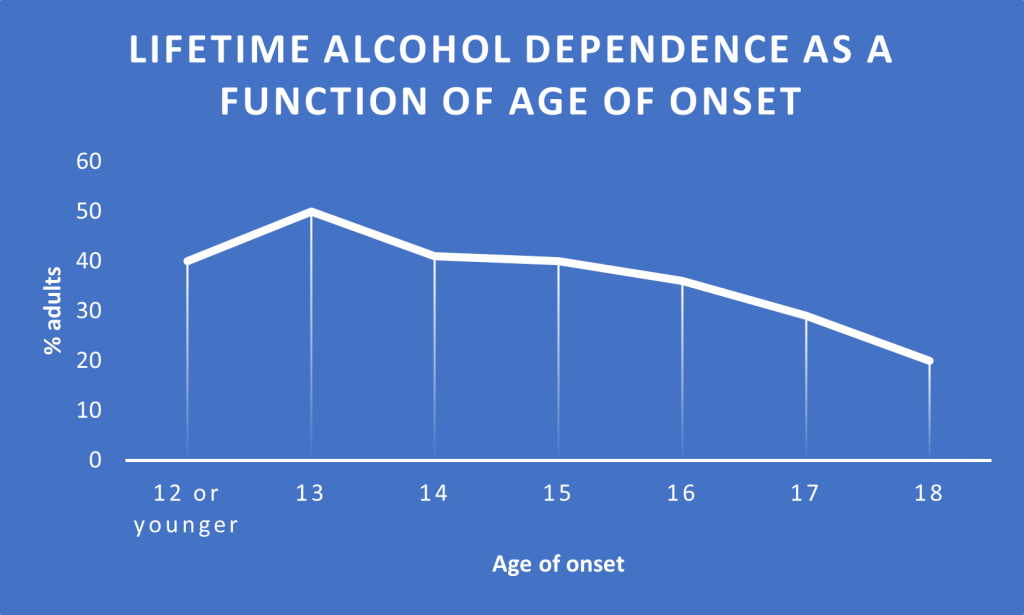
It should not be surprising to learn that an inverse relationship exists between the age of drinking onset and the likelihood of developing longer and more severe episodes of alcohol dependence. The frontal cortex of the brain does not fully develop until adulthood. As a result, the adolescent brain is particularly vulnerable to the effects of alcohol and drugs. The deleterious effects of alcohol use, coupled with the relatively poor decision-making capabilities of adolescence yields an inverse relationship between age of onset of alcohol use and the prevalence of alcohol abuse in adulthood, as shown in the following figure.
Other studies with rodents have also shown that ethanol preexposure will increase ethanol self-administration.
The question arises whether a single dose of ethanol can induce lasting changes in the brain that could account for the increased likelihood of dependence and misuse of alcohol. Knabbe et. al. (2022) did just that, and discovered that a single episode of alcohol intoxication can result in acute and lasting neuronal changes in the brains of mice that will manifest themselves in behavioral changes.
Their study involved 3 levels of investigation:
- Looking for and examining changes in the abundance of proteins within the proteome of the synapses in hippocampus and thalamus sections. The function of the hippocampus is to help humans process and retrieve declarative memories and spatial relationships. Declarative memories are those related to facts and events, such as memorizing speeches or lines in a play, while spatial relationship memories involve pathways or routes. The thalamus has multiple functions: relaying sensory information; relaying motor information; prioritizing attention; and maintaining alertness;
- Examining responses of alcohol-naive mice to a single intoxication;
- Comparing ethanol conditioning odor preference responses of control and mitochondrial trafficking adult Drosophila.
With the investigation of tissue slices, this team of researchers found the following:
- Changes in protein concentrations in both the hippocampus and primary somatosensory/motor cortex of the brain;
- Two enzymes whose concentrations decreased as a result of a single exposure to ethanol included gamma-aminobutyric acid (GABA) reuptake transporter (GAT4) and GABA transaminase, the latter of which catabolizes GABA. The reduction of these two enzymes should increase GABA signaling;
- They were able to quantify changes in the distribution and formation of spines on neurons, thus suggesting changes in memory.
With the investigation of living animals, they were able to detect an increase in mitochondrial mobility during and after acute ethanol intoxication, another indication of changes in associative learning.
Finally, by using strains of Drosophila fruit flies, they were able to demonstrate that an increase in mitochondrial trafficking is required to mediate positive rewarding properties of ethanol in dopaminergic neurons. This last finding is significant because stimulation of dopaminergic neurons has been found to have a behaviorally reinforcing effect on fruit flies, mice, and humans.
Knabbe, J.; Protzmann, J.; Schneider, N.; Berger, M.; Dannehl, D.; Wei, S.; Strahle, C.; Tegtmeier, M.; Jaiswal, A.; Zheng, H.; Kruger, M.; Rohr, K.; Spanagel, R.; Bilbao, A.; Engelhardt, M.; Scholz, H. and Cambridge, S.B. (2022). Single-dose ethanol intoxication causes acute and lasting neuronal changes in the brain. https://doi.org/10.1073/pnas.2122477119 .
 Addictions and Recovery