
Acupuncture as a detoxification modality
The gold standard for determining the efficacy and safety of medical procedures and pharmaceuticals is the randomized double-blind study, where neither the administering physician nor the patient knows whether the patient is receiving the active ingredient or a placebo.
Acupuncture as a detoxification modality has not undergone the kind of extensive randomized double-blind testing that we would expect of a procedure or medication approved by the Food and Drug Administration (FDA). Nonetheless, acupuncture as a detoxification modality is based on modern-day adaptations of 3,000 year-old practices in Chinese medicine (Brumbaugh, 1994). Describing the procedure that are used and trying to explain the reasons why it works requires a lingo that is quite unusual by Western allopathic standards.
To a practitioner of Oriental medicine, the success of acupuncture as a treatment modality is based on the concept of “Chi”. In Oriental medicine, Chi refers to the life force that imbues each living person. It is allotted at birth, and is gone when you die. There are two forms of Chi, including Ancestral Chi, which is genetically-based and given at birth, and Jing, which is the energy of growth. The essential life energy of Chi circulates throughout body on a 24-hour cycle through 12 basic & 2 central channels. Drugs burn up the liver, which is a source of shen, and leads to anger.
It is assumed that stimulation of certain points on the surface of the body could cure or relieve diseases by affecting certain internal organs. The sensations evoked by stimulation on the surface of the skin always traveled to other parts along definite routes, called meridians.
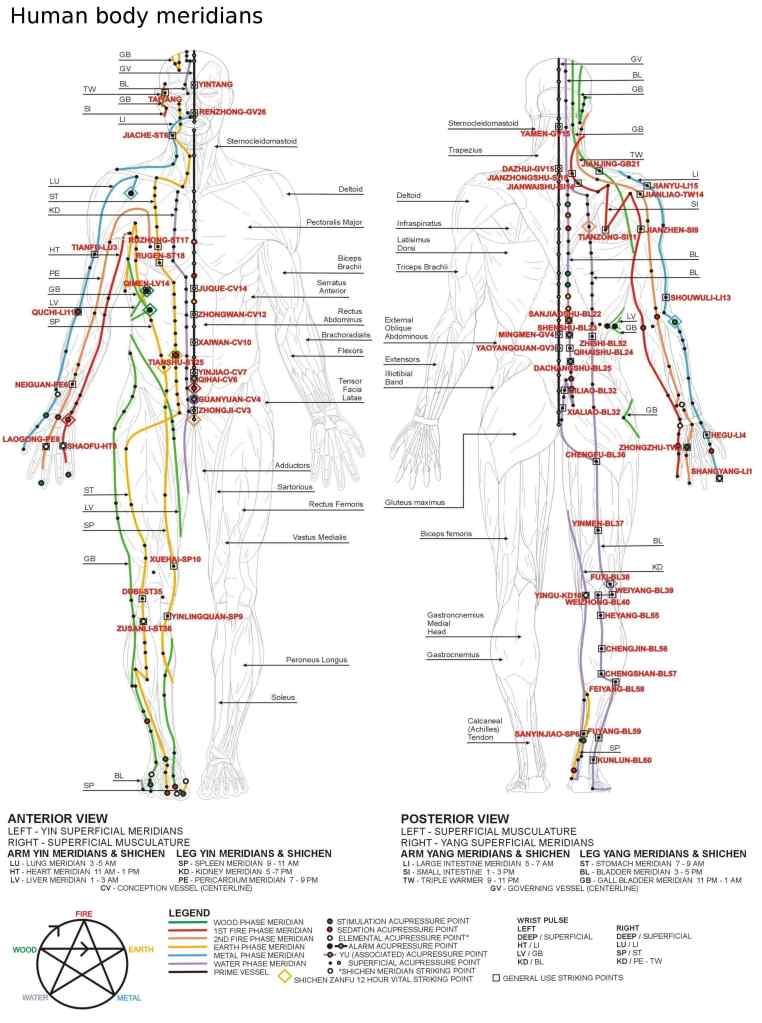
By KVDP – Own work, Public Domain, https://commons.wikimedia.org/w/index.php?curid=8989443
These meridians, distributed symmetrically over the human body, are considered the conduits for flow of “Qi” (chi) and connect internal viscera with external skin and sense organs. There are 12 major meridians, corresponding to the twelve “organs”, eight “extra meridians”, called collaterals, as well as a network of minor meridians.
According to Dr. Michael Smith, “the intense and frequent abuse of chemical substances damages the Jing-essence.” The kidney, which is the organ which stores this quality of Jing becomes damaged, so that Jing becomes depleted, and the individual becomes Yin – deficient, so the patient shows the signs of “empty fire syndrome”, manifested by undirected and unchanneled anger and resentment (Brumbaugh, 1994). The symptoms associated with premature aging, including stooped posture, decaying teeth, graying hair, and a sunken look about the eyes, are all indicative of Jing-depletion. Will you find any mention of “empty fire syndrome” as a manifestation of alcohol abuse in any Western medical textbook? No, I don’t think so. However, does it term serve as an eloquent metaphor of the consequences of alcohol abuse? Absolutely.
In 1955, the French physician Paul Nogier found that all traditional Chinese meridians were accessible via the ear, so that ear reflects entire body. The ear is in the shape of an upside-down human being, and has 150 points, corresponding to each of the points in the body. Applying pressure onto selected points with acupuncture needles elicits an effect which restores the proper balance of energy. The specific points which are stimulated by ear needles include the following:
- Sympathetic (heals physical manifestations of withdrawal)
- Shen men (calms emotional anxiety)
- Kidney (and next two are filtering organs of body.)
- Liver
- Lung
The treatments are quite simple. They simply involve a daily administration of 5 needles in one ear, held in place for 45 minutes per day. Treatment sessions are non-verbal, i.e. the acupuncturist does not ask for a medical history or any details of drug use, and the patient does not have to volunteer that information. These treatments are conducted in a group setting. An herbal tea prepared with a mixture of chamomile, hops, catnip, skullcap, peppermint and yarrow is served, and its purpose is to encourage patients to “feel free to do nothing” and to sleep.
The following is a mock demonstration of an acupuncture technique. (That’s my ear, by the way.)

Long-term positive outcomes require additional components: Group and individual counseling, case management, and education.
According to Carol Taub (1988), acupuncture offers a considerable number of benefits:
- Reduction of craving for the substance;
- Reduction of withdrawal symptoms;
- Marked relaxation, a feeling of well-being;
- Improved sleep patterns;
- A “clearer mind” which promotes receptive, rational thinking and therefore enhances the benefits of counseling and group experiences;
- Stimulation and strengthening of particular organ systems, especially the kidney, liver and lungs;
- Improvement in health problems which often accompany long-term alcohol and drug abuse.
For all this, the initial treatment protocol requires only a daily administration of 5 needles in the ear, held in place for 45 minutes/day. Urine samples are collected to assess abstinence.
Most of the studies demonstrating efficacy and safety in acupuncture detoxification do not meet the criteria of a randomized double-blind study. However, the anecdotal evidence and single-blind studies are encouraging:
- In a study of men and women incarcerated in the Honor Farms, minimum security annexes of the Santa Barbara County Jail, jail personnel reported fewer discipline problems and improved attitude on the part of inmates receiving treatment. Inmates reported consistent relief from post-acute drug/alcohol withdrawal and improvements in sleep and energy levels. There was an inverse relationship between the number of treatments inmates received and the number of re-arrests following release (Brumbaugh and Wheeler, 1991);
- One year later, Brumbaugh (1992) reported a project involving 29 women receiving acupuncture treatments and 29 women who served as controls receiving no acupuncture treatments. Women receiving acupuncture treatments showed a reduced re-arrest rate, even 120 days after release;
- Fourteen chronic pain inpatients and the Department of Anesthesiology Pain Clinic at the University of California, Los Angeles Medical School who had become addcicted to opioids were rapidly detoxified using both auricular electroacupuncture and naloxone. Twelve of these individuals were completely withdrawn from methadone within 2-7 days, and they showed minimal or no withdrawal symptoms during the detoxification process. Furthermore, they remained off narcotic medication for over one year (Kroening and Oleson, 1985).
- In a study of 15 cocaine-addicted pregnant women at Columbia Presbyterian Hospital in New York, the average birth weights of babies born to women receiving treatment were significantly higher (3400 grams) and those born to women not undergoing treatment (2800 grams)
Ask a physician trained in Western allopathic medicine and a physician trained in Oriental medicine, “Why does acupuncture work?”, and you will get two very different mechanisms:
| Question: Why does acupuncture work? | |
| Western Allopathic Answer | Oriental Medicine Answer |
| “Acupuncture may facilitate withdrawal by activating the release of previously suppressed natural endorphins which can then occupy the receptor sites dominated by the narcotic drug” (Kroening and Oleson, 1985). Human subjects show a rise in endorphins (Clement-Jones, et. al., 1979) that is specific for stimulation of the appropriate acupuncture points. Studies with laboratory mice have shown that electrical stimulation at “real” acupuncture points, i.e. points which are known to be involved in the control of drug addictions, exhibit higher pain thresholds than mice given “sham” electroacupuncture, where only non-specific points were stimulated(Pomeranz and Chieu, 1976). The analgesic effects of stimulation of the “real” points is reversed by the administration of naloxone, an opiate antagonist. | The lack of inner calm tone due to the use of chemical substances is described as a condition called “empty fire syndrome” (Smith, 1985), wherein heat of aggressiveness overcompensates and the calm inner tone is lost. The empty fire condition represents the illusion of power, and manifests itself as a hollow-aggressive ego. This leads to a worsening cycle of desperate chemical use and senseless violence. Acupuncture stimulates “yin” points to restore inner calm tone. Smith also observes that the same acupuncture points are effective for different substances of abuse, suggesting that the critical energy disturbance is similar for all substances of abuse. |
It is on the basis of successes such as the ones mentioned above, and the cost effectiveness of treatment, that acupuncture has been incorporated as an integral part of detoxification programs, for which the funding has come largely from the criminal justice community. For example, estimates indicate that 85% of the jail inmate population in the United States, 75% of filed criminal offenses, and 65% of welfare aid to families with dependent children are directly related to alcohol or other drug dependence.
In Memphis, Tennessee alone, an estimated 80% of all crimes are alcohol and/or drug related. As a result, there is considerable interest in the applications of acupuncture, and individuals who are guilty of DUI infractions are offered acupuncture as a detoxification modality (Dr. Judi Herrick, 4/9/99, personal communication.)
 Addictions and Recovery