
N.B. : I apologize for this blog being so late. I thought I had uploaded it a long time ago, as it was supposed to be part of the series on nicotine.
A lesson that I learned from an inorganic chemist is that legislation that is based on “detectable levels” on any compound is inherently faulty because technology has allowed the appropriate equipment to be very sensitive. Whether a compound that can now be detected in the parts per billion is, in fact, harmful, may be difficult to determine.
As of 2022, over 9500 chemical compounds have been found in tobacco and tobacco smoke. Of them, 83 carcinogens have been identified, 37 in unburned tobacco and 80 in tobacco smoke (Li and Hecht, 2022). The chemicals found in cigarette are derived from several sources:
Pesticides and herbicides
According to Davila, et. al., 2020, pesticides are generally used to control “a range of unwanted animal, plant, and microbial, fungal pests.” Due to the processing of tobacco leaves to turn them into cigarettes, the residue levels in tobacco leaves are expected to decline. In their samples of tobacco leaves, they found ten different active ingredients (AI), of which thiodicarb, alachlor, and endosulfan are no longer allowed in Europe.
Chemicals found in the native tobacco leaves
Some tobacco plants are grown in soil that contains cadmium and lead (https://www.fda.gov/tobacco-products/products-ingredients-components/chemicals-every-tobacco-plant#ref) . These elements are absorbed into the plant and constitute significant health hazards:
- Cadmium: According to the US Centers for Disease Control (CD) ( https://www.cdc.gov/biomonitoring/Cadmium_FactSheet.html#:~:text=Breathing%20high%20levels%20of%20cadmium,considered%20a%20cancer%2Dcausing%20agent), “When eaten, large amounts of cadmium can severely irritate the stomach and cause vomiting and diarrhea. Breathing high levels of cadmium damages people’s lungs and can cause death. Exposure to low levels of cadmium in air, food, water, and particularly in tobacco smoke over time may build up cadmium in the kidneys and cause kidney disease and fragile bones. Cadmium is considered a cancer-causing agent.”
- Lead: Again, according to the US Centers for Disease Control ( https://www.cdc.gov/nceh/lead/prevention/health-effects.htm ), exposure to lead can seriously harm a child’s health and cause well-documented adverse effects such as: 1)Damage to the brain and nervous system; 2)Slowed growth and development; 3);Learning and behavior problems; and 4)Hearing and speech problems. These results can cause the following: 1)Lower IQ; 2)Decreased ability to pay attention; and 3)Underperformance in school.
Compounds generated by the combustion of chemicals in the tobacco leaves.
The major compounds that are generated can be seen in this picture:
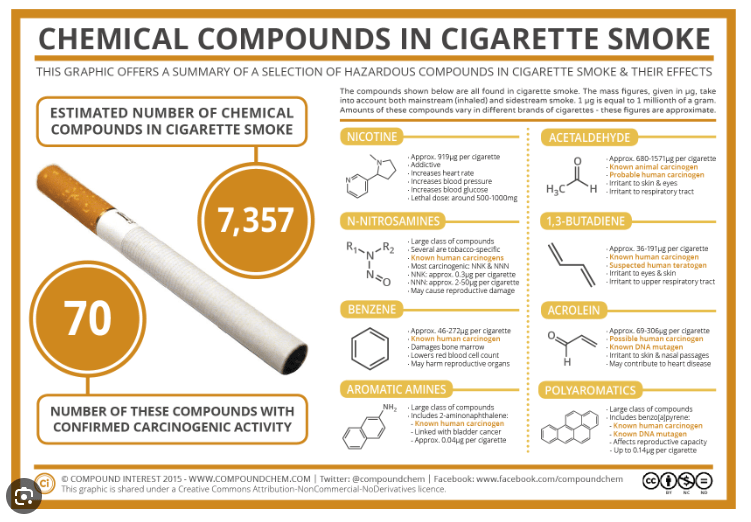
N.B.: Nicotine is already in the native tobacco leaves. In addition to the organic compounds generated by the combustion of tobacco leaves, both carbon dioxide and carbon monoxide are generated. Carbon monoxide can cause dizziness, headaches, and nausea at the concentrations found in tobacco smoke. At higher doses, exposure to carbon monoxide can be fatal.
The long-term effects of exposure to tobacco smoking can be seen in a comparison of the gross anatomy of healthy lungs with lungs belonging to a person who smoked for a long time:
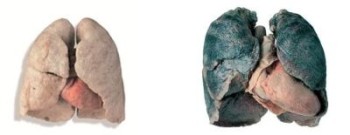
It was an image very much like this that I was showing to a class during a lecture about the hazards of smoking when I started to hear someone weeping behind me. I turned, and there was a girl who was crying, and she said that her father had recently died of lung cancer caused by smoking. I felt awful for causing her to cry, so I apologized, but she replied, “Smoking is a cruel mistress, and we tried so hard to get him to stop, and he didn’t.”
Centers for Disease Control and Prevention (US); National Center for Chronic Disease Prevention and Health Promotion (US); Office on Smoking and Health (US). How Tobacco Smoke Causes Disease: The Biology and Behavioral Basis for Smoking-Attributable Disease: A Report of the Surgeon General. Atlanta (GA): Centers for Disease Control and Prevention (US); 2010. 3, Chemistry and Toxicology of Cigarette Smoke and Biomarkers of Exposure and Harm. Available from: https://www.ncbi.nlm.nih.gov/books/NBK53014/
Li, Y., Hecht, S.S. (2022). Carcinogenic Components of Tobacco and Tobacco Smoke: A 2022 Update. Food Chem Toxicol. July: 165:113179. doi:10.1016/j.fct.2022.113179.
 Addictions and Recovery