
The definition of “Harm Reduction” which appears in wikipedia.com starts with the following:
Harm reduction, or harm minimization, refers to a range of intentional practices and public health policies designed to lessen the negative social and/or physical consequences associated with various human behaviors, both legal and illegal.[1] Harm reduction is used to decrease negative consequences of recreational drug use and sexual activity without requiring abstinence, recognizing that those unable or unwilling to stop can still make positive change to protect themselves and others.[2][3]

Harm reduction is most commonly applied to approaches that reduce adverse consequences from drug use, and harm reduction programs now operate across a range of services and in different regions of the world. As of 2020, some 86 countries had one or more programs using a harm reduction approach to substance use, primarily aimed at reducing blood-borne infections resulting from use of contaminated injecting equipment.[4]
In the case of nicotine, the multitude of compounds found in cigarette smoke which have been shown to cause a multitude of life-threatening conditions necessitate some form of harm reduction for those individuals who are unable to quit the nicotine habit.
Nicotine’s mode of action on the reward circuitry of the brain makes it very hard for someone to break a nicotine habit, so for many people, smoking cessation is either an unrealistic or an unattainable goal.
Plan B, therefore, is to utilize a harm-reduction strategy, i.e. use a device that provides the user with the nicotine to satisfy the addiction, but avoids exposing the user to the carcinogenic and other harmful compounds that come with nicotine in cigarette smoke, and such as device is an electronic, or -cigarette.

Parts of a second generation electronic cigarette, copied from a FEMA pdf. As the source is a government publication, it is in the public domain.
Both the ingredients in the e-cigarette cartridge and in the aerosol which gets delivered to the smoker are simpler than the chemicals found in the native tobacco or in the smoke:
| E-cigarette (data from Margham, et. al., 2021) | Tobacco | |
| # of compounds in the original source | 4* | 600 |
| # of compounds in the delivered aerosol or smoke | 94-139 | >9,000 |
Both the initial components of the e-cigarette solution and the chemicals that are produced in the vapor from heating can elicit harmful effects:
Solvents:
- “Propylene glycol has been associated with upper respiratory infection-like symptoms. It is formed by the hydration of propylene oxide, which is a probable human carcinogen. Vegetable glycerin exposure is associated with irritation of the eyes, lungs and esophagus. Vaporization of the glycerol constituent forms the compound acrolein, which is a potent skin, eye, and nasal irritant as well as a potential carcinogen.” (Eltorai, et. al., 2019)
- The solvent in the cartridge is a mixture of propylene glycol to vegetable glycerin. ”A recent study showed that a mixture of propylene glycol and vegetable glycerin produced more reactive oxygen species than either solvent alone.” (Eltorai, et. al., 2019). Reactive oxygen species can damage proteins and DNA molecules.
Flavorants:
- Diacetyl-like diacetin, a compound approved for flavoring but not inhalation, has been shown to reduce lung capacity;
- Other flavoring chemicals, such as acetoin (butter), diacetyl, maltol, and ortho-vanillin elicit a significant pro-inflammatory response in human lung epithelial cells and primary lung fibroblasts.
Eltorai, et. al., 2019 also describe profound effects of e-cigarette vapor on the cardiovascular, pulmonary, and immune systems:
Cardiovascular:
- In a study with zebrafish embryos, treatment with nicotine alone had minimal impact on cardiac cell differentiation, but treatment with either e-cigarette aerosol or cigarette smoke resulted in a greater incidence and severity of cardiac defects;
- Human embryonic stem cells posed to e-cigarette extract shoed significantly lower expression of several late-stage contractile proteins and transcription factors;
- Both conventional combustible and e-cigarettes caused an increase in oxidative stress among 40 subjects (20 smokers, 20 non-smokers).
Pulmonary
- Mice exposed to nicotine-containing e-cigarette vapor exhibited significantly diminished lung growth and alveolar cell proliferation;
- Human lung epithelial cells exposed to e-cigarette vapor can lead to cytotoxicity, pro-inflammatory cytokine release, and oxidative stress;
- Five minutes of vaping with a nicotine-containing source was sufficient to induce a statistically significant increase in respiratory flow resistance.
Immune
- Human lung alveolar type II epithelial cells treated with e-cigarette vapor had greater cell death compared to air-exposed cells;
- Furthermore, alveolar macrophages from mice and neutrophils from humans, “both key mediators of innate immunity and bacterial clearance, showed attenuated antimicrobial activity after 2 hours of exposure to cigarette vapor.” (Eltorai, et. al., 2019)
E-cigarettes and youth
Although there is ample evidence that nicotine is harmful to the developing adolescent brain, it is among adolescents that the use of e-cigarettes has increased. In fact, there has been an 8-fold increase in adolescent e-cigarette use since 2011, and users attribute the availability of flavors as the most important reason for using nicotine.
E-cigarette manufacturers use a variety of tactics to lure kids to use their products:
- Slick magazine ads
- Sponsorship of concerts and auto races
- Celebrity endorsements
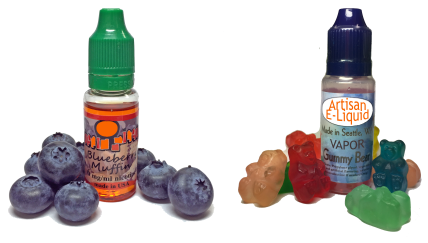
- Sweet, colorful flavors sold in brightly colored bottles, as shown below:
In fact, some communities (e.g. King County, Washington State) report that youth e-cigarette use is now higher than the use of conventional cigarettes.
Kid friendly flavors
Summary
Both the number of harmful chemicals and their quantities in e-cigarette vapor are less than those in conventional combustible cigarettes. Nonetheless, they both carry similar health risks to cardiovascular and pulmonary systems.
They both contain nicotine, the addictive component, and each generation of e-cigarette shows ever-increasing efficiency to deliver nicotine. Adult e-cigarette users do not use them to wean themselves away from nicotine, and adolescents are showing an increase in their use.
Perhaps it is for that reason that Eltorai et. al. state in their summary “Overall, the current data do not support the efficacy of e-cigarettes for smoking cessation.”
Eltorai, A.E.M.; Choi, A.R.; Eltorai, A.S. (2019). Impact of Electronic Cigarettes on Various Organ Systems. Respiratory Care 64(3):328-336.
Margham, J.; McAdam, K.; Cunningham, A.; Porter, A.; Fiebelkorn, S.; Mariner, D.; Digard, H.; Proctor, C. (2021). The Chemical Complexity of e-Cigarette Aerosols Compared with the Smoke From a Tobacco Burning Cigarette. Frontiers in Chemistry Setepmber 2021 (9):1. doi: 10.3389/tchem.2021.743060 .
Patten, S.B. (2020). Vaping and Mental Health. Journal of the Canadian Academy of Child and Adolescent Psychiatry/De L’Academe Canadienne de Psychiatrie de L’enfant et de L’adolescent. 30(1):3-5.
 Addictions and Recovery