
The good news is that the proportion of adults who smoke has declined over the past 40 years. The following graph shows the trend among UK and USA adults:

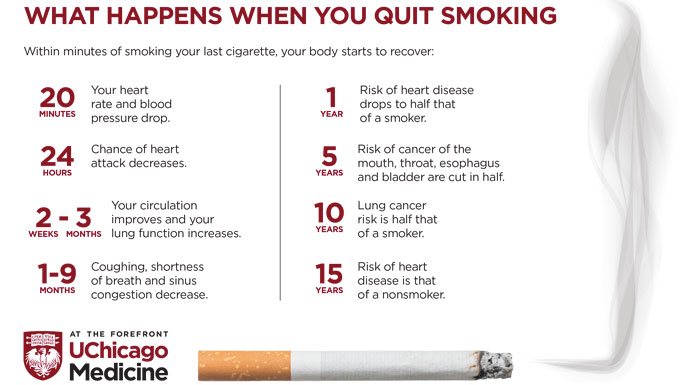
And no one is disputing the benefits from smoking cessation:
Nonetheless, the nicotine habit is tenacious, and is very hard to break. The following statistics are from the US Center for Disease Control and Prevention:
Most adult cigarette smokers want to quit.1
- In 2015, 68.0% of adult smokers (22.7 million) said that they wanted to quit smoking.2
More than half of adult cigarette smokers report having made a quit attempt in the past year.1
- In 2018, 55.1% of adult smokers (21.5 million) said that they had made a quit attempt in the past year.3
Fewer than one in ten adult cigarette smokers succeed in quitting each year.1
- In 2018, 7.5% of adult smokers (2.9 million) successfully quit smoking in the past year.3
Four out of every nine adult cigarette smokers who saw a health professional during the past year did not receive advice to quit.1
- In 2015, 57.2% of adult smokers (18.8 million) who had seen a health professional in the past year reported receiving advice to quit.2
- Even brief advice to quit (<3 minutes) from a physician improves cessation rates and is highly cost-effective.1
Less than one-third of adult cigarette smokers use cessation counseling or medications approved for cessation by the Food and Drug Administration when trying to quit smoking.1
- In 2015, 31.2% of adult smokers (7.6 million) reported using counseling or medication when trying to quit.2
- In 2015, 6.8% of adult smokers (1.7 million) reported using counseling, 29.0% (7.1 million) reported using medication, and 4.7% (1.1 million) reported using both counseling and medication when trying to quit.2
More than three out of five adults who have ever smoked cigarettes have quit.1
- In 2018, 61.7% of adult smokers (55.0 million adults) who ever smoked had quit.3
As with withdrawal from any drug, there will be unpleasant symptoms associated with withdrawal from nicotine — https://www.cdc.gov/tobacco/campaign/tips/quit-smoking/7-common-withdrawal-symptoms/index.html:
- Having urges or cravings to smoke
- Feeling irritated, grouchy, or upset
- Feeling jumpy and restless
- Having a hard time concentrating
- Having trouble sleeping
- Feeling hungrier or gaining weight
- Feeling anxious, sad, or depressed
There are, of course, ways to manage these symptoms, because they will subside.
The Center for Disease Control and Prevention also provides suggestions as to how to quit smoking at How to Quit Smoking Infographic (cdc.gov) . The two main strategies are counseling and medications.
COUNSELING:
- Talk to a quit smoking counselor individually or in a group;
- Get free confidential coaching through a telephone quitline (1-800-QUIT-NOW)
- Use free online resources like CDC.gov/quit and Smokefree.gov

Home page for CDC.gov/quit

Home page for Smokefree.gov
- Sign up for free texting programs like SmokefreeTXT
- Use a mobile app like quitSTART

Home page for quitSTART app.
MEDICATIONS:
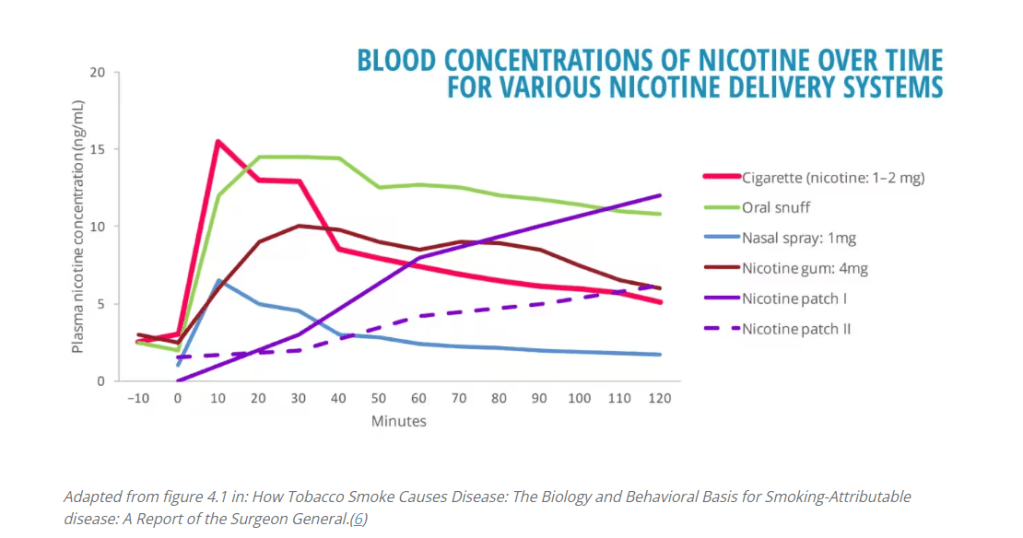
Use Nicotine Replacement Therapy (NRT) in the form of over-the-counter forms like a patch, gum, or lozenge, or of prescription forms, like an inhaler or a nasal spray. My personal opinion is that using nicotine replacement therapy alone will have limited success because nicotine delivered by any means other than a cigarette just can’t match the same rapid increase in blood concentration followed by a rapid drop that is typical of exposure by cigarette. That characteristic “hit” provided by cigarettes is an integral part of why cigarettes are so addicting:
Rock star Ozzy Osbourne admitted that his nicotine habit was the most difficult addiction to quit. This is what Ozzy Osbourne said about his addiction to nicotine and his use of nicotine patches:
“They’re all a b**ger to kick, but I’d have to say cigarettes,” Contactmusic quoted him as saying.
“I used to cover my whole body with (nicotine) patches. I looked like a f**king mummy.
And I’d still smoke! Then my heart would start beating like crazy and I’d break out in sweats.
But one day I just said, ‘Enough of this s**t.’ And I quit, just like that,” he added.

Prescription medications
- Varenicline: This drug binds to the same acetylcholine receptors that nicotine does, thereby inducing the release of dopamine in the nucleus accumbens, which is an essential part of the reward circuit of the brain. It also inhibits the binding of nicotine to these same receptors, and in doing so, it diminishes the reward from smoking a cigarette. Varenicline also appears to be more efficacious than nicotine replacement therapy alone. Ebbert et. al. (2010) report that “prolonged smoking abstinence for the last four weeks of treatment was higher for varenicline-treated participants than patients receiving the nicotine patch (56% versus 43.2%). Side effects, compared to placebo, include nausea (28.1% vs. 8.4%), headache (15.5% vs. 12.2%), insomnia (14.0% vs. 12.8%), and abnormal dreams (10.3% vs. 5.5%). These side effects, particularly nausea, can be reduced by splitting the single daily dose into two doses per day.
- Bupropion: First developed as an antidepressant for the treatment of major depressive disorder in 1989, its smoking cessation properties were first noticed in the US (Tong, et. al., 2006). Its mode of action is both to inhibit the reuptake of dopamine and to attenuate the stimulant effects of nicotine on the nicotinic acetylcholine receptors. According to a study by Gonzales et. al. (2001), six month continuous abstinence rates following treatment with buproprion SR 150 mg bd versus placebo were 12% vs. 2%. Major side effects of bupropion are similar to those of varenicline:
- Cytisinicline: Currently, cytisinicline is not licensed in the US, but it is available as an over–the-counter smoking cessation product Central and Eastern Europe. Its mode of addiction is “to selectively bind to a particularly nicotinic acetylcholine receptors subtype that mediates nicotine dependence, acting as a partial agonist tore duce nicotine withdrawal symptoms while also blocking the reinforcement generated by nicotine when smoking cigarettes (Rigotti, et. al., 2023). In a 3-group, double-blind, placebo-controlled randomized trial, Rigotti (2023) showed that cytisinicline was an effective drug to provide continuous abstinence rates over a 12-week-course. They report nausea, abnormal dreams, and insomnia occurring in less than 10% in each of the 3 groups.
| Placebo % | Bupropion % | |
| Insomnia | 9-21 | 24-42 |
| Headache | 3-33 | 4-33 |
| Dry mouth | 4-24 | 6-28 |
| Nausea/vomiting | 5-6 | 9-13 |
| Dizziness | 1-6 | 2-11 |
| Constipation | 1 | 5-6 |
Ebbert, J.O.; Wyatt, K.D.; Hays, J.T.; Klee, E.W.; Hurt, R.D. (2010). Varenicline for smoking cessation: efficacy, safety, and treatment recommendations. Patient Preference and Adherence 2010(4):355-362.
Rigotti, H.A.; Benowitz, N.L.; Prochaska, J.; Leischow, S.; Nides, M.; Blumenstein, B.; Clarke, A.; Cain, D.; Jacobs, C. (2023). Cytisinicline for Smoking Cessation: A Randomized Clinical Trial. Journal of the American Medical Association 2023:330(2):152-160. doi:10.1001/jama.2023.10042
Tong, E.K.; Carmody, T.P.; Simon, J.A. (2006). Buproprion for smoking cessation. A Review. Comprehensive therapy 32(26-33).
Wilkes, S. (2008). The use of bupriopion SR in cigarette smoking cessation. International Journal of COPD 2008:3(1) 45-53.
 Addictions and Recovery