
Between 2000 and 2003, I arranged with the Counseling Department at Christian Brothers University (Memphis, TN), where I taught biology, to distribute a questionnaire to incoming students enrolled in Orientation 100, a half-semester course for incoming freshmen to “learn the ropes” of becoming a college student. With this questionnaire, I was able to take a snapshot of alcohol and drug use among these students who had just graduated from high school. Here are the results, adapted from Table 5 of Mostert and Eisen (2008).
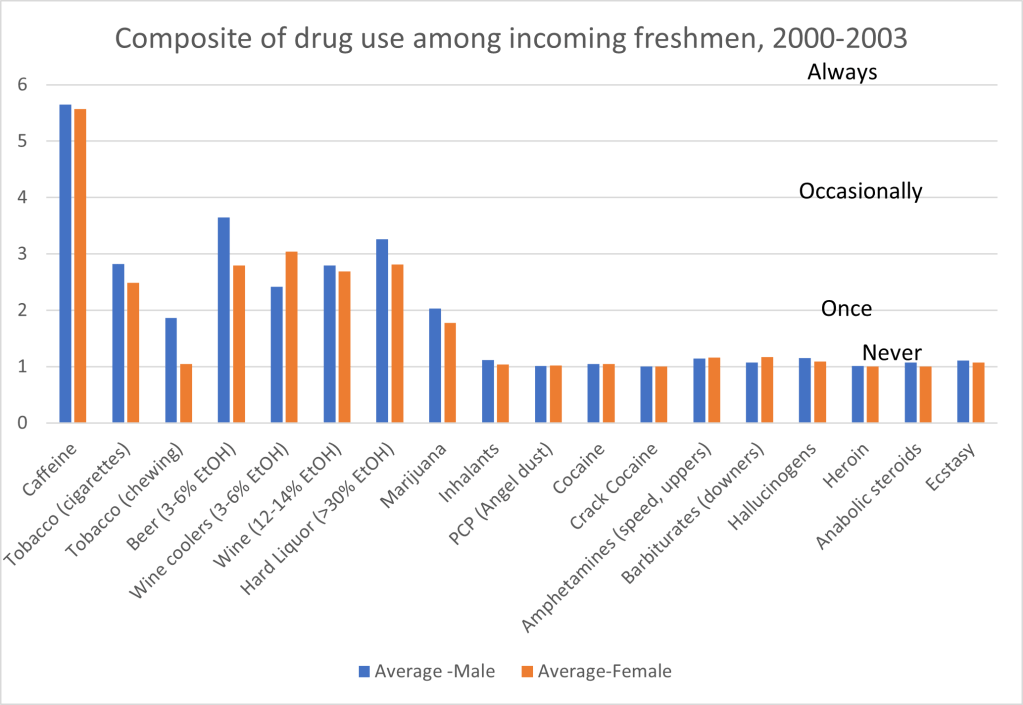
I showed this graph to a friend of mine who was a drug counsellor, and suggested that perhaps it is caffeine that is the primary gateway drug and he disagreed.
He said, “No, you’re wrong. Caffeine is not the primary gateway drug”, to which I asked, “OK, then what is the primary gateway drug?”
“It’s mother’s milk”, he replied.

To which I smiled, and said, “Ah, I see what you did there! Clever!”

The gateway drug hypothesis refers to a predictable sequence of substance use during adolescence whereby legal substances, such as nicotine and alcohol, precede the progressive use of illicit substances like marijuana*, cocaine, and heroin.
*Please note that it is only recently (April 2024) that the US Department of Justice has decided to reschedule marijuana from a Schedule I drug, which are drugs with “[h]igh abuse potential with no accepted medical use; medications within this schedule may not be prescribed, dispensed, or administered” to a Schedule III drug, which have “Intermediate abuse potential (ie, less than Schedule II but more than Schedule IV medications)” {https://apnews.com/article/marijuana-biden-dea-criminal-justice-pot-f833a8dae6ceb31a8658a5d65832a3b8}.
The Gateway Hypothesis, as articulated by Kandel (1975), posits that there is a specific sequence of drug use followed by users of hard drugs and that said sequence is as follows: alcohol → tobacco → marijuana → hard drugs. The assumption is that exposure to the less dangerous drug or substance somehow primes the brain in such a way that the use of more dangerous drugs becomes more likely.
For example, Yamaguchi and Kandel (1984) report a follow-up study of high school students in grades 10 and 11 in New York State who were subsequently reinterviewed nine years later at ages 24-25. They found a significant difference in the progressions among men and women:
Among men, 87% of men are characterized by the following progression:
- Alcohol precedes marijuana;
- Alcohol and marijuana precede other illicit drugs;
- Alcohol, cigarettes and marijuana precede the use of prescribed psychoactive drugs.
A total of 86% of women share a different pattern
- Either alcohol or cigarettes precedes marijuana;
- Alcohol, cigarettes, and marijuana precede other illicit drugs;
- Alcohol and either cigarettes or marijuana precede prescribed psychoactive drugs.
Results of other reports are consistent with the gateway hypothesis:
- Willner (2001) presents the results of a study of 4544 11-16 year olds attending secondary schools in the north-west midlands of England. He found that alcohol use leads to changes in cannabis expectancies and thereby to cannabis use;
- Kirby and Barry (2012) conducted a secondary analysis of the 2008 Monitoring the Future 12th-grade data to compare initiation times into alcohol, tobacco, and other drug use, analyzed using a Guttman scale. They found that alcohol represented the ‘gateway’ drug, leading to the use of tobacco, marijuana, and other illicit substances. Moreover, students who used alcohol exhibited a significantly greater likelihood of using both licit and illicit drugs;
- In a study of 562 out-of-treatment heroin users, Woodcock et. al. (2015) state that the majority of participants (79.7%) reported substance use progression consistent with the gateway hypothesis. However, gateway-inconsistent individuals were more likely to be African-American and to report younger age at initial use, longer duration of heroin use, and more frequent past-month heroin use;
- Garcia-Perez et. al. (2023) mention 3 objectives in their study of cannabis use by Spanish adolescent: 1) To describe the sequences of cannabis use with legal and illegal substances; 2) to estimate the likelihood of using any legal and illicit drug after cannabis use among a representative national sample of Spanish adolescents; and 3) to analyze the predictive effect of the age of cannabis use onset on subsequent substance use. They found that the use of cannabis increases the probability of progressing to legal and illegal drugs. Furthermore, they found that most people followed the classic gateway sequence, with only a few adolescents using cannabis before legal substances (6%) and illegal substances before cannabis (10%).
There are, however, other studies which suggest that the gateway hypothesis, or at least testing the validity of the gateway hypothesis, are problematic. For example, Lee (2015) points out that evidence of an association may not indicate a causal relationship. Suppose that A is the less dangerous drug, while B is the more dangerous one. He states at an association may arise if any of the following occur: 1) A causes B, i.e. the gateway hypothesis is true; 2) B causes A, i.e. reverse causation; 3) A third factor (or set of factors) C causes both A and B, i.e. confounding.
An alternative model to the progressive use of drugs is known as the shared factors or common liability model, which seeks to explain the relationship between different types of co-occurring or comorbid mental health disorders. According to a publication by the American Addiction Centers (https://americanaddictioncenters.org/the-addiction-cycle/gateway drugs), “[t]his model views the relationship as a nonspecific liability that results in individuals who have one type of mental health disorder being at greater risk for additional mental health disorders.”
One study which supports the common liability model is described by van Leeuwen et. al. (2011). In this study, investigators used data from 2,113 (51% female) Dutch adolescents who participated in three consecutive assessment waves (mean age: 11.09, 13.56, and 16.27 years, respectively) of the TRacking Adolescents’ Individual Lives Survey study. (Pre)adolescent cannabis, tobacco and alcohol use was assessed using the Youth Self-Report and a TRacking Adolescents’ Individual Lives Survey developed questionnaire. They found that adolescents who reported early onset comorbid use of both tobacco and alcohol have a higher likelihood to initiate cannabis use than adolescents who have tried either tobacco or alcohol. The gateway hypothesis is not broad enough to explain this finding. They conclude that the Common Liabilities Model best predicts their findings.
Garcia-Perez, A.; Aonso-Diego, G.; Weidberg, S.; Secades-Villa, R. (2023). Testing the cannabis gateway hypothesis in national sample of Spanish adolescents. Addictive Behaviors, https://doi.org/10.1016/j.addbeh.2023.107751.
Kirby, T.; Barry, A.E. (2012). Alcohol as a gateway drug: a study of US 12th graders. Journal of School Health Aug:82(3):371-9. doi: 10.1111/j.1746-1561.2012.00712x.
Miller, M.L.; Hurd, Y.L. (2017). Testing the Gateway Hypothesis. Neuropsychopharmacology 42, 985-986. doi: 10:1038/npp.2016.279.
Mostert, C.H.; Eisen, S. (2008). Gender Differences in Licit and Illicit Substance Use Reported by Incoming Freshman College Students. Tennessee Medicine, November 2008, 34-37.
van Leeuwen, A.P.; Verhulst, F.C.; Reijneveld, S.A.; Vollebergh, W.A.M.; Ormel, J.; Huizink, A. (2011) Can the Gateway Hypothesis, the Common Liability Model and/or, the Route of Administration Model Predict Initiation of Cannabis Use During Adolescence? A Survival Analysis—The TRAILS Study. J Adolesc Health. 2011 Jan;48(1):73-8. doi:10.1016/j.jadohealth.2010.05.008.
Willner, P. (2001). A new through the gateway: expectancies as a possible pathway from alcohol to cannabis. Addiction May 96(5):591-703. doi: 10.1046/j.1360-0443.2001.0656915x
Woodcock, E.A.; Lundahl, L.H.; Stoltman, J.J.K.; Greenwald, M.K. (2015). Progression to regular heroin use: Examination of patterns, predictors, and consequences. Addict Behav. June(45):287-293. doi:10.1016/j.addbeh.2015.02.014 .
Yamaguchi, K.; Kandel, D.B. (1984). Patterns of Drug Use from Adolescence to Young Adulthood: II. Sequences of Progression. American Journal of Public Health 74(7):668-672.
 Addictions and Recovery