

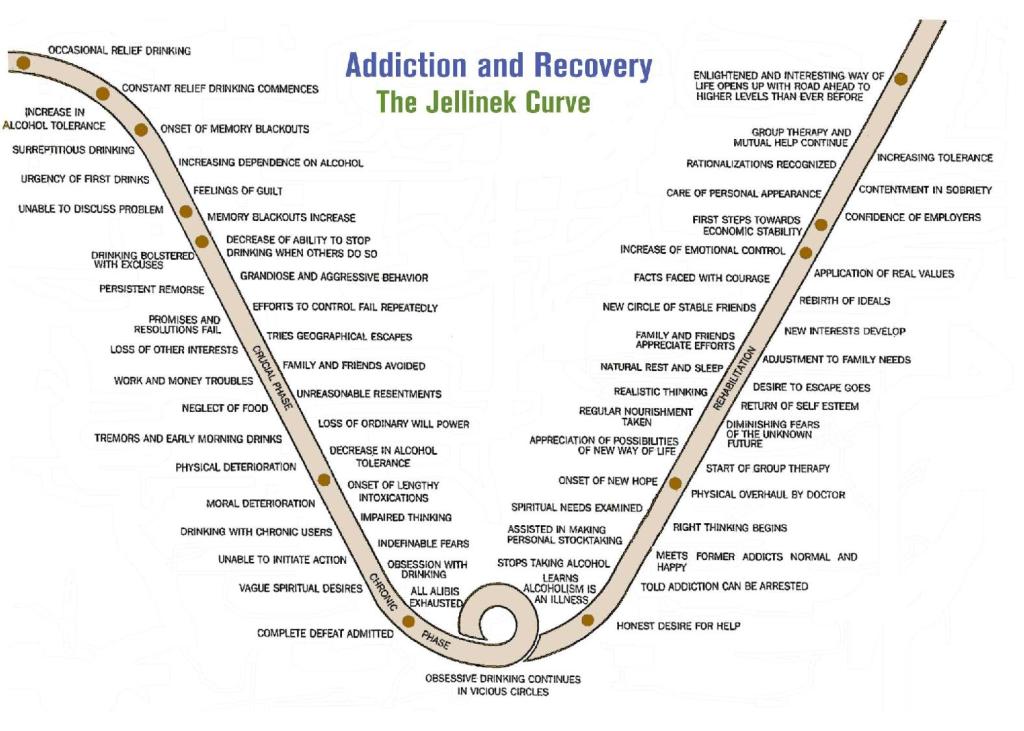
In 1960, E. Morton Jellinek wrote The Disease Concept of Alcoholism, in which he articulated the idea that alcoholism, or alcohol misuse, is a disease. The Jellinek Curve, named in his honor, was constructed to give a visual representation of the five types of alcoholism described in his book. Although Jellinek eventually distanced himself from the curve, it provides a useful model for the progressive nature of alcoholism, followed by a gradual recovery. For my purposes here, I will only show the downwards spiral half:

Similarly, Koob and Le Moal (2005) addressed addiction solely in the context of drugs, and defined it as a “chronically relapsing disorder that is characterized by (1) compulsion to seek and take the drug, (2) loss of control in limiting intake, and (3) emergence of a negative emotional state (e.g. dysphoria, anxiety, irritability) when access to the drug is prevented.”
One may argue that these same hallmarks can be used to describe internet addiction issues.
Digital technology provides numerous benefits. It provides a venue for easy access to information and increased communication and entertainment options. Furthermore, it supports social interaction.
However, the excessive, uncontrolled use promotes addiction. According to the American Psychological Association, “internet addiction” is defined as “a behavioral pattern characterized by excessive or obsessive online and offline computer use that leads to distress and impairment. The condition, though controversial and not recognized yet as a disorder in the Diagnostic and Statistical Manual of Mental Disorders, or DSM-V, has attracted increasing attention in the popular media and among health care professionals. Expanding research has identified various subtypes, including those involving excessive gaming, sexual preoccupations, and e-mail and text messaging. (https://dictionary.apa.org/internet-addiction)”.
Part of the difficulty in assessing the disorder is defining what is meant by “excessive or obsessive online and offline computer use.” Computers have become ubiquitous in business and household settings. By 2008, 60% of American households had at least one personal computer (PC), and nearly 55% of households were connected to the Internet (Shaw and Black, 2008). Furthermore, there are numerous people in business and academic settings who depend on the use of the computer and spend many hours in front of a screen. Therefore, the criterion for internet addiction is the non-essential, i.e. non-business or non-academic use.
According to Hartney (2023), there are at least 3 subtypes of Internet addiction which have been identified: video game addiction, cybersex or online sex addiction, and online gambling addiction.
Internet addiction specialist, Dr. Kimberly Young has identified 8 major symptoms of Internet addiction. She suggests that if five or more of these signs of Internet addiction apply to you that you consider seeing a mental health specialist about your internet use: https://www.healthyplace.com/addictions/internet-addiction/symptoms-internet-addiction:
- Preoccupation — You think constantly about previous online activity or keep looking forward to the next online session. Some people crave time on the Internet the way a smoker craves a cigarette.
- Increased use — You need to spend increasing amounts of time online to achieve satisfaction. A parent who’s spending 50 hours a week in a chat room might neglect basic responsibilities such as doing laundry or making dinner for the kids.
- Inability to stop — You can’t cut back on your Internet use, even after several attempts. Some people can’t stop visiting chat rooms while at the office, even though they know their bosses are monitoring the sites they visit.
- Withdrawal symptoms — You feel restless, moody, depressed, or irritable when you attempt to stop or cut down Internet use. Some people feel so grumpy in jobs where they can’t go online that they make excuses to go home and use the computer.
- Lost sense of time — Everyone lets time slip by occasionally while on the Internet. Consider it a problem if it happens to you consistently when you’re online and you’re also experiencing some of the other symptoms on this list.
- Risky behaviors — You jeopardize a significant relationship, job, or educational or career opportunity because of Internet use. One man decided to leave his wife of 22 years for someone he had corresponded with on the Internet for a couple of months.
- Lies — You lie to family members, a therapist, or others to conceal the extent of your involvement with the Internet. Someone who’s seeing a therapist for depression might not tell the therapist about her Internet use.
- Escape to the Internet — You use the Internet as a way to avoid thinking about problems or to allay depression or feelings of helplessness. One CEO constantly downloaded pornography for stress relief at work.
In 2008, Shaw and Black summarize the results of nine community and four online surveys to estimate the prevalence of internet addiction. The prevalence (%) ranged from 0.3-0.7% in a survey taken in the United States to 38% in a survey taken in China. Furthermore:
- In 6 surveys, the prevalence among males was greater than that of females. In 2 surveys, the prevalence among females was greater than that of males. In 3 surveys, the prevalence among males and females was equal, and in 2 surveys, the difference between males and females was not addressed.
- There is frequent psychiatric co-morbidity issues with internet addicts, with the most common being mood disorders (24%), anxiety disorders (19%), substance use disorders (14%) and psychotic disorders.
- Other disorders included pathological gambling, pyromania, compulsive sexual behavior, kleptomania and compulsive exercise;
- The increased use of the Internet was associated with higher ratings on measures of depression, loneliness and social isolation;
- The disorder has a range of onset in the late 20s or early 30s.
In 2023, Melca et. al. conducted a systematic review of articles regarding the association of internet addiction and mental disorders in medical students. They found that Internet Addiction Disorder (IAD) has a prevalence among of 30.1% among medical students, 5 times higher than that in the general population. Furthermore, they found the following correlations:
- A small positive correlation between IAD and sleep disorders (p=0.0515);
- Moderate correlations with anxiety (p=0.22), depression (p=.0002), and stress (p=.0322).
P.S.: Jellinek’s full curve:
Hartney, E. (2023). How to Know If You Have an Internet Addiction and What to Do About It. https://www.verywellmind.com/internet-addiction-4157289.
Jellinek, E.J. (1960). The Disease Concept of Alcoholism. 2020 publication date of Barakaldo Books edition.
Koob, G.F.; Le Moal, M. (2005). The Neurobiology of Addiction. Academic Press.
Shaw, M.C.; Black, D. (2008). Internet Addiction: Definition, Assessment, Epidemiology and Clinical Management. CNS Drugs 22(5): 353-365, DOI: 10.2165/00023210-200822050-00001.
Melca, I.A.; Teixeira, E.K.; Nardi, A.E.; Spear King, A.L. (2023). Association of Internet Addiction and Mental Disorders in Medical Students: A Systematic Review. Prim Care Companion CNS Disord 2023; 25(3):22r03384.
 Addictions and Recovery