
In 2018, the World Health Organization (WHO) included Internal Gaming Disorder (IGD), in the 11th revision of the International Classification of Diseases (ICD), while in 2013, Internet gaming disorder (IGD) was included in the DSM-5 in 2013 as a condition requiring further research (Darvesh, et. al., 2020).

A brief description of Internet Gambling Disorder as defined by the World Health Organization is mentioned in https://www.who.int/standards/classifications/frequently-asked-questions/gaming-disorder:
- What is gaming disorder? Gaming disorder is defined in the 11th Revision of the International Classification of Diseases (ICD-11) as a pattern of gaming behavior (“digital-gaming” or “video-gaming”) characterized by impaired control over gaming, increasing priority given to gaming over other activities to the extent that gaming takes precedence over other interests and daily activities, and continuation or escalation of gaming despite the occurrence of negative consequences.
- How is gaming disorder identified? For gaming disorder to be diagnosed, the behaviour pattern must be severe enough that it results in significant impairment to a person’s functioning in personal, family, social, educational, occupational or other important areas, and would normally have been evident for at least 12 months.
- Why is gaming disorder being included in ICD-11? A decision on inclusion of gaming disorder in ICD-11 is based on reviews of available evidence and reflects a consensus of experts from different disciplines and geographical regions that were involved in the process of technical consultations undertaken by WHO in the process of ICD-11 development. Further research showed that there is a need to standardize gaming disorder[1]. The inclusion of gaming disorder in ICD-11 follows the development of treatment programmes for people with health conditions identical to those characteristic of gaming disorder in many parts of the world, and will result in the increased attention of health professionals to the risks of development of this disorder and, accordingly, to relevant prevention and treatment measures.
- Should all people who engage in gaming be concerned about developing gaming disorder? Studies suggest that gaming disorder affects only a small proportion of people who engage in digital- or video-gaming activities. However, people who partake in gaming should be alert to the amount of time they spend on gaming activities, particularly when it is to the exclusion of other daily activities, as well as to any changes in their physical or psychological health and social functioning that could be attributed to their pattern of gaming behaviour.
The DSM-V suggests the following criteria for Internet Gaming Disorder:
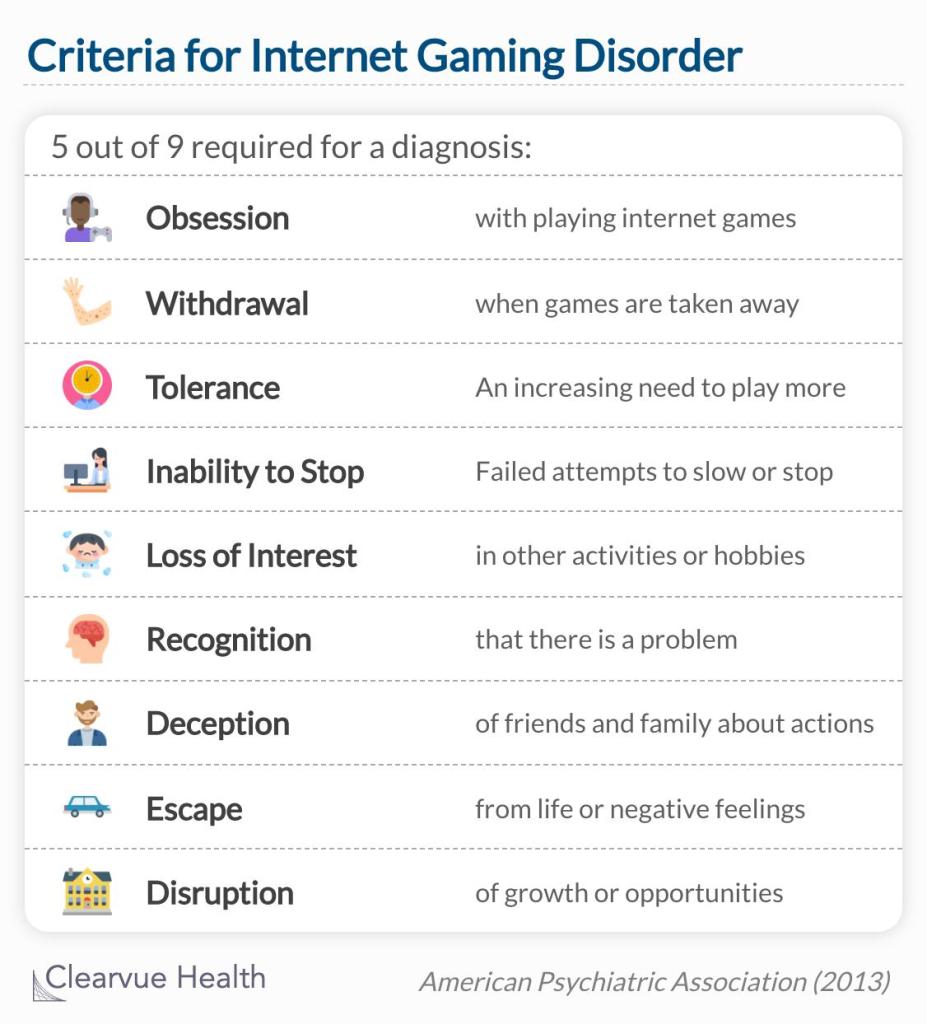
In the scoping review by Darvesh, et. al. (2020), they report the results from 156 full-text articles published between 2014 and 2018 that represented 160 studies. The methodologies used to determine Internet Gaming Disorder were diverse, so it was difficult to interpret reported ranges of prevalence:
| Sample population | Number of studies | Prevalence |
| General | 61 | 0.21-57.50% |
| Clinical | 10 | 3.20-91.00% |
| Severe | 6 | 68.60-79.25% |
Personal and family risk factors which may predispose a child to IGD
Concentrating on the youth of Norway, Wichstrom et. al. (2019) describe a number of risk factors which may predispose a child to IGD:
- Psychopathology
- Personality factors, e.g. low self-esteem, high impulsivity and negative affectivity)
- Social cognitions, e.g. perceived loneliness, poor social competence
- Impaired cognitive attentional and behavioral control
- Sex: boys display considerably more IGD symptoms than girls
- Family stability – those not growing up in two-parent families evince more problematic gambling, as do children in families with high conflict or discord
Health effects of IGD
According to King and Delfabbro (2018), the primary way in which individuals with IGD are negatively affected by their gaming relates to the extreme time investment in gaming (i.e., 8–12 hr/day). The consequences, therefore, may be divided into several categories:
Physical symptoms:
- Weight gain due to overeating or weight loss due to restricted diet;
- Physical pain issues due to poor posture and repetitive strain injuries;
- Restricted and poor sleep and/or reverse sleep–wake cycle that results in fatigue and lethargy
Displacement of normal activities, such as
- Basic activities (i.e., sleep, eating, and personal hygiene);
- Real-world social interaction (i.e., talking to people, meeting friends face-to-face, visiting family; and
- Important responsibilities (i.e., school, work, and care of pets and children)
King and DelFabbro (2018) state the following: “Within a short period of time (i.e., less than 3 months), the user may experience negative consequences, such as failing at school, reprimands or lost productivity at work, and/or arguments with family or a partner. Negative mood states (i.e., usually irritability, sadness, and boredom) accompany the times when the individual is not playing or is less able to play.”
Treatment options
Chang et. al. (2022) suggest that combining pharmacotherapy
with cognitive behavioral therapy (CBT) or multi-level counseling (MLC) is the most effective treatment option. They indicate that pharmacotherapy combined with CBT or MLC might be an effective therapeutic strategy for youth with gaming disorder.
Chang, C-H.; Chang, Y-C; Yang, L.; Tzang, R-F. (2022). The Comparative Efficacy of Treatments for Children and Young
Adults with Internet Addiction/Internet Gaming Disorder: An
Updated Meta-Analysis. Int J Environ Res Public Health. 2022 Mar; 19(5): 2612. doi: 10.3390/ijerph19052612
Darvesh, N.; Radhakrishnan, A.; Lachance, C.C.; Nincic, V.; sharpe, J.P.; Ghassemi, M.; Straus, S.; Tricco, A.C. (2020). Exploring the prevalence of gaming disorder and Internet gaming disorder: a rapid scoping review. Systematic Reviews 9:68.
https://doi.org/10.1186/s13643-020-01329-2.
King, D.L.; DebFabbro, P.H. (2018). The concept of “harm” in Internet Gaming Disorder. Journal of Behavioral Addictions 7(3), pp. 562–564.DOI: 10.1556/2006.7.2018.24
Wichstrom, L.; Stenseng, F.; Belsky, J.; von Soest, T.; Hygen, B.W. (2018). Symptoms of Internet Gaming Disorder in Youth: Predictors and Comorbidity. Journal of Abnormal Child Psychology 47:71-83. https://doi.org/10.1007/s10802-018-0422-x.
 Addictions and Recovery