
A discussion of biblical narratives as they relate to the consequences of alcohol misuse is topical this time of year. With last week’s holiday of Simchat Torah, i.e., Celebration of the Law, Jews renew the annual cycle of reading the Torah, and the first weekly reading which describes the consequences of alcohol misuse, Noah, will be read next Saturday (Genesis 6:9 through 11:32).
Noah
God states (Genesis 6:13-19): “I am about to destroy them (all flesh) from the earth…And as for Me–Behold I am about to bring the Flood-waters upon the earth to destroy all flesh, in which there is a breath of life, from under the heavens; everything that is in the earth shall expire. But I will establish My covenant with you, and you shall enter the Ark — you, your sons, your wife, and your sons’ wives with you. And from all that lives, of all flesh, two of each shall you bring into the Ark to keep alive with you; they shall be male and female.”
And sure enough (Genesis 7:11): “In the six hundredth year of Noah’s life, in the second month, on the seventeenth day of the month, on that day all the fountains of the great deep burst forth; and the windows of the heavens were opened. And the rain was upon the earth forty days and forty nights.”
If you were to ask children to draw their conception of Noah and his Ark, you would usually see Noah and the animals in the Ark smiling, and the picture would be drawn with bright colors, somewhat like the following:
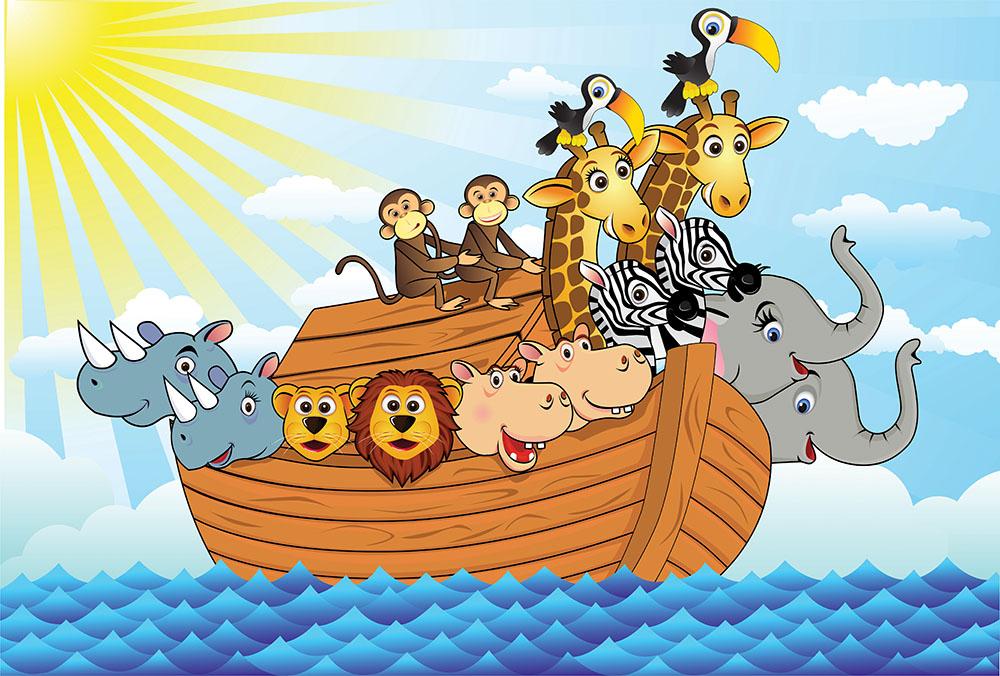
(Noah’s Ark, from Canvas Art Rocks)
or this:
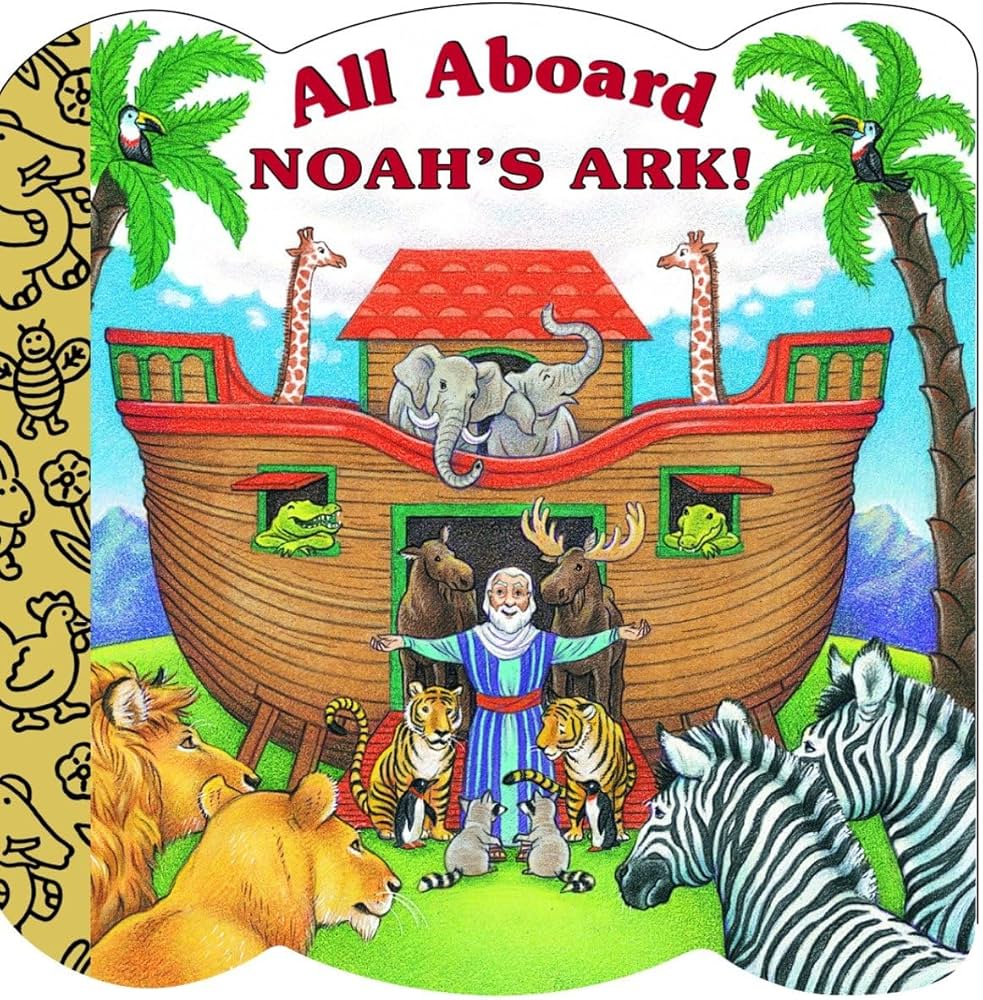
All Aboard Noah’s Ark, A Chunky Book from Amazon
In truth, I think that the view would be far more threatening than these, but would, instead, show swirling winds, horizontal rain, turbulent seas, and bloating bodies floating on the water’s surface, something like this:
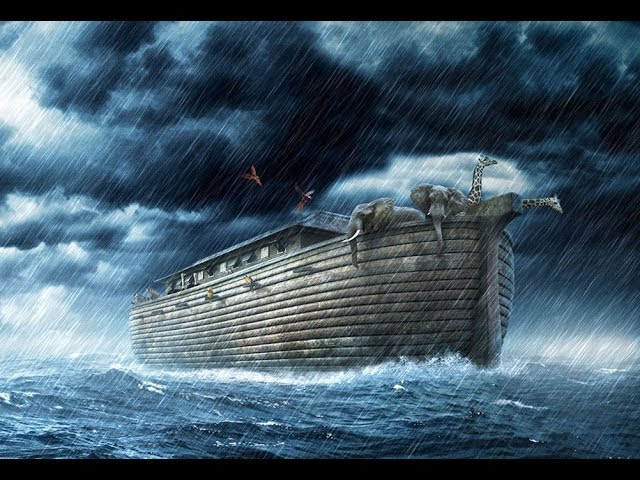
The above picture reminds me of the opening lines to AC/DC’s Hell’s Bells:
I’m a rolling thunder, pouring rain, I’m coming on like a hurricane
My lightning’s flashing across the sky, You’re only young, but you’re gonna die, I won’t take no prisoners, won’t spare no lives.
or this:
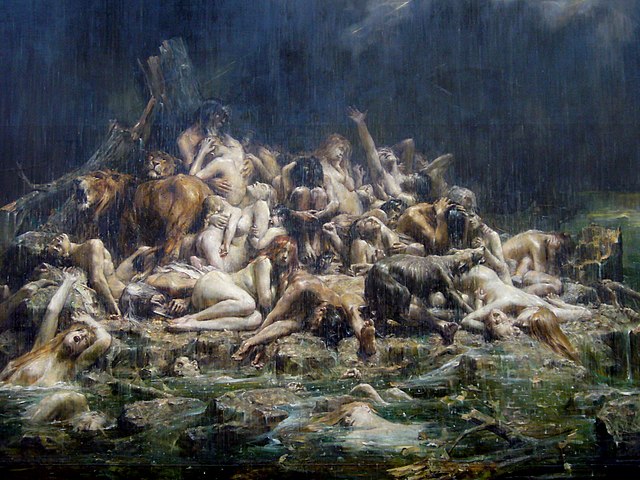
Le_déluge_-_musée_de_beaux_arts_de_Nantes_20091017
After an estimated 370 days, Noah and his family were able to leave the Ark, and return to dry land.
And what did Noah do when he and his family left the Ark? Verses 9:20 and 21 state “Noah, the man of the earth, debased himself and planted a vineyard. He drank of the wine and became drunk, and he uncovered himself within his tent.”
My question is, “Why did he plant a vineyard so soon after leaving the Ark?” Is it possible that he was ruminating all that time that he and his family witnessed the total destruction of the world as he knew it? Is it possible that he started to wonder, “Why did I survive? Why not my neighbors? What did they do to deserve this fate?”
Therefore, I am suggesting that he, like others who experience trauma, is manifesting Post Traumatic Stress Syndrome, during which these recurring thoughts are so disturbing and upsetting that he feels the need to do something to blot them out. So in two short verses, the Bible describes that he plants a vineyard with the intent of making the ruminating stop.
Please note that it took only two verses to describe Noah’s actions after leaving the Ark.
Tell me something, let’s just say that we have some venture capital and we decide that we want to plant some grape vines in order grow the grapes, harvest them, and produce wine. Realistically, how much time is involved? After all, there are numerous steps:
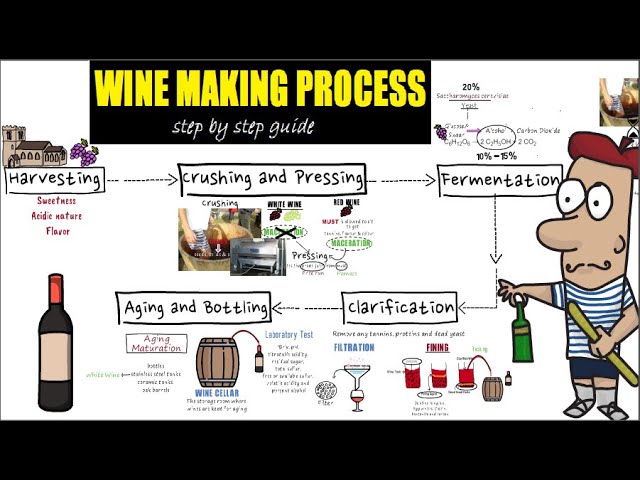
According to Strutt and Parker, “It [also] requires patience, as it will take four years (for still wine) to eight years (for sparkling) from planting before your wine is ready for sale. You will enjoy your first harvest three years after planting, but the full yield from your vines won’t be achieved until the fifth year.” (https://www.struttandparker.com/knowledge-and-research/how-easy-is-it-to-plant-my-own-vineyard#:~:text=It%20also%20requires%20patience%2C%20as,achieved%20until%20the%20fifth%20year.)
So Noah had plenty of time to ruminate about the fact that he and his family were the only surviving humans.
The text gets more interesting when it describes what his sons did as a result of Noah getting drunk(Chapter 9:22-26): “Ham, the father of Canaan, saw his father’s nakedness and told his two brothers outside. And Shem and Japheth took a garment, laid it upon both their shoulders, and walked backwards, and covered they father’s nakedness; their faces were turned away, and they saw not their father’s nakedness. Noah awoke from his wine and realized what his small son had done to him. And he said, ‘Cursed is Canaan; a slave of slaves shall he be to his brothers.’”
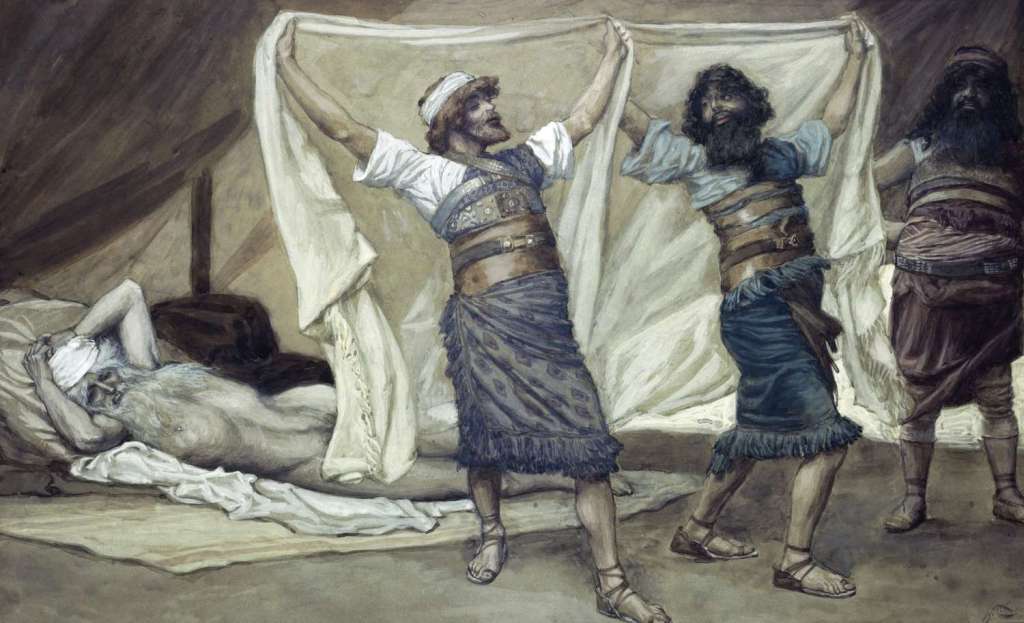
I brought this passage to the attention of my Rabbi, and said to him, “In modern lingo, Shem and Japheth were enabling their father by covering their nakedness, but Ham is cursed by telling his brothers what he saw. Why was he cursed?”
The Rabbi replied, “There is a story in the Oral Tradition, that Ham was a particularly selfish and greedy young man, and was not interested in sharing his inheritance with any more siblings yet to be born, so he castrated his father.”
Why does the phrase “dysfunctional family” suddenly come to mind?
Two weeks later, we will encounter Lot and his daughters, in the weekly portion entitled VaYeira.
Lot and his daughters (Genesis: 19)
The same men (angels?) who visited Abraham now visit Lot in Sodom. He welcomes them, invites them to eat and stay the night, but:
(Verses 4-8): “They (Ed. note: the guests) had not lain down when the townspeople, Sodomites, converged upon the house, from young to old, all the people from every quarter. And they called to Lot and said to him, ‘Where are the men who came to you tonight? Bring them out to us that we may know them.’ Lot went out to them to the entrance, and shut the door behind him. And he said, ‘I beg you, my brothers, do not act wickedly. See, now, I have two daughters who have never known a man. I shall bring them out to you and do them as you please; but to these men do nothing inasmuch as they have come under the shelter of my roof.’”
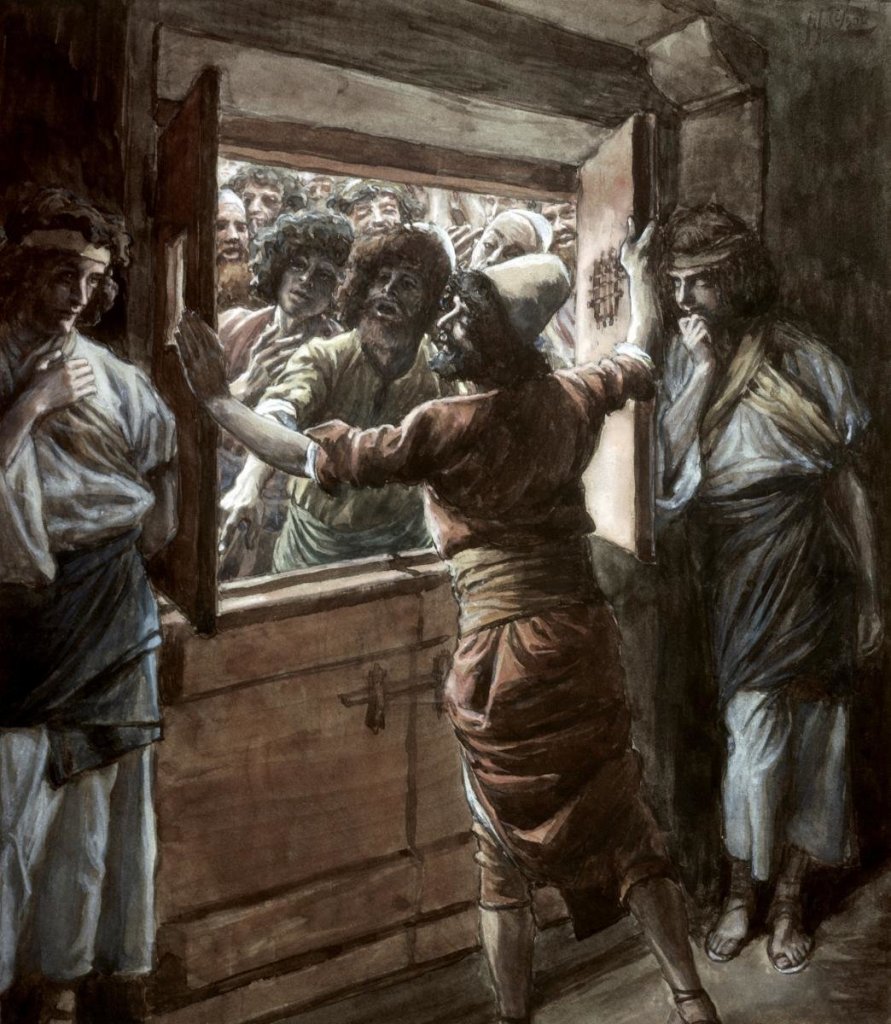
Sodomites, by James Tissot, available at the Global Gallery ( https://www.globalgallery.com/detail/280515/tissot-sodomites )
So the men of the city converge on Lot’s residence with the intent of gang-raping his guests, so to defend his guests, he offers his own virgin daughters to the townspeople to do as they please.
While it is true that while the guests were in Lot’s home, he had to do his utmost to protect them. However, offering his own daughters to the crowd does not strike me as an adequate strategy to do so.
Why does the phrase “dysfunctional family” suddenly come to mind?
Instead, the men at the entrance of the house are struck with blindness. The guests turn to Lot and say (Verses 12 and 13), “Whom else do you have here – a son-in-law, your sons, or your daughters? All that you have in the city remove from the place, for we are about to destroy this place; for their outcry has become great before Hashem (God), so Hashem has sent us to destroy it.”
Interestingly, it was not until the following dawn was breaking the next day, that the men “grasped him (i.e., Lot) by his hand, his wife’s hand, and the hand of his two daughters in Hashem’s mercy on him; and they took him out and left him outside the city.” Lot pleads with these men to let them settle in a city named Zoar, and permission is granted.
Back to the narrative:
(Verses 30-32): “Now Lot went up from Zoar and settled on the mountain, his two daughters with him, for he was afraid to remain in Zoar; he dwelt in a cave, he with his two daughters. The older one said to the younger, ‘Our father is old and there is no man in the land to marry us in the usual manner. Come, let us ply our father with wine and lie with him that we may give life to offspring through our father.”
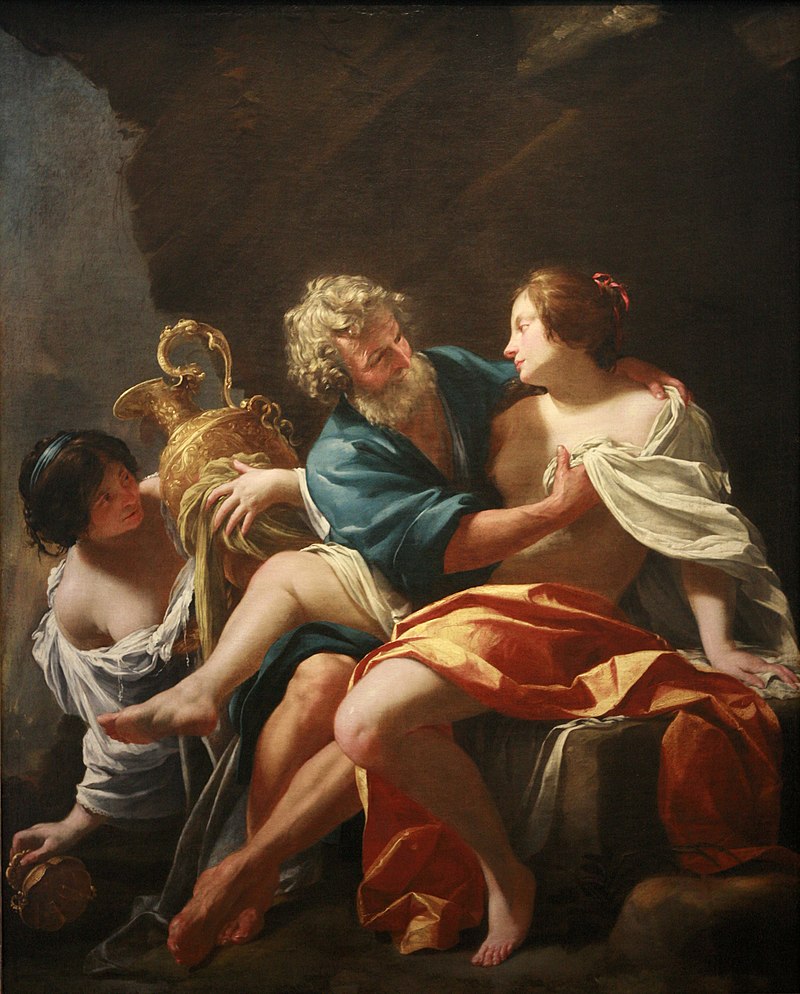
Lot and his daughters, painting by Simon Vouet, 1633, located at Musée des Beaux-Arts, Strasbourg
Were these daughters serious? They just left Zoar, described as a CITY. What, there were no men in Zoar? When they left Zoar to the cave, did they fail to see anyone?
(Verses 33-38): So they plied their father with wine on that night; and the older one came and lie with her father, and he was not aware of her lying down and of her getting up. And it was on the next day that the older one said to the younger, ‘Behold, I lay with my father last night; let us ply him with wine tonight as well, and you come lie with him that we may give life to offspring through our father.’ So they plied their father with wine that night also; and the younger one got up and lay with him, and he was not aware of her lying down and of her getting up. Thus, Lot’s two daughters conceived from their father.”
So the modern term for Lot’s behavior is that he experienced two blackouts, during which he committed incest and impregnated his two daughters.
And what were the names of the offspring? “The older daughter bore a son and she called his name Moab,” which means “of his father”, while the younger one called her son Ben-Ammi, which means “Son of my people”. These two names suggest to me, at least, that the daughters were utterly shameless in their behavior.
However, the text I am using for translations (Tanach: The Stone Edition) offers an interesting commentary: “Lot’s daughters were modest righteous women whose actions were nobly motivated. Thinking that the rest of the world had been destroyed in the upheaval of Sodom — and that even Zoar had been spared only while they were there — they felt that it was their responsibility to save the human race by bearing children, even though the only living male was their own father: Because their intentions were pure, they merited that among their descendants would be Ruth, ancestress of David, and Naamah, queen of Solomon and mother of Rohoboam, his successor and the next link in the Davidic chain. Lot, however, was different; his intentions were not at all sincere. Even though he was intoxicated and unaware of what he was doing the first night, he knew in the morning what had happened — but allowed himself to be intoxicated again, knowing full well what the result would be [Rashi]. Unlike his daughters, he knew from the angels that the upheaval was to affect only a limited group of cities, not the whole world.”
Death of Nadab and Abihu, Aaron’s eldest sons (Leviticus 10:1-2, 8)
It is the day of the inauguration of the Tabernacle and the installation of the priests to take on their duties. Perhaps in the ecstasy of the moment, Nadab and Abihu, Aaron’s eldest sons, make a fatal mistake:
(Verses 1-2): “The sons of Aaron, Nadab and Abihu, each took his fire pan, they put fire in them and placed incense upon it; and they brought before Hashem an alien fire that He had not commanded them. A fire came forth from before Hashem and consumed them, and they died before Hashem.”
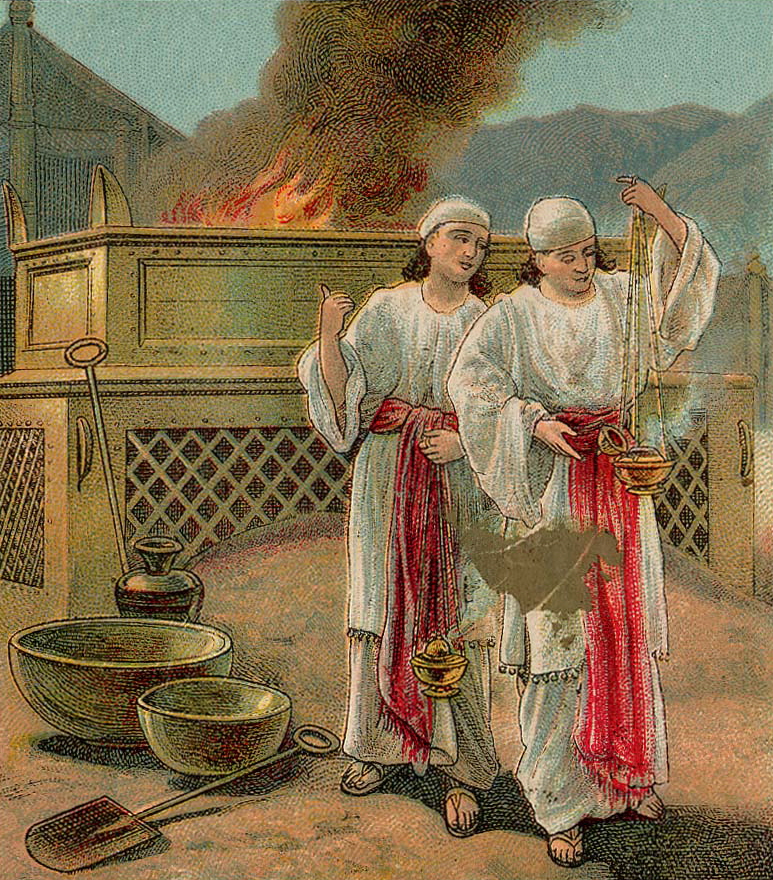
The Sin of Nadab and Abihu, as in Leviticus 10, illustration from a Bible card published 1907 by the Providence Lithograph Company, http://thebiblerevival.com/clipart/1907/lev10.jpg
There is considerable discussion among the commentators as to what constituted an “alien fire” and to the reasons why Nadab and Abihu died. Some of the reasons are listed at https://www.chabad.org/parshah/article_cdo/aid/4321414/jewish/The-Mysterious-Life-and-Death-of-Nadab-and-Abihu-Sons-of-Aaron.htm
- Being Disrespectful, as they were to their teacher Moses; at it was a mitzvah for them to bring their own fire to the altar;
- Staying Celibate, since they thought that no woman was good enough for them;
- Behaving Casually Before the Divine, as they did when G‑d revealed Himself at Sinai;
- Seeking Power, by thinking aloud when their father, Aaron, and Moses, would die so that they could take over;
- Not Seeking Advice, as they were too self-assured and didn’t seek counsel or advice from Moses, Aaron or even each other.
However, the explanation I want to explore here is suggested a few verses later, with God speaking to Aaron, saying “Do not drink intoxicating wine, you and your sons with you, when you come to the Tent of Meeting, that you not die — this is an eternal decree for your generations.”
There is a general principal in Biblical interpretation that when two verses are adjacent to each other, which seem incongruous in their positioning, that there must be a connection. In this case, there is the possibility that Nadab and Abihu were so caught up in the ecstasy of the moment that they became inebriated.
In Arthur Wolack’s essay, Alcohol and the fate of Nadab and Abihu: A Biblical Cautionary Tale Against Inebriation, he emphasizes that inebriation was the root cause for Nadab’s and Abihu’s demise:
“The need for sobriety is self-evident – priests are community leaders doing holy work. They must therefore retain a clear mind in order to perform their duties thoughtfully. If Nadab and Abihu had somehow been intoxicated, they would not have kept a clear head and might thus have committed an infraction that aroused God’s anger. That infraction could have been any of those ritual offenses already mentioned. Why would these priests have done any of these things? Alcohol – a drug known to interfere with clear thinking – may indeed have been the cause, leading God to issue the warning against priestly intoxication (or drinking any alcohol at all) in Leviticus 10:8-10.
In Leviticus Rabbah, the Midrash alludes to alcohol in a series of references to Leviticus 10:1-3. For example: “Just as an adder separates life from death … so wine caused a separation between Aaron and his sons in the matter of the death penalty.” Wine is clearly understood here as the root cause of the death of Aaron’s two sons. Leaving no room for doubt, “R. Shim’on expounded: The two sons of Aaron died only because they entered the Tent of Meeting when they were drunk.”
R. Pinhas in the name of R. Levi asserts that intoxication was indeed the main offense of Aaron’s sons. “The matter may be compared to a king who had a reliable steward, but who observed the man standing in the doorway of a [wine] shop. He cut off his head without disclosing the reason and appointed another steward in his place. Now we do not know why he killed the first man, but from the instruction he gave to the second we can draw the proper conclusion, for he said: ‘Do not enter that [wine] shop.’ That tells us why he killed the first man. So here it is written, And fire came forth from the presence of the Lord and devoured them; and they died before the Lord (Lev. 10:2).
The Rabbis of the Midrash understood that alcohol was the underlying problem that led to Nadab and Abihu’s demise, based on the proximity of the warning against intoxication to the account of their death. ‘Now we do not know the reason why they were put to death. But from what the Holy One,
blessed be He, told Aaron, saying to him, Drink no wine or strong drink [you or your sons with you, when you go into the Tent of Meeting, lest you die] (Lev. 10:8), we may draw the conclusion that they were put to death only on account of wine.’”
Perhaps we can all agree that the need for sobriety, particularly among our elected or appointed officials, should be self-evident. A person’s ability to think and to make the appropriate decisions, especially under pressure, will be compromised if (s)he is inebriated. It is therefore, somewhat disconcerting to note that quite a few American presidents carried out the responsibilities of their office while under the influence. Here is a partial list, from https://www.palmpartners.com/ten-presidents-who-loved-to-booze-up/:
- Martin van Buren (1837-1841): Buren was one of those high functioning alcoholics. He could drink for days and not show any signs of being intoxicated. It was to the point that his friends gave him the nickname “Blue Whiskey Van.” In 1840, William Henry Harrison’s campaign painted Van Buren as an alcoholic which contributed to him losing the election;
- Franklin Pierce (1853 – 1857): When the Democratic party decided not to re-nominate Pierce after his first term in office, he told reporters,“There’s nothing left but to get drunk.” Franklin Pierce might have been America’s MOST alcoholic president. He drank hard for his entire adult life and kept going right on through the end of his presidency;
- James Buchanan (1857 – 1861): This president’s ENTIRE life centered on drinking. One report has it that Buchanan flipped when he found out the white house would only be stocked with small bottles of champagne. That’s why every Sunday, he’d go to a distillery and pick up a 10 GALLON jug of whiskey. According to reporters, he’d drink cognac and up to two BOTTLES of other alcohol every night. If you’re thinking he was a drunken mess 24/7… not really. This president also knew how to hold his liquor. He remained calm and cautious on the outside so most people around him did not know he was drunk. On the inside though, his body was suffering. Soon his immune system was so weakened by such high alcohol consumption, he developed serious stomach issues like inflammation of his intestines on several occasions;
- Ulysses S. Grant (1869–1877): Famous General Ulysses S. Grant drank a staggering amount of Old Crow whiskey throughout the war. While many were shocked at his constant inebriated state, he went on to become one of the most celebrated generals of the war and was twice elected as president. Grant has the biggest drinking reputation of any U.S. president. One report stated that during Civil War battles “he’d just sit there, drinking, all day long.” Grant had attempted to gain sobriety many times and wanted to control his drinking. Time and time again though, Grant returned back to the booze. Fun Fact: When Ulysses S. Grant was on his death bed he passed out and a doctor was able to revive him and give him a couple of extra minutes of life…by giving him brandy;
- Richard Nixon (1969 – 1974): Unlike most presidents on this lists, the case of Nixon is a considerably darker one. In the book, One Man Against The World: The Tragedy of Richard Nixon, journalist Tim Weiner paints a picture of the 37th president as a paranoid madman, driven to shameful behavior through crippling addiction and mental collapse. Evidence for his behavior come from newly released recordings from the Nixon administration. In the book Weiner reports:
- Nixon had been up all night drinking when he accepted defeat in his 1960 bid for the presidency, delivering his infamous line, “You won’t have Nixon to kick around anymore,” to reporters.
- • By 1968, his close adviser John Ehrlichman was ready to call it quits over Nixon’s drinking. “He was convinced that Nixon’s drinking could cost him any chance of a return to public life,” Weiner writes. “He had seen Nixon drunk during the 1960 and 1962 campaigns and the 1964 Republican convention, and he made him take the pledge: ‘If he wanted me to work for him he would lay off the booze.’”
- • During Watergate, Nixon took Seconal, a barbiturate, as a sleep-aid, and Dilantin, a drug that leveled you out and was later diagnosed to people with bipolar disorder. Because he would combine the drugs with alcohol, it heightened the effects. “It wasn’t so much that he was a huge drinker, but one scotch with the pills would mess him up. He’d drunk dial people in his cabinet, his staff, or his old football coach, who would listen to Nixon until he’d mumble himself to sleep.”
- • According to Weiner, Nixon’s constant insomnia and drinking fueled his aggression in the war in Vietnam.
AC/DC. Hell’s Bells. https://www.youtube.com/watch?v=3tOKYFR4Rzg
Scherman, Rabbi N. (1997). Tanach: The Stone Edition. The ArtScroll Series, Published by Mesorah Publications, Ltd.
Wolack, A.J. (2013). ALCOHOL AND THE FATE OF NADAB AND ABIHU: A BIBLICAL CAUTIONARY TALE
AGAINST INEBRIATION. Jewish Bible Quarterly 41(4):219-226.
 Addictions and Recovery
