
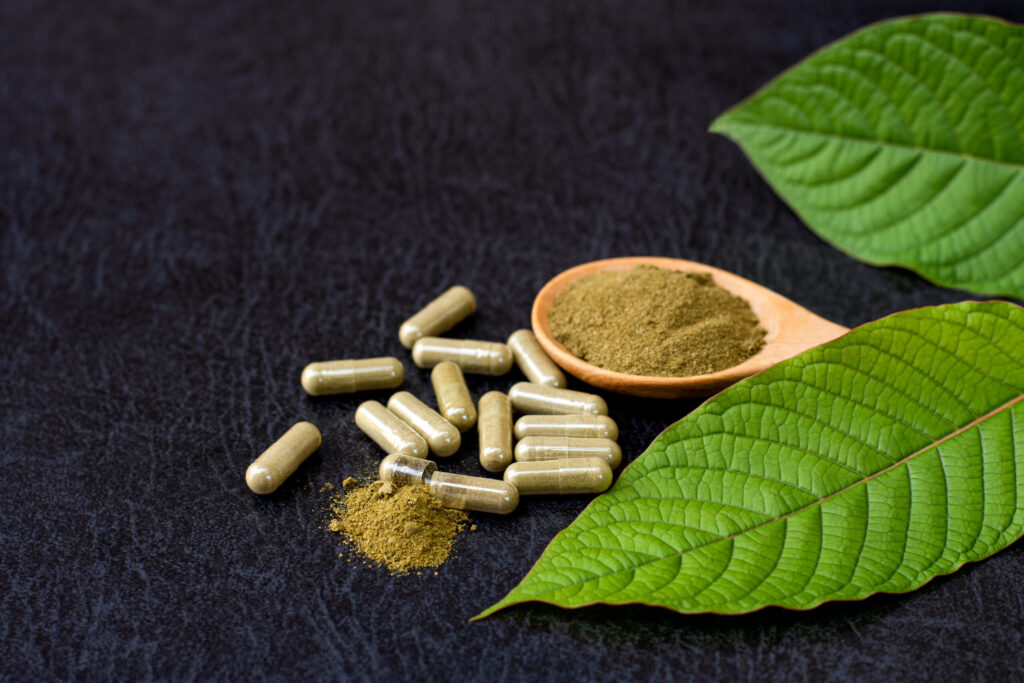
Kratom (Mitrogyna speciosa) leaves, powder, and pills
According to the European Union drug agency ( https://www.euda.europa.eu/publications/drug-profiles/kratom_en ), “Mitragyna speciosa Korth. (of the Rubiaceae family) is a 4 to 16 metre high tropical tree indigenous to South East Asia, the Philippines and New Guinea but now cultivated elsewhere. In Thailand, the tree and leaf-preparations from it are called kratom. Traditionally, fresh or dried kratom leaves are chewed or made into tea; they are seldom smoked. At a low dose, kratom has stimulant effects and is used to combat fatigue during long working hours. At high dosages, however, it can have sedative-narcotic effects. It is also used in traditional medicine and as an opium substitute. The phytochemicals isolated from various parts of the tree include over 40 structurally related alkaloids as well as several flavonoids, terpenoid saponins, polyphenols, and various glycosides. The main psychoactive components in the leaves are mitragynine and 7-hydroxymitragynine, both found only in Mitragyna speciosa.”
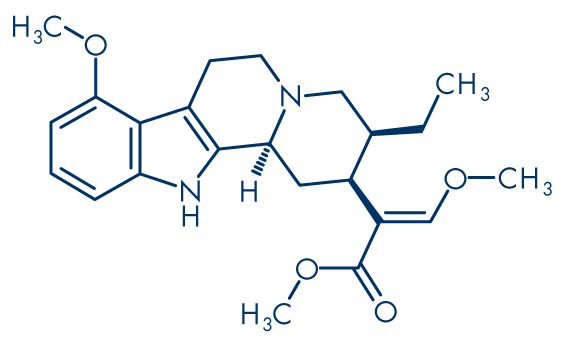
Molecular structure of mitragynine
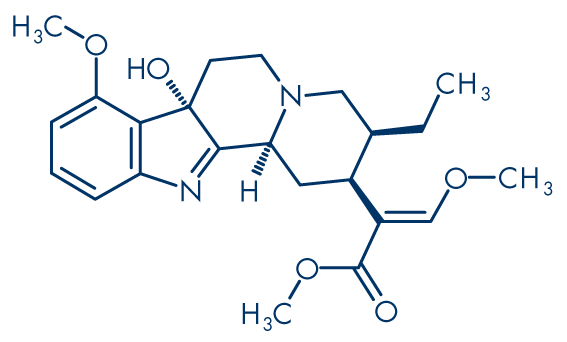
Molecular structure of 7-hydroxymitragynine
It is sold as kratom, mitragyna, and other street names such as ketum, thom, blak, and thang (Sethi, et. al., 2023).
According to National Institute on Drug Abuse (NIDA), (https://nida.nih.gov/research-topics/kratom), Kratom and kratom-based products are currently legal and accessible in many areas, though U.S. and international agencies continue to review emerging evidence to inform kratom policy.1 While there are no uses for kratom approved by the U.S. Food and Drug Administration, people report using kratom to manage drug withdrawal symptoms and cravings (especially related to opioid use), pain, fatigue and mental health problems. Rare but serious effects have been reported in people who use kratom, including psychiatric, cardiovascular, gastrointestinal and respiratory problems. Compared to deaths from other drugs, a very small number of deaths have been linked to kratom products and nearly all cases involved other drugs or contaminants.
How it was and is currently used
People typically use kratom by swallowing raw plant matter in capsule or powder form, mixing kratom powder into food or drinks, brewing the leaves as a tea, or taking liquid kratom extract. People who use kratom report both stimulant-like effects (increased energy, alertness and rapid heart rate) and effects that are similar to opioids and sedatives (relaxation, pain relief and confusion). Studies and case reports have also indicated rare adverse effects may be associated with kratom or individual kratom compounds.
Anthropologists report that kratom has been used in Southeast Asia for hundreds of years as a multi-purpose remedy in traditional medicine, to increase alertness and energy while working and during social gatherings. While estimates of the scope of kratom use in the United States vary, the expansion of kratom vendors and increasing case reports suggest kratom use has become more common over the past two decades.
Effects of kratom on the body
Researchers are still learning how kratom and kratom compounds affect the body, as well as how short- and long-term kratom use may impact health. While evidence is quickly evolving, early studies have revealed important information about how the drug works.
- Effects may vary widely. Like all drugs, kratom’s effects may depend on the amount taken, potency (concentration and strength), formulation of the product, the way it is ingested, other drugs in a person’s system, a person’s underlying medical conditions, and a person’s previous experience with the substance, among other factors. Importantly, kratom products vary, so effects are difficult to predict. Some kratom products have been found to contain contaminants that produce effects not associated with kratom or kratom compounds alone.
- Kratom produces opioid- and stimulant-like effects. People who use kratom report both stimulant-like effects (increased energy, alertness and rapid heart rate) and effects that are similar to opioids and sedatives (relaxation, pain relief and confusion). While many people who use kratom report that smaller doses of kratom produce stimulant-like effects and larger doses produce opioid- or sedative-like effects, studies have not yet established that these effects depend on the amount or method of kratom consumed.
- Adverse effects range from mild to severe. Some people who use kratom have reported mild side effects, such as nausea, constipation, dizziness and drowsiness. In case reports, clinicians report seeing patients with a wide range of rare but serious adverse effects associated with kratom exposure—including mental and neurological symptoms (confusion, tremors and seizures), heart and lung problems (high blood pressure and slow breathing), gastrointestinal problems (nausea and vomiting) and liver problems. A very small number of deaths have been linked to kratom products, and nearly all cases involved other drugs or contaminants. The following is a summary of adverse effects of Kratom Ingestion, adapted from Table 2 of Sethi, et. al., 2020:
| General | Nausea, vomiting, constipation, anorexia, weight loss, small black feces, fatigue, sweating |
| Endocrine | Hypothyroidism |
| Gastrointestinal | Dry mouth, nausea, vomiting, constipation, small black feces, diarrhea |
| Hepatic (liver) | Jaundice, itching, intrahepatic cholestasis (Intrahepatic Cholestasis of Pregnancy (ICP) is a liver disorder which occurs during pregnancy. This condition affects the normal flow of bile, leading to severe itching and possibly jaundice) |
| Neurologic | Dizziness, irritability, poor concentration, impaired memory, decreased sexual drive, tremors, headaches, seizure-like activity, coma, numbness |
| Psychiatric | Visual alterations, social withdrawal, psychosis |
| Cardiac and pulmonary | Hypertension, heart palpitations, shortness of breath |
- Drug interactions may influence effects. Studies suggest many people who use kratom also use other drugs and have conditions for which medications are often prescribed. Case reports suggest using kratom in combination with other drugs (sometimes called polysubstance use) may produce severe adverse effects, such as liver problems or even death. More research is needed to better understand the impact of using kratom in combination with other substances.
- Long-term health effects are not well understood. Because kratom research is relatively new compared to more widely used drugs, there is little evidence to determine how kratom use may affect someone over time. Case reports do show regular, long-term, kratom use in large amounts may be associated with serious liver problems. These cases appear to occur unpredictably in a small minority of people who use kratom, and it is unclear what role other substances and underlying health conditions may play. Researchers are also still learning how often and to what extent people who use kratom experience withdrawal or substance use disorder symptoms related to kratom use.
- Research on potential therapeutic effects of kratom is ongoing. Researchers have not proven kratom to be safe or effective for any medical purpose, though kratom has been used in traditional medicine. Many people who use kratom products report doing so to self-treat pain, anxiety, depression, fatigue, and drug cravings and withdrawal symptoms (especially related to opioid use). NIDA supports and conducts research on therapeutic uses of kratom and related compounds.
How do kratom compounds work in the brain?
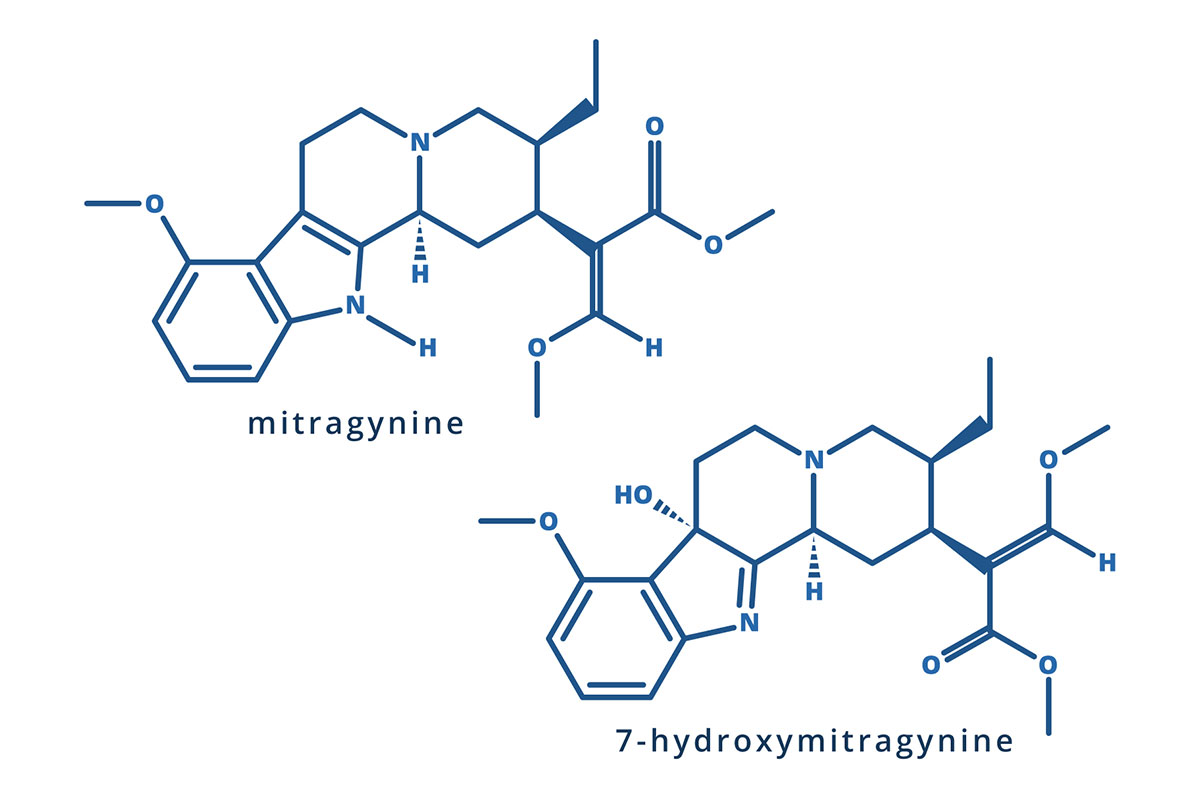
Mitragynine is found in kratom leaves and breaks down into 7-hydroxymitragynine in the body when digested. Both activate mu-opioid receptors (specific molecular structures on the surface of nerve cells), but the resulting effects only partially compare to those of opioids like heroin or oxycodone.
These compounds also have antagonist effects on the k- and delta-opioid receptors. Furthermore, kratom has anti-inflammatory properties and has demonstrated parasympathic-blocking effects which are reversible with naloxone (Sethi, et. al., 2020).
Some research suggests that mitragynine and 7-hydroxymitragynine may not cause some of the more serious adverse effects associated with opioid use—such as respiratory depression (trouble breathing)—that can occur during a life-threatening opioid overdose. Scientists also have observed that mitragynine may bind to adrenergic receptors, serotonin receptors and dopamine receptors, which may be responsible for some of the arousing effects some people who use kratom report experiencing.
What is the scope of kratom use in the United States?
Among people aged 12 or older in 2021, an estimated 0.6% (or about 1.7 million people) reported using kratom in the past 12 months (2021 DT 8.22).*
Source: 2021 National Survey on Drug Use and Health*
*Estimates of how many people regularly use kratom vary.
Is kratom addictive? Do people experience kratom withdrawal?
Studies suggest people may experience mild to moderate withdrawal symptoms when they stop regular kratom use, but more research is needed to understand to what extent people develop substance use disorder symptoms related to kratom.
Preliminary data from anonymous surveys of people who use kratom suggest a minority of people report experiencing kratom-related withdrawal symptoms and a smaller minority report experiencing substance use disorder symptoms related to kratom use.
Some experts are concerned about kratom’s addictive potential because the main kratom compounds, mitragynine and 7-hydroxymitragynine, partially activate the same receptors (specific molecular structures on the surface of nerve cells) in the brain on which drugs with known addictive properties act. However, researchers have observed that the way kratom compounds activate these receptors may reduce the potential for addiction relative to opioids. Further, studies in animal models indicate that the addictive potential of mitragynine and 7-hydroxymitragynine may differ from one another. Further research is needed to better understand how various compounds related to kratom interact to influence the risk of withdrawal and addiction.
How are withdrawal and substance use disorder symptoms related to kratom use treated?
While withdrawal and substance use disorder symptoms related to kratom use have not been extensively studied, some people who use kratom report experiencing them. Symptoms include severe muscle spasms, myalgia, chronic pain, sleeping difficulty, and intense cravings. There are currently no approved medical therapies for these conditions. In very limited cases, some researchers have reported using medications for the treatment of various withdrawal symptoms. The following is adapted from Table 4 of Sethi, et. al., 2020:
| Withdrawal Symptoms | Available Treatment Options |
| Anxiety and agitation | Benzodiazepines, buprenorphine |
| Nausea, vomiting, diarrhea and abdominal cramps | Nonopioid antidiarrheal |
| Muscle, body, and joint pain, nerve pain | Nonsteroidal pain relievers |
| Insomnia, sedation, fatigue | Buprenorphine and clonidine |
| Sweating, rhinorrhea, watery eyes | Buprenorphine and clonidine |
| Tremors, ataxia, dystonia | Buprenorphine and clonidine |
| Psychological restlessness, anger, depressed mood, nervousness, increased craving | Buprenorphine and clonidine |
Could kratom be used as medicine?
Kratom users report positive experiences such as relaxation, euphoria, state of well-being, pain relief, and enhanced empathy. Individuals also report successful use of kratom as replacement for unwanted substance use, especially opioids.
These anecdotal comments and initial research suggest kratom and kratom compounds warrant further study as experimental treatments for substance use disorders, specifically opioid use disorder. Such treatments are urgently needed to help curb the drug overdose epidemic in the United States. NIDA and its partners conduct and support research evaluating kratom and related compounds as potential treatments for chronic pain and for opioid withdrawal and opioid use disorder. ow are withdrawal and substance use disorder symptoms related to kratom use treated?
Is kratom legal?
While kratom use or sale has been banned or restricted in several countries, kratom products are currently legal and accessible online and in stores in many areas of the United States. The U.S. Drug Enforcement Administration (DEA) has listed kratom as a “drug of concern,” though kratom and kratom compounds are not listed on the U.S. schedule of controlled substances.
In 2021, the World Health Organization’s (WHO) Expert Committee on Drug Dependence (ECDD) examined the evidence on kratom’s health effects and concluded that there is insufficient evidence of adverse effects that would warrant additional critical review or inclusion in the United Nations list of internationally controlled substances. (See the full WHO ECDD report on kratom.) Kratom remains on the list of substances under surveillance by the WHO ECDD.
According to the Mayo Clinic, kratom is unsafe and ineffective.
Side effects and safety concerns
People who take kratom believe that it helps them. But kratom hasn’t been shown to be safe or to treat any medical conditions. The U.S. Food and Drug Administration (FDA) has warned people not to use kratom because of possible harm it can cause. The U.S. Drug Enforcement Administration calls kratom a drug of concern.
Poison control centers in the United States received more than 3,400 reports about use of kratom from 2014 through 2019. These included reports of death. Side effects reported included high blood pressure, confusion and seizures.
Kratom has known side effects, including:
- Weight loss.
- Dry mouth.
- Nausea and vomiting.
- Constipation.
- Liver damage.
- Muscle pain.
- High blood pressure.
Kratom also affects the mind and nervous system. It causes:
- Dizziness.
- Drowsiness.
- Smells, tastes, sights, touches or sounds that seem real but aren’t, called hallucinations.
- False beliefs, called delusions.
- Depression.
- Trouble breathing.
- Confusion, tremors and seizures.
Kratom products have been linked to a small number of deaths. That’s small compared with deaths from other drugs. Nearly all deaths from kratom also involved other drugs or substances that might have been harmful.
Many of the problems linked to pain medicines happen when people take them at high doses or for a long time. Experts don’t know what level of kratom can cause those problems. People can overdose with kratom, but it’s rare.
Research continues
Researchers continue to study the effects of kratom. Studies so far have found that kratom has many safety issues.
Kratom has been reported to react with other medicines. This may lead to severe effects, such as liver damage and death. More research is needed.
In a study testing kratom as a treatment for symptoms of quitting opioids, called withdrawal, people who took kratom for more than six months reported withdrawal symptoms like those from opioid use. And people who use kratom may begin craving it. They may need treatments given for opioid addiction, such as buprenorphine (Brixadi, Sublocade, others) and buprenorphine-naloxone (Suboxone, Zubsolv).
Kratom also affects babies during pregnancy. When a pregnant person uses kratom, the baby may be born with symptoms of withdrawal and need treatment.
Kratom products have been found to have heavy metals, such as lead, and harmful germs, such as salmonella, in them. Salmonella poisoning can be fatal. The FDA has linked more than 35 deaths to salmonella-tainted kratom.
Kratom is not regulated in the United States. But federal agencies are taking action to fight false claims about kratom. In the meantime, your safest choice is to work with your healthcare professional to find other treatments.


Sethi, R; Hoang, N.; Ravishankar, D.A.; McCracken, M.; Manzardo, A.M. (2020). Kratom (Mitragyna speciosa): friend or foe? Prim Care Companion CNS Disord. 22(1):19nr-2507. https://doi.org/10.4088/PCC.19nr02507.
 Addictions and Recovery