
Some years ago, I read that 70% of all hospital admissions are alcohol-related. I wanted to verify that with my internist so the conversation went like this during an office visit:
Me: I read that 70% of all hospital admissions are alcohol-related. Is that true?
Her: That sounds about right.
Me: Wait a minute. What about all those people who are hospitalized because of broken legs?
Her: Mostly alcohol-related.
Me: And people who have severe heart disease?
Her: Mostly alcohol-related.
Me: What about all those women who are in labor and delivery?
Her: How do you think they got pregnant in the first place?

How would George Takei say it? “Oh, my!”

So this conversation got me interested in finding out just how much medical students learn about alcoholism as a direct or indirect factor in hospitalization, so when I logged onto Google keyed in “what do medical students learn about alcoholism”, I got this as the first set of hits:
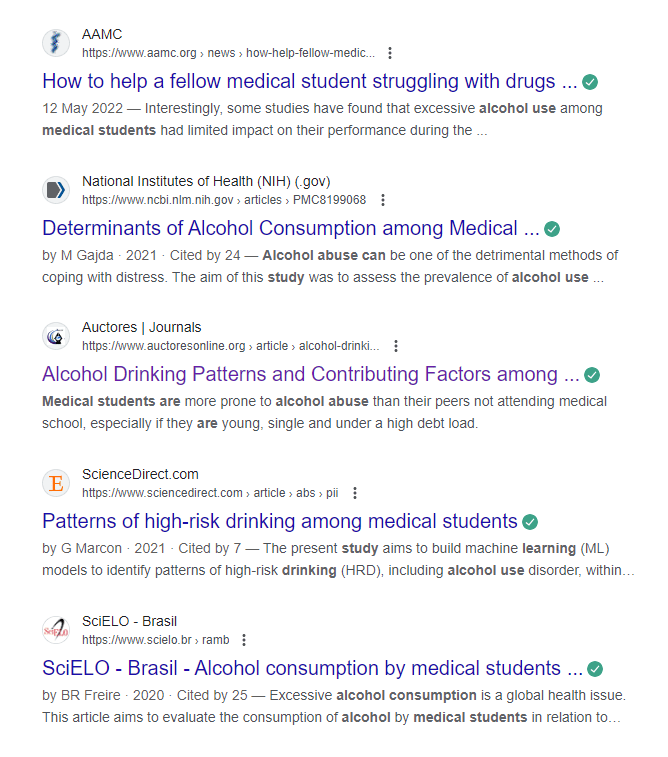
So this blog is dedicated to investigating patterns of drinking among medical students. The larger issue, of course, is the degree to which medical students engage in all kinds of risky behaviors in addition to consuming alcohol, such as smoking, extramarital sex, and use of illicit drugs, and whether these trends among medical students are different from other individuals of the same age.
Moghaddam Tabrizi et. al. (2022) specify the following risky behaviors in their study of medical students in Iran:
- Cigarette smoking;
- Hookah use;
- Opium consumption;
- Alcohol drinking;
- Tramadol/ecstasy taking; and
- Extramarital sex
Of an estimated 5,000 medical students, 450 participated in this study, of which 196 were men and 254 were women. The mean age of the participants was 22 ± 2 years.
Not surprisingly, the prevalence of high-risk behaviors is significantly higher in males than in females:
| High-risk behavior | Total | Male | Female |
| Hookah use | 20 | 32.6 | 9 |
| Cigarette smoking | 17 | 29.2 | 6.8 |
| Alcohol use | 8.3 | 13.8 | 3.6 |
| Extramarital sex | 8.2 | 12.0 | 5 |
| Tramadol and ecstasy | 4 | 8.0 | 1 |
| Opium | 0.4 | 0.9 | No data |
Chart adapted from Table 3: Prevalence of high-risk behaviors in all students and stratified by gender.
The biggest difference was related to hookah use, while the least difference was related to extramarital sex and tramadol/ecstasy use (P = 0.001).
Bede et. al. (2020) see an entirely different problem among medical students in the Cameroon, and that is malnutrition. In a study of 203 consenting students in the Faculty of Medicine and Biomedical Sciences of the University of Yaoundé I, Faculties of Health Sciences of the Universities of Bamenda
and Buea, Bede et. al. found the following:
- The ages of the students ranged from 17 to 27 years with a mean age of 20.8 ± 1.7 years;
- Most (59.6%) lived alone;
- In this study, the prevalence of underweight, overweight and obesity was 4.9%, 21.7% and 3.0% respectively;
- 16.7% (n=34) students had one meal, 49.8% (n=101) had two meals, and 33.5% (n=68) had three meals. In addition, 40.8% (n=83) had taken a snack (“snack” refers to all foods and drinks taken outside the context of the three main meals) in a day. Breakfast was consumed by 18.7% (n=38) of students in a day, while 29.6% (n=60) had lunch and 51.7% (n=105) had supper.
- The most frequently reported (52.7%, n=214) reason for skipping a meal being by students being attributed to being busy (emphasis mine). Of these students, 63.0% (n=128) admitted consuming alcohol either occasionally or regularly.
They conclude “Though not a direct objective of this study, educating and empowering medical student on healthy eating and living may be beneficial as they have the potential
of helping others make healthy dietary and lifestyle choices as future medical personnel and hence they have a role to play in combating malnutrition.”
Yoo, et. al. (2020) conducted a questionnaire-based, multicenter, cross-sectional study of 323 students from 5 medical colleges in Korea between July and October 2016. They used the Korean version of the Alcohol Use Disorders
Identification Test (AUDIT) and an anonymous, self-administered questionnaire that included demographic
characteristics, smoking status, consumption of alcohol, and drinking motives. They found that heavy drinking (75.9%) and binge drinking (56.0%) were very high among Korean medical students. Female medical students drank as much as male
students, and much more than other women. The probability that a student would be a binge drinker was 2.72 times higher for a smoker than a non-smoker. The scores for drinking frequency, alcohol intake at one time, heavy drinking, binge drinking, and alcohol dependence symptoms were highest in the group who had “enhancement drinking motives”.
What were the reasons for the heavy and binge drinking? ‘Among the various motives for drinking, social motives (47.3%) were the most common, followed by enhancement motives (20.6%), coping motives (19.4%), conformity motives (7.3%), and other (5.5%) among male students. Among female students, the most common motive for drinking was social motive (50.0%), followed by coping motive (18.0%), conformity motive (10.9%), enhancement motive (9.4%), and other (11.7%). Drinking motives differed between male and female students (p<0.001, data not shown). The scores for drinking frequency, alcohol intake at one time, heavy drinking, binge drinking, and alcohol dependence symptoms were highest in the group whose response was, “enhancement drinking motives.”’
They concluded that heavy drinking and binge drinking are common among both male and female medical students in Korea and this behavior is associated with smoking and enhancement drinking motives. Medical schools should consider implementing effective interventions to prevent and reduce problem drinking among medical students.
Post-script: What I should have keyed in was “does the curriculum in medical school cover alcoholism”, because when I did, this is what was generated:
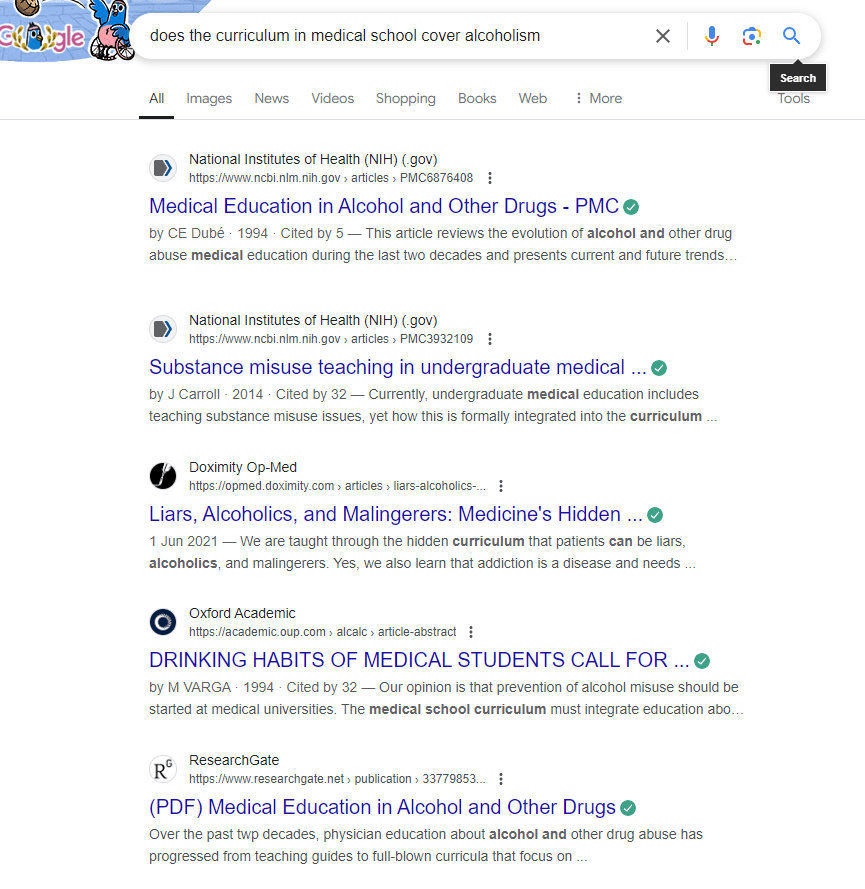
So that will be the topic of the next blog. Ciao.


P.P.S.: https://www.youtube.com/watch?v=PAK5blgfKWM

Bede, F.; Cumber, S.N.; , Nkfusai, C.N.; Venyuy, M.A.; Yunga Patience Ijang, Y.P.; Wepngong, E.N.; Kien, A.T.N. (2020). Dietary habits and nutritional status of medical school students: the case of three state universities in Cameroon. Pan African Medical Journal. 2020;35:15. doi:10.11604/pamj.2020.35.15.18818.
Moghaddam Tabrizi, F.; Sharafkhani, R.; Heydari, Z.; Khorami Markani, A.; Ahmadi Aghziyarat, N.; Khalkhali, H.R. (2022) Estimating the prevalence of high-risk behaviors using network scale-up method in medical university students. Journal of Education and Health Promotion 11(1):356. DOI: 10.4103/jehp.jehp_920_21
Yoo, H.H.; Cha, S.W.; Lee, S.Y. (2020). Patterns of Alcohol Consumption and Drinking Motives Among Korean Medical Students. Med Sci Monit, 2020; 26: e921613. DOI: 10.12659/MSM.921613.
 Addictions and Recovery