
One woman’s testimony about how her addiction to methamphetamine started: https://youtube.com/shorts/5BFOMxZOCvU?si=CGiEw3UU_523GCwm

Methamphetamine (METH) was formerly used to treat conditions such as obesity and attention deficit hyperactivity disorder, but now is primarily used recreationally (Prakash, 2017).

Methamphetamine chemical structure.
It is relatively easy to synthesize, and can be produced illicitly in meth labs, as was portrayed in the Breaking Bad television series:

Mode of Action
Its mode of action is summarized by the figure below, showing a closeup of a presynaptic cell containing vesicles of the neurotransmitters dopamine (D), norepinephrine (NE) and serotonin (5HT):
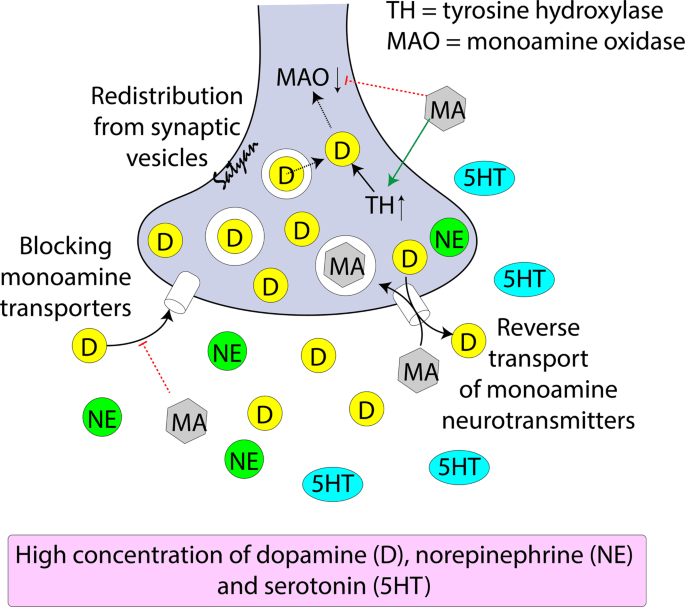
The open area signifies the synapse, the space between the presynaptic and postsynaptic neurons.
Methamphetamine acts by doing the following (Yasaei and Saadabadi, 2023):
- Normally, dopamine transporters are supposed to bring neurotransmitter molecules back into the presynaptic cell for reprocessing. Methamphetamine causes the release of monoamine neurotransmitters (dopamine, norepinephrine, and serotonin) from their storage vesicles into the synaptic space by forcing the reversal of movement in dopamine transporters;
- Reduces the expression of dopamine transporters at the cell surface;
- Enhances the expression and activity of the dopamine-synthesizing enzyme tyrosine hydroxylase.
“The immediate effect of amphetamine is that it triggers elevated mood, alertness, increased concentration, increased sexual libido, and decreases in appetite and weight.” (Yasaei and Saadabadi, 2023).
While the euphoric effects of cocaine are measured in minutes, the equivalent effects of methamphetamine can last for hours.
Short-term Effects
- Decreased appetite
- Nausea
- Psychosis
- Tachycardia
- Hypertension
- Increased body temperature
- Panic attack
- Mydriasis (dilation of pupils)
- Disturbed sleep patterns
- Violent, bizarre, and erratic behavior
- Hallucinations and irritability
- Seizures, convulsions, and death from high doses
Continued use of amphetamine in higher does can induce psychosis, bleeding in the brain, skeletal muscle breakdown, and seizures. Moreover, it can cause violent behavior, mood swings, and psychosis such as paranoia, delirium, auditory and visual hallucination, and delusions when used chronically. ” (Yasaei and Saadabadi, 2023).
Long-term Effects
- Long-lasting damage to the blood vessels of the heart and brain
- Lung, liver, and kidney damage
- Hypertension that can lead to heart attacks, strokes, and death
- Severe tooth degeneration (discussed in more detail below)
- In cases where the drug was sniffed, destruction of soft tissues in the nose
- In cases where the drug was smoked, respiratory problems
- In cases where the drug was injected, infectious diseases, cellulitis, and abscesses
- Weight loss and malnutrition
- Disorientation, apathy, confusion, and exhaustion
- Severe psychological dependence
- Psychosis
- Depression
- Damage to the brain structure similar to Alzheimer disease, epilepsy, and stroke.
Skin lesions
Chronic users often have the sensation of bugs crawling under their skin, which is called formication clinically and informally called “meth mites”, “crank bugs”, and “snow bugs”. This sensation may cause methamphetamine users to obsessively pick and scratch at their skin causing skin lesions that can result in abscesses or cellulitis (Scofield, 2007).

“Meth mites” lesions
The above lesions can be quite characteristic. As soon as I saw the photograph of Rosie O’Donnell’s daughter, Chelsea, being arrested in Marinette County, Wisconsin on drug charges, I knew, prior to reading the article, that the charges had to involve methamphetamine:

Paranoia
Yasaei and Saadabadi (2023) state that the last stage of methamphetamine misuse occurs when the person who inappropriately uses methamphetamine becomes paranoid and irritable because of a lack of sleep for about 3 to 15 days. Such individuals start to manifest a behavior called tweaking, during which they can behave violently, and get involved in domestic arguments and spur-of-the-moment offenses, thereby becoming a danger to others or themselves. Such “tweakers” can behave normally and have clear eyes, concise speech, and brisk movements, but careful observation will indicate that the affected person’s eye movement is much faster than normal, and they may have a minor quiver voice and jerky movements.
Oral effects
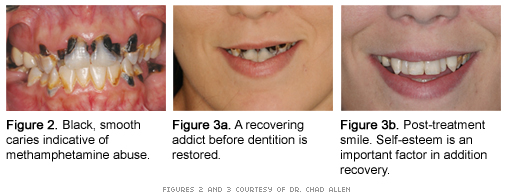
Scofield (2007) continues to describe the high incidence of oral disease in patients addicted to methamphetamine. Methamphetamine decreases the salivary flow leading to persistent xerostoma, i.e. dryness of the mouth. The accompanying craving for sweets leads users to consume large quantities of carbonated beverages and fruit juices. The result is a distinctive pattern of “rampant caries”:


Left: Patient with normal dentition; Right: Dentition of methamphetamine addict.


Panoramic x-rays. Left: Patient with normal dentition. Note the even distribution of teeth, and each shows a significant deposition of calcium; Right: Dentition of methamphetamine addict. Note loss of numerous teeth, fillings for most of the remaining teeth, misalignment of teeth and loss of calcium.
Repair of this damage is possible, however. Please note the progressive improvement of this patient, as shown in https://dimensionsofdentalhygiene.com/article/the-gravity-of-methamphetamine-addiction/:
The Revolving Door in law enforcement: The 2005 “Faces of Meth” project of Multnomah County (OR) Sheriff’s Office. (Photo and info courtesy of the Multnomah County Sheriff’s Office)
Addiction to methamphetamine is not pretty. To help awareness about the dangers of methamphetamine, the Multnomah County Sheriff’s Office, located near Portland, OR, initiated a project in which they would photographs individuals arrested for amphetamine use, and as you can see, there are profound changes that can occur anywhere between 3 months to 5 years. Please note how almost every one of them shows skin lesions on his/her face, the aforementioned “meth mites” :





It gets worse:
https://www.youtube.com/watch?v=YEqrD3Aoqfs


Prakash, M.D.; Tangalakis, K.; Antonipillai, J.; Stojanovska, L.; Nurgali, K.; Apostopoulos, V. (2017). Methamphetamine: Effects on the brain, gut and immune system. Pharmacology Research Jun:120:60-67. doi: 10.1016/j.phrs.2017.03.009.
Scofield, J. C. (2007). The Gravity of Methamphetamine Addiction. Dimensions of Dental Hygiene, https://dimensionsofdentalhygiene.com/article/the-gravity-of-methamphetamine-addiction.
Yasaei, R.; Saadabadi, A. (2023). Methamphetamine. Methamphetamine – StatPearls – NCBI Bookshelf, https://;www.ncbi.nlm.nih.gov/books/NBK535356.
 Addictions and Recovery