
In this blog, we will look at two interrelated issues:
- The types of psychoactive drugs, AKA entheogens, which are used to enhance or elicit religious experiences;
- Those individuals of a community, the shamans, who use these drugs to exert their leadership in the community.
Winkelman (2019) starts his article with pointing out that hominids began using psilocybin-containing mushrooms a very long time ago, perhaps a million years ago, and that this was inevitable, given the ubiquitous distribution of mushrooms which produce psilocybin (as with Psilocybe spp. or Paneolus spp.) or muscimol and ibotenic acid, as in the case with Amanita muscaria, AKA fly agaric:
I. Psilocybe spp.

(Global distribution of over 100 psychoactive species of genus Psilocybe mushrooms.Figure from https://en.wikipedia.org/wiki/Psilocybin)

(Image from wikipedia)
II. Paneolus spp.


(Paneolus antillarum – By Alan Rockefeller – Own work, CC BY-SA 4.0, https://commons.wikimedia.org/w/index.php?curid=44931440)
III. Amanita muscaria

(Figure from https://www.discoverlife.org/mp/20m?kind=Amanita+muscaria )
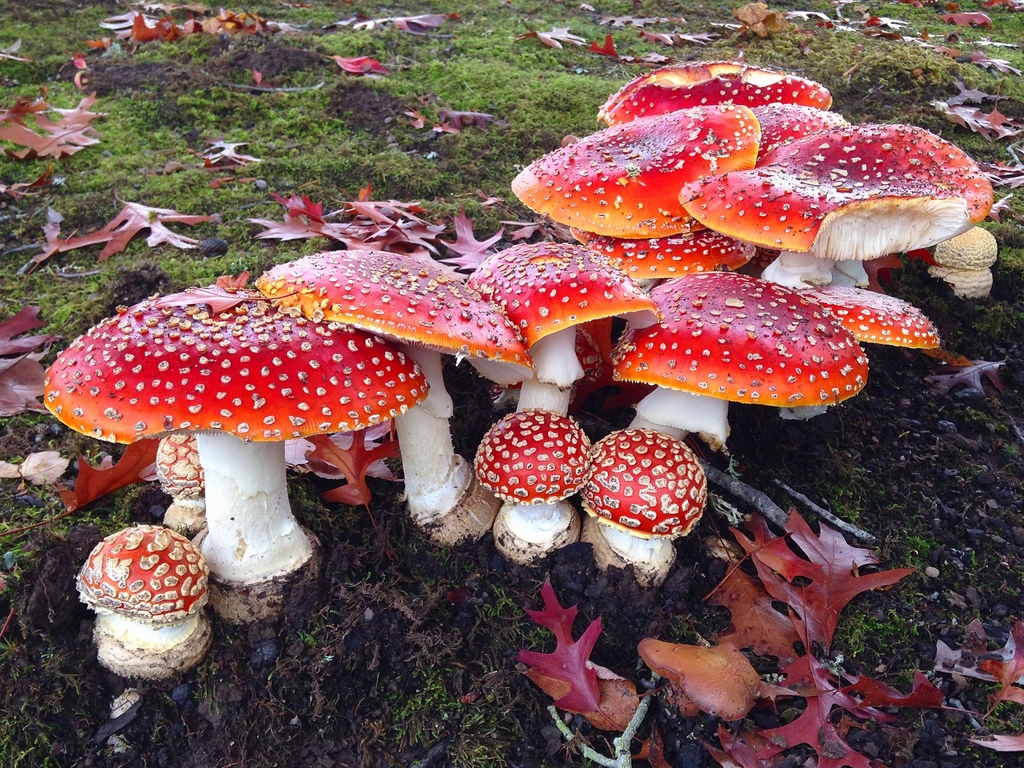
The modes of action for psilocybin, on the one hand, and both muscimol and ibotenic acid on the other, are quite different. Psilocybin is part of a family of molecules called the indolamines, which includes DMT and LSD and also more common endogenous neurotransmitters, such as serotonin. It is converted to its metabolite, psilocin, which can cross the blood-brain barrier and, given its structural similarity to serotonin, can easily activate the serotonin 5-HT2A receptor. It is this receptor activation that is thought to produce psilocybin’s psychedelic effects. These effects, which are dose-dependent, can include heightened perception, imagery, complex hallucinations and distortions of time.
The following is an excerpt from a previous blog, Are psychedelic drugs addicting, https://wordpress.com/post/addictionsandrecoverydotblog.com/1257, in which I describe 5HT (serotonin) receptors and their locations in the brain:
5-HT2 receptors constitute one of 7 families of receptors found largely in the brain and gut. 5-HT (serotonin) is involved in a large number of physiological functions, including cognition, mood and social interaction, sexual behavior, feeding behavior, the sleep-wake cycle, and thermoregulation (Beliveau, et. al., 2017). Disturbances in the 5-HT system are linked to numerous brain disorders such as major depression, anxiety, and schizophrenia.
5-HT2 receptors are concentrated in the prefrontal cortex, the executive functioning part of the brain, and in the limbic system, which is involved in regulating mood and alertness.
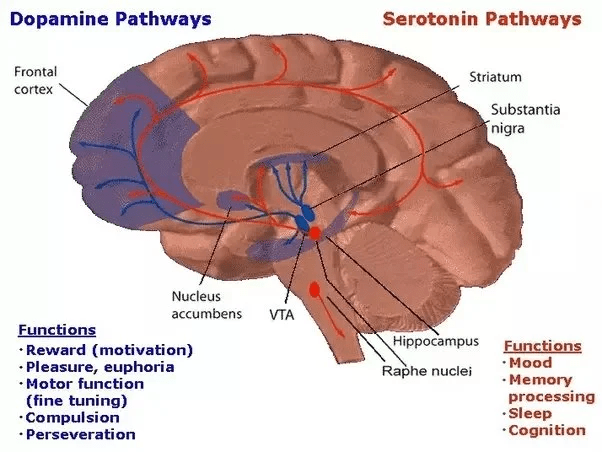
There are a number of theories on how psilocybin produces psychedelic effects in the brain, including alterations to thalamic gating and increases to activity in the prefrontal cortex.
Muscimol acts to quiet activity in the central nervous system. It does so by mimicking the action of GABA, “the main inhibitory neurotransmitter in the central nervous system. By binding to GABA-A receptors, muscimol increases the inhibitory effects of GABA, leading to hyperpolarization of neurons (i.e., decreasing the likelihood that nerve cells will fire) and decreased neuronal excitability” (from https://en.wikipedia.org/wiki/Muscimol#:~:text=show%20characteristic%20spikes.-,Mechanism%20of%20action,in%20the%20central%20nervous%20system).

Location of GABA receptors in the brain. Image from https://www.researchgate.net/profile/Mandi-Le-Roux/publication/320465835/figure/fig5/AS:551234117566464@1508435863208/GABA-pathways-in-a-normal-human-brain-Lundbeck-institute-2014.png
Ibotenic acid is a stimulatory drug, and acts to stimulate receptors for glutamate (or glutamic acid), which is, itself, the principal stimulatory neurotransmitter.

Image from https://www.researchgate.net/figure/Five-glutamate-pathways-a-The-cortical-brainstem-glutamate-projection-is-a-descending_fig3_233789754. There are 5 glutamate pathways. (a) The cortical brainstem glutamate projection is a descending pathway that projects from cortical pyramidal neurons in the prefrontal cortex to brainstorm neurotransmitter centers (raphe, locus coeruleus, ventral tegmental area, substantia nigra) and regulates neurotransmitter release. (b) Another descending glutamatergic pathway projects from the prefrontal cortex to the striatum (corticostriatal glutamate pathway) and to the nucleus accumbens (cortico-accumbens glutamate pathway), and constitutes the “corticostriatal” portion of cortico-striatal-thalamic loops. (c) Thalamocortical glutamate pathways are pathways that ascend from the thalamus and innervate pyramidal neurons in the cortex. (d) Corticothalamic glutamate pathways descend from the prefrontal cortex to the thalamus. (e) Intracortical pyramidal neurons can communicate with each other via the neurotransmitter glutamate. These pathways are known as cortico-cortical glutamatergic pathways. Three of the five pathways project from the frontal cortex and penetrate into deeper brain areas where they exert control over the neuroanatomic structures residing there.
In either case, hominids discovered the psychedelic effects which would do the following to the user:
- “Provide access to a spiritual world, the supernatural, bringing the world of mythic beliefs into experience;
- Produce an experience of one’s soul or spirit and its separation from the body and travel to the supernatural world;
- Cause experiences of the activation of powers within and outside of the person;
- Induce experiences of relationships with animals and at times the sense of transformation into an animal;
- Provide experiences of ego death followed by transformation or rebirth;
- Provide information through visions;
- Engage healing, especially through the dramatic ritual evocation of emotional experiences; and
- Provide processes for group integration and enhanced social cohesion. (Winkelman, 2019)”
In order to accomplish all of the following required an intimate knowledge of the flora in the environment, and this became the domain of shamans.

Photo by Rita Willaert: Ritual at the shaman: Kyzyl – capital of Tuva – Siberia – “Republic of Tuva” Siberia, kamlanie, ritual, Russia, shaman, Sjamaan, Tuva. (Ed. note: I, for one, would not mess with a guy who looks like this. He kinda reminds me of Lee Van Cleef.)
The rituals during which the shaman uses these compounds is remarkably similar across multiple cultures. “…the shaman consumes the sacrament to enhance the healer’s spiritual force and divinatory capacity for purposes of healing. These entheogenic practices generally occur in a communal ritual context with the attendance of the entire local group, who are are often subjected to the conditions of ritual-fasting, as well as the experiences from drumming, singing, and clapping and overnight vigil. These ritual practices enhance the effects of the entheogen in producing experiences of communication with divinities for a range of objectives. These include:
- Diagnoses of disease and guiding treatment;
- Establishing contact with the ancestors to obtain advice;
- Seeking advice from the spirits regarding plans for the future;
- Acquiring information regarding hunting and about missing family members; and
- Seeking to influence spiritual forces to enhance well-being.”(Winkelman, 2019)
There is evidence across cultures and across modern religions of the use of entheogens.
First, petroglyphs and petrographs:
According to Wikipedia, https://en.wikipedia.org/wiki/Petroglyph, “a petroglyph is a rock engraving, whereas a petrograph (or pictograph) is a rock painting.[1][2] In common usage, the words are sometimes used interchangeably.[3][4] Both types of image belong to the wider and more general category of rock art or parietal art…”
I. Amanita muscaria:

(From: Schoningh, F. (2020). The Grand Narrative of the Mukhomor. The Soviet and Post-Soviet Review 47:135-184). Note the “headdresses of the figures, corresponding to the caps of Amanita sp. mushrooms.)
II. Psilocybe spp.:

(From https://www.openculture.com/2021/01/algerian-cave-paintings-suggest-humans-did-magic-mushrooms-9000-years-ago.html. The location is in Algeria, and this petroglyph is estimated to be 9,000 years old.)

(Psilocybe stone, from https://www.pinterest.com/pin/256212666290758692/ )
And then there’s the connection to modern religions
I. Christianity
In 2022, Alex Henderson, Curator of Living Collections, Royal Botanical Gardens in Canada, wrote a blog entitled “Fungi, Winter Solstice…and Santa Claus?”, (https://www.rbg.ca/fungi-winter-solstice-and-santa-claus/ ) in which he suggests that there is a connection between Christmas traditions and the mycological and ethnobotanical rituals of North European shamans during pagan celebrations of the winter solstice involving Amanita. Here is a suggestive illustration showing the connection between the use of red and white colors, Santa Claus and childhood stories with the harvesting and use of Amanita:

While we’re at this juncture, what, exactly, is going on here?:

II. Judaism
a. Shamanistic practices in Judaism
Although shamanism occurs in numerous cultures across time and around the world, there are some common cultural motifs (Winkelman, 2013). Furthermore, Danny Nemu (2019) provides example from the Torah in which nearly every item in this list appears in the stories of Moses and his siblings:
| Cultural motif (from Winkelman, 2013) | How they appear in the stories of Moses and his siblings (Nemu, 2019) |
| A dominant social role as the preeminent charismatic leader; | From Exodus through Deuteronomy, Moses is portrayed as the leader of the Israelites. |
| A nighttime community ritual; | Here Nemu states “Moses also instigates three nighttime (Emphasis mine) community rituals per year (Exodus 23:14-16). I respectfully disagree with him, because the passage does not specify nighttime: 14 Three times you shall slaughter sacrifices to Me during the year. 15 You shall observe the festival of unleavened bread; for seven days you shall eat unleavened bread as I have commanded you, at the appointed time of the month of springtime, for then you left Egypt, and they shall not appear before Me empty handed. 16 And the festival of the harvest, the first fruits of your labors, which you will sow in the field, and the festival of the ingathering at the departure of the year, when you gather in [the products of] your labors from the field. |
| Use of changing, singing, drumming, and dancing; | Both Moses (Exodus 15:1) and Miriam, his sister (Exodus 15:20) lead the Israelites in song. |
| An initiatory crisis involving a death and rebirth experience; | At the conclusion of Moses’ initiation, Moses has a brush with death, when “YHWH met him, and sought to kill him” (Exodus 4:24) |
| Shamanic training involving induction of an altered state of consciousness (ASC), particularly with fasting and social isolation; | Moses ascends Mount Sinai for forty days and nights, without food or water, to learn the terms of the Covenant (Exodus:28). “And he was there with יהוה (Ed. note: Hebrew for YHWH) forty days and forty nights; he ate no bread and drank no water; and he wrote down on the tablets the terms of the covenant, the Ten Commandments.” |
| An ASC experience characterized as a soul journey (but not possession); | |
| ASC involving visionary experiences; | Moses sees a burning bush that is not consumed by the fire (Exodus 3.2) |
| Abilities of divination, diagnosis, and prophecy; | Moses barters with YHWH to forgive the Israelites for the sin of the Golden Calf (Exodus 32:31-33): 31 And Moses returned to the Lord and said: “Please! This people has committed a grave sin. They have made themselves a god of gold. 32 And now, if You forgive their sin But if not, erase me now from Your book, which You have written.” 33 And the Lord said to Moses: “Whoever has sinned against Me, him I will erase from My book!” |
| Healing processes focused on soul loss and recovery; | When Miriam criticizes Moses for his choice of wife, YHWH afflicts her with leprosy. Upon finding this out, Moses immediately prays to YHWH to heal her (Numbers 12:13): 13 Moses cried out to God, saying, “Please, God, please heal her!” |
| Illness believed to be caused by spirits, sorcerers, and the intrusion of objects or entities; | |
| Animal relations as a source of power, including control of animal spirits; | |
| The ability of the shaman to transform into animals; | Neither Moses nor Aaron transform into animals, but Moses’ staff turns into a snake (Exodus 4:4), and Aaron’s turns into a snake later in the confrontation with Egyptian magicians (Exodus 7:10-12). |
| Malevolent acts of sorcery, including the ability to kill others; | This is reflected in the plagues afflicting Egypt: “Aaron stretched out his hand over the waters of Egypt; and the frogs came up, and covered the land” (Exodus 8:6). Later, there is the plague of boils (Exodus 9:10) and killing of the first-born (Exodus 11:4-5). |
| Hunting magic, assistance in acquiring animals for food. | YHWH guides Moses to game (Exodus 16:11) and to water (Exodus 17:6). |
b. Ergot as the principal component of manna
Ergot is a fungus which parasitizes a variety of plants. This fungus secretes ergotamine, which can be toxic by itself, but can be converted to both D-lysergic acid amide (LSA), a potent visionary, and LSD. Hofmann, who synthesized LSD, states that the separation of the hallucinogenic agents from ergot involves the use of a water solution, a technique similar to the Biblical description of how the manna was prepared: “…[they] ground it in mills, or beat it in a mortar” (Numbers 11:8), then boiled it and baked it.
Interestingly, quail was also offered to the Israelites in the Wilderness, yet the text states “12 “I have heard the grumbling of the Israelites. Tell them, ‘At twilight you will eat meat, and in the morning you will be filled with bread. Then (Ed. note: meaning, only in the morning?) you will know that I am the Lord your God.’” Does that suggest that manna satisfied the Israelites in a more profound way than meat?
c. Psychoactive components of the anointing oil and incense
The Oral Tradition (Talmud, Kereisos 6a) and other writings specify the spices that are included in the anointing oil and incense. Some of these spices have psychoactive compounds, some of which are released when burned:
| Spice | Psychoactive compound(s) | Effect(s) |
| Myrr (Commiphora myrrha) | furanosesqui-terpenoids, alpha-pinene, limonene, cuminaldehyde, eugenol, safrole, myrcene, and elemicin | Limonene and eugenol increase the absorption of chemicals across the skin. Limonene is also an adenosine A(2A) receptor agonist which will stimulate serotonin and dopamine function in the brain. Extracts from C. myrra stimulate Mu opioid receptors, which would increase the sensation of pain relief and well-being. |
| Cinnamon (Cinnamomum verum) | Cinnamaldehyde, eugenol, linalool, safrole, myrcene, cinnamic aldehyde | *Cinnamaldehyde dilates peripheral capillaries of the vascular system, increasing blood flow and helping distribute any psychoactive compounds absorbed. *Eugenol acts on the brain in a manner similar to MDMA. *Cinnamon contains compounds which inhibit those enzymes which deactivate psychoactive compounds |
| Kaneh bosem, meaning “fragrant cane” (Cannabis sativa) | Tetrahydro-cannabinol (THC), cannabidiol, nerolidol, phytol |
III. Islam
a. Shamanistic practices in Islam
The role of shamans was suppressed because shamans liked to regard themselves as prophets, and as a result, they faced opposition by the faithful of Islam (Khalmuratov, 2017). At the same time, there are communities in central Asia in which the members called upon shamans, religious scholars and bakhshis (singers of epic tales), and these individuals acted without interfering with each other.
Khalmuratov states that the process of incorporating Islamic ideas to the mind and soul of Central Asia people took a very long time, even after the native people had accepted Islam. Shamanistic beliefs persisted, and often influenced the ceremonies of Turkish people, for example, where originally shamanistic events were Islamic in form and shamanistic in meaning. For example, the Turkish bakhsis asked for help from Imomi a’zam and Imomi Malik, hoping for their hep in fighting against enemy spirits. Shamans or folk healers customarily did not accept their permanent clients on Thursdays or Fridays, which were days off for Muslims.
b. The possible link between the miraculous ascent of the Prophet Mohammed to Jerusalem and Amanita muscaria (fly agaric)

Ascent of Muhammad to Heaven (c. 1539–1543), from the Khamseh of Nizami
In Muslim tradition, Mohammed traveled overnight from Mecca to Jerusalem by means of a beast called Buraq. How this creature is represented varies across time and location. One such representation states that this creature was larger than a donkey but smaller than a mule, had the head of a woman and the tail of a peacock.
In a series of illustrations from a 15th century manuscript derived from the Timurid era of rule in Western Afghanistan, the Buraq is shown with the distinctive red and white spotted skin of the Amanita muscaria mushroom, and the depiction is remarkable in the smallest detail. They both share a distinctive shade of red as a background color, covered by small circular or oval white patches that have ragged edges and, when aged, a darkened center. This representation could be coincidental, but Piper (2019) argues that this representation is, in fact, deliberate.
At the same time, Piper states that as Islam adapted to different cultural milieus, so that the artist may have embellished the beast with a hide resembling the skin of a psychoactive mushroom based on the practices of local shamans.

illustrations by the court workshop at Herat, Public domain, via Wikimedia Commons. https://upload.wikimedia.org/wikipedia/commons/5/59/Miraj-BNF-1436.jpg
While the story of Mohammed ascending a ladder to Heaven has some resemblance to related Biblical stories, some authorities suggest that the ladder could be compared to the notched tent pole by means of which Siberian shamans are sometimes described as accomplishing their celestial ascents.
c. Hashish in Islam
Although cannabis had been used as an intoxicant in India and Iran since 1000 B.C.E., where it was called bhang, it was unknown in the Middle East during the lifetime of the prophet Mohammed (570-632 C.E.)
By the ninth century, however, it was called hashish and its use as an intoxicant is mentioned in Islam, first by religious Persian and Iraqi sects in the eastern periphery of the Islamic empire. Its use spread as Arabs conquered lands both westward to India and westward to northern Africa and to Spain (Nahas, 1982).
The controversy regarding whether the use of hashish was permitted in Islam spanned over 1,000 years, and it is based on two issues:
- Fermented beverages such as beer and wine are expressly banned, whereas hashish is not;
- The Koran states “Approach not prayers with a mind befogged not until you can understand all that you say.” Given that Moslems must pray at regular intervals five times, the prohibition of praying while under the influence of intoxicants limits their use considerably.
Nonetheless,
- Islamic medical texts prescribe hashish for a variety of ailments, including dandruff, dissolving flatulence, epilepsy, asthma, gonorrhea, and constipation. It also was used as an antidote for poisoning.
- Regardless of any ban, the consumption of hashish was very popular among the poor and low class. “An ounce of hashish is more effective than pints of wine.” It could be easily concealed, was cheap, and was easy to carry.
- Meanwhile, a large number of people in privileged and wealthy castes would consume wine.
Numerous poets defended the use of hashish and extolled its use. For example, al-Ukbari (1275) wrote “Know that the holy law has not indicated that the use of drugs that cause joy such as safron or others similar to hashish is forbidden. No indication has come down from the Prophet that it is forbidden as such and no punishment has been established for eating it. (Rosenthal, 1971).
P.S.: As an adherent to the Modern Orthodox approach to Judaism, I found what I wrote in this blog about the connections between shamanism and entheogens with Judaism to be startling and unexpected. HOWEVER, as I was walking in Park Yarmut, a national park close to my apartment, I came across the following sign, featuring a mushroom strikingly like Amanita muscaria :

Translation? — 60 Minutes in a day. Every minute counts.
You reach 60 minutes of physical activity daily in any way you want and in any type of activity you want.
Walking, playing in the yard, cycling and walking the dog, ball games, classes and sessions, climbing the stairs and more. Whatever activity you choose, at home or outside alone or with friends, the main thing is to be in motion because physical activity is part of life!
Uh, can someone please explain to me what is going on here?
P.P.S.: Please take a look at the two images shown below. Coincidence? I think not.


P.P.S.: According to https://www.westword.com/music/the-ten-best-songs-about-hallucinogens-7053301 , these are the 10 best songs about hallucinogens:
10. The Beatles — “Lucy in the Sky With Diamonds”
Sample lyric: Picture yourself in a boat on a river/With tangerine trees and marmalade skies/Somebody calls you, you answer quite slowly/A girl with kaleidoscope eyes.
9. Jefferson Airplane — “White Rabbit”
Sample lyric: One pill makes you larger/And one pill makes you small/And the ones that mother gives you/Don’t do anything at all/Go ask Alice, when she’s ten feet tall
8. Timothy Leary — “How to Operate Your Brain”
7. The Moody Blues — “Legend of a Mind”
Sample lyric: He’ll fly his astral plane/Takes you trips around the bay/Brings you back the same day/Timothy Leary. Timothy Leary.
6. Jimi Hendrix — “Purple Haze”
Sample lyric: Purple haze all in my brain/Lately things just don’t seem the same/Actin’ funny, but I don’t know why /Scuse me while I kiss the sky.
5. Of Montreal — “Lysergic Bliss”
Sample lyric: And I’m dizzy from her kiss so vertiginous lost in lysergic bliss.
4. ATB — “Ecstasy”
Sample lyric: Have you ever noticed that I’m not acting as I used to do before?/Have you ever wondered why I always keep on coming back for more?
3. Nicki Minaj — “Beez in the Trap”
There are a few ecstasy references in Minaj’s songs. “Beez in the Trap” has 2 Chainz saying “got your girl on Molly,” and Lil Wayne raps, “Pop a Molly, smoke a blunt, that mean I’m a high roller” in “Roman Reloaded.”
2. Xzibit — “Shrooms”
Sample lyric: Yeah, that’s some other shit/One of the reasons why George Clinton sees the mothership.
1. Eminem — ‘Mushrooms”
Sample /Lyric: I said, ‘Wait, first try this hallucinogen/It’s better than heroin, Henn, the booze or the gin.‘


Khalmuratov, B.R. (2017). The impact of Islam on shamanistic traditions: Historicalness and modernism. International Journal of Development Research 07(10):16432-16434.
Nahas, G.G. (1982). Hashish in Islam: 9th to 18th Century. Bull. N.Y. Acad. Med. 58(9):814-831.
Nemu, D. (2019). Getting high with the most high: Entheogens in the Old Testament. Journal of Psychedelic Studies 3(2):117-132. DOI: 10.1556/2054.2019.004.
Piper, A. (2019). Buraq depicted as Amanita muscaria in a 15th century Timurid-illustrated manuscript? Journal of Psychedelic Studies 3(2):133-141. DOI: 10.1556/2054.2019.023.
Rosenthal, F. (1971). The Herb. Leiden, Brill.
Winkelman, M. (2013). Shamanism in cross-cultural perspective. International Journal of Transpersonal Studies, 31(2):47-62. DOI: 10.24972/ijts.2012.31.2.47.
Winkelman, M. (2019). Introduction: Evidence for entheogen use in prehistory and world religions. Journal of Psychedelic Studies 3(2):43-62. DOI: 10.1556/2054.2019.024.
 Addictions and Recovery

