

The recreational use of nitrous oxide was known long before anyone recognized any application in culinary arts or in medicine.
In 1772, Joseph Priestly, an English chemistry and natural philosopher synthesized nitrous oxide. By 1799, nitrous oxide became popular as a recreational drug at “laughing gas parties” for members of the upper class in British society. It was known to cause euphoria, laughing, dancing, mild hallucinations and generally silly behavior. It was a favorite pastime of medical students at universities ( https://www.docseducation.com/blog/wacky-history-nitrous-oxide-its-no-laughing-matter ) .
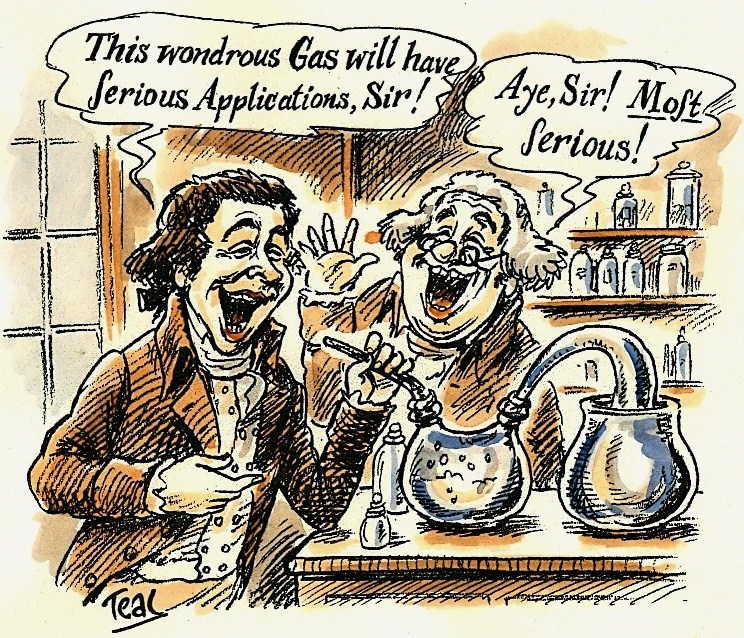
Illustration from https://www.huffingtonpost.co.uk/adrian-teal/hippie-crack-drug-of-choice-in-the-1790s_b_3749846.html
Here is how Peter Mark Roget (yes, of Roget’s Thesaurus) described his exposure to nitrous oxide:
“The first effect was that of making me vertiginous, and
producing a tingling sensation in my hands and feet; I
seemed to lose the sense of my own weight, and I imagined
I was sinking into the ground. I then felt a drowsiness
gradually steal upon me, and a disinclination to motion;
even the actions of inspiring and expiring were not performed without effort; and it also required some attention
of mind to keep my nostrils closed with my fingers. I
was gradually roused from this torpor by a kind of
delirium, which came on so rapidly that the air-bag
dropt from my hands and I suddenly lost sight of all the
objects around me, they being apparently obscured by
clouds, in which were many luminous points. I felt myself
totally incapable of speaking, and for some time lost all
consciousness of where I was or who was near me. My
whole frame felt as if violently agitated; I thought I
panted violently; my heart seemed to palpitate and every
artery to throb with violence; I felt a singing in my ears:
all the vital motions seemed to be irresistibly hurried on
as if their equilibrium had been destroyed and everything
was running headlong into confusion. My ideas succeeded
one another with extreme rapidity, thoughts rushed like a
torrent through my mind, as if their velocity had been
suddenly accelerated by the bursting of a barrier which
had before retained them in their natural and equable
course.” (Cartwright, 1972)
Although Humphry Davy wrote about the analgesic effect and potential surgical uses of N2O in 1800, it was not until 1844 when Dr. Horace Wells, a dentist in Hartford, Conn performed a series of experiments and demonstrations to show that nitrous oxide can serve as an anesthetic for dental procedures.
The use of nitrous oxide in the preparation of foods has been going on since the 1800’s, but the culinary arts have been revolutionized by the its application in various foods:
- It is mainly used as a propellant gas in aerosol products. A clear example of this is its use in whipped cream, in which the cartridges of this component are used to convert the cream into foam;
- Some of the dishes in which nitrous oxide is usually used are for the preparation of whipped cream and merengues of all kinds of colors and flavors. Also, many professionals often use it to prepare Belgian waffles and for pancakes, because it makes the dough more aerated ( https://gasesgrit.com/en/nitrous-oxide-applications/ );
Also:
- Nitrous oxide is considered an ideal food additive because it does not react during the process of use. It is very safe, even when used for the preparation of different dishes.
However, in February 2025, The Atlantic published an article written by Amogh Dimri entitled “The Illegal Drug at Every Corner Store” ( https://www.theatlantic.com/ideas/archive/2025/02/nitrous-oxide-drug-loophole/681532/ ). In it, he describes how people use nitrous oxide, described in the 1800’s as “laughing gas”, to get high, and its use is becoming increasingly popular: the illicit use of nitrous oxide has increased from 12.5 million over the age of 12 in 2018 to nearly 14 million in 2022. Perhaps the irony of it all is that the “buzz” or “high” only lasts a few seconds.
Apparently, there are two mechanisms by which people get high. The first is by hypoxia. If people are inhaling nitrous oxide from a cartridge, that means that they are NOT inhaling air, and THAT means that they are depriving themselves of necessary oxygen.
The other symptoms are associated with nitrous oxide’s tendency to deplete the body of vitamin B12. Vitamin B12 is crucial for the formation of red blood cells and for the proper functioning of neurons (nerve cells). Hence, the depletion of Vitamin B12 leads to serious disorders of the cardiovascular and nervous systems:
Cardiovascular system:
- Pernicious anemia
Nervous system:
- Progressive leg pain
- Toe numbness
- Difficulty walking due to pain
- Reduced toe sensation bilaterally
- Reduced reaction to pain
- Reduced proprioreception, i.e., reduced awareness of joint position in space
- Weak reflexes
- Unstable gait
These results of chronic nitrous oxide use are summarized in the following video:
Cartright, F.F. (1972). HUMPHRY DAVY’S RESEARCHES ON NITROUS OXIDE . British Journal of Anaesthesia 44:291-296.
Dimri, A. (2025). The Illegal Drug at Every Corner Store. ( https://www.theatlantic.com/ideas/archive/2025/02/nitrous-oxide-drug-loophole/681532/ )
P.S.:
 Addictions and Recovery