
Before we begin to look at the possible deleterious effects and risks associated with the ingestion of caffeine, I would like to suggest that we all pause for a moment of reverent reflection in honor of Khaldi, the goatherder who is credited with the discovery of coffee. (We will see that there is an important distinction between the chemical compound, caffeine, and coffee, the beverage produced from the roasted the coffee bean.)

Khaldi the Goatherder, from https://dreambeanscoffee.ie/history-of-coffee-kaldi-the-goatherd/
Legend has it that sometime around 850 AD, an Abyssinian (Ethiopian) goat herder named Kaldi was the first to recognize the potential of the beans that grew in the ancient coffee forests high on the Ethiopian plateau.
According to legend, Kaldi discovered coffee after observing that his previously “irreproachable” goats became so lively after eating the berries from a certain tree that they could not get to sleep at night. Kaldi tried the berries for himself and found that he was filled with energy and that his persistent gloom had lifted.
Kaldi informed the Islamic abbot of a nearby Sufi monastery, who made a drink from the berries and discovered that it kept him awake throughout the lengthy hours of nightly prayer. The abbot informed the other monks at the monastery about his discovery, and word of the energising berries spread quickly.
As news spread east and coffee reached the Arabian Peninsula, it embarked on a voyage that would eventually take these beans around the world.
Coffee in Yemeni Sufi Monastaries
The first credible evidence of coffee consumption originates from the 15th century in Yemeni Sufi monasteries.
Yemeni traders first brought coffee berries to Yemen from Ethiopia, and later began cultivating the plant. Sufi monks would consume coffee as a stimulant to help them stay awake during their meditation and prayers, according to Abd Al-Qadir al-Jaziri, who wrote an early report of the history of coffee.
“They drank it every Monday and Friday eve, putting it in a large vessel made of red clay. Their leader ladled it out with a small dipper and gave it to them to drink, passing it to the right, while they recited their usual formulas”
Coffee spreads through the Middle East and into Europe
Abd Al-Qadir al-Jaziri’s manuscript chronicles the spread of coffee from Yemen through Mecca and Medina, and then to Damascus, Baghdad, Cairo, and Constantinople, the Middle East’s most important trading centers at the time.
By the 1500s, several coffee shops had opened in Egypt, Syria, and Istanbul, spreading the beverage and its culture even further.
Following the spread of coffee shops in Africa and the Middle East, coffee expanded around the world, finding some of its biggest fans in European cities (https://dreambeanscoffee.ie/history-of-coffee-kaldi-the-goatherd/ ).
The active ingredient Kaldi’s goats awake was, whose chemical structure is shown here:

However, coffee has numerous other components, in addition to caffeine (https://www.toper.com/en/chemical-structure-of-coffee/):
| Component | Percent |
| Volatile aromatic substances | 0.1% |
| Alkalines | 0.8-2.5% |
| Acids | 4-5% |
| Proteins | 11% |
| Water | 10-13% |
| Lipids | 10-13% |
| Carbohydrates | 30-40% |
Caffeine itself has two principal modes of action in the brain:
- Caffeine is an antagonist of adenosine, a compound which acts on presynaptic cell in such a way that as the day wears on, the rate of presynaptic cell firing decreases. This gradual accumulation of adenosine is part of the daily sleep-inducing routine of the brain, the binding of caffeine to adenosine receptors thereby delays the sensation of fatigue. This effect is graphically shown in the following image;

- It also stimulates the release of dopamine in the reward circuit of the brain, so that there will be incentive to repeat the behavior.
Because of these effects, caffeine is generally considered a functional or beneficial drug because it can improve mood and alertness at low doses (Addicott, 2014). It is no wonder, therefore, that its use is ubiquitous.
Key findings from https://www.circana.com/intelligence/press-releases/2024/global-coffee-consumption-surges-circanas-insights-illuminate-key-trends/ include:
Global Beverage Comparison. Coffee outpaced both tea (+4%) and carbonated soft drinks (+3%) in terms of year-over-year servings growth, emphasizing its position as one of the fastest-growing beverage categories globally.
Growth Across Countries. Coffee servings, at over $36 billion, witnessed growth of 5% across nations, with 11 of the 12 monitored countries forecasted to grow. South Korea stands out as the only country that did not experience year-over-year growth in coffee servings.
Rising Popularity of Cold Coffee. While hot coffee remains the dominant choice globally, cold coffee has gained momentum, indicating a long-term growth trend. China led cold coffee consumption growth from 2019 to 2023, boasting a 20% compound annual growth rate, with cold servings constituting 33% of total coffee consumption.
According to https://www.rgare.com/knowledge-center/article/coffee-consumption-how-much-is-too-much-and-how-little-is-not-enough, “Globally, an estimated 2.25 BILLION (emphasis mine) cups of coffee are consumed every day.1 Roughly 80% of Americans drink coffee with 60% of the total population drinking coffee daily.”
In an earlier blog, I mentioned that prior to retiring, I was a biology professor. From 2000-2003, I worked with the Counseling Department in distributing a survey to incoming freshmen regarding which drugs they have used and how often. Here are the results of that survey:

Nearly all students imbibed caffeine, in either coffee, tea or soft drinks, every day.
Nonetheless, there are some individuals for whom the ingestion of caffeine, either in the form of a beverage or a tablet, will create far more problems than it solves, and they show evidence of either deleterious health effects, or of dependence, thereby justifying the creation of caffeine use disorder as a condition for further study:

Physiological effects of ingesting coffee (Chou, 1992):
- Disruption of sleep: Ingesting caffeine 30 to 60 minutes before sleep will increase sleep latency, decrease total sleep time, and substantially worsen subjective estimations of sleep quality;
- Cardiovascular effects: Immediately upon ingestion of coffee, blood pressure increases about 10 mm of mercury. The heart rate slows for about an hour, then increases for two to three hours thereafter. Tolerance to caffeine develops quickly, however;
- Endocrine and Metabolic Effects: Most, but not all studies, suggest that the ingestion of coffee leads to an increase in blood levels of both cholesterol and fatty acids. This is probably not a direct of caffeine, but rather another component in coffee;
- Gastrointestinal effects: In the distal colon, coffee stimulates motility and promotes defecation. As the same effect is seen with decaffeinated coffee, it is unlikely to be mediated by caffeine. As coffee decreases lower esophageal sphincter tone, it will promote gastroesophageal reflux;
- Psychological effects: It will cause nervousness, restless, anxiety and insomnia in sensitive individuals.
Caffeine Use Disorder
Caffeine use can result in the same types of pathological behaviors caused by alcohol, cocaine, opiates, or other drugs of abuse (Addicott, 2014).
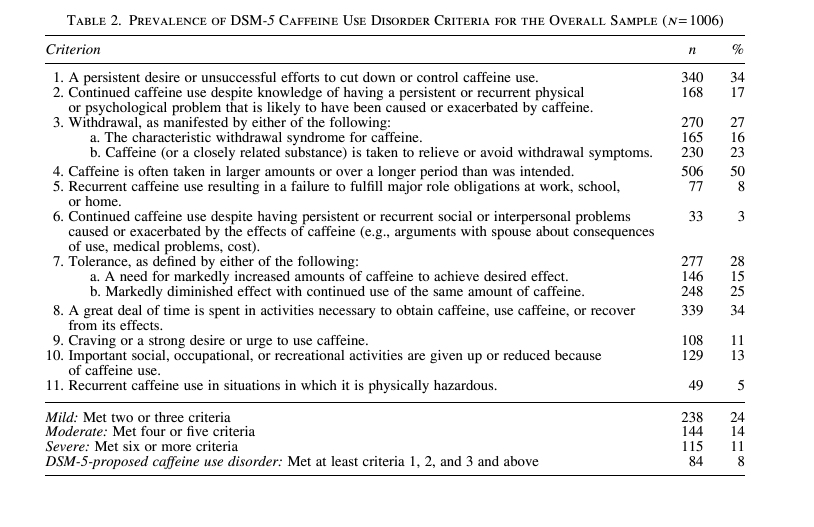
According to Sweeney, et. al. (2020), “DSM-5 proposed three necessary and sufficient diagnostic criteria for caffeine use disorder: (1) a persistent desire or unsuccessful efforts to cut down or control caffeine use; (2) continued caffeine use despite knowledge of having a persistent or recurrent physical or psychological problem that is likely to have been caused or exacerbated by caffeine; and (3) withdrawal, as manifested by the characteristic withdrawal syndrome for caffeine, or caffeine or a closely related substance is taken to relieve or avoid withdrawal symptoms. Six additional diagnostic criteria included in other substance use disorders, such as craving, tolerance, and taking caffeine in larger amounts or over a longer period of time than intended, were also included as markers for greater severity beyond the three key criteria for caffeine use disorder. To mitigate the potential for overdiagnosis given the ubiquity of caffeine consumption, the proposed diagnostic strategy for caffeine is more conservative than for other substances, which require fulfillment of any 2 of 11 diagnostic symptoms to meet criteria for mild substance use disorder.14,15 “
The following Table, extracted from Sweeney, et. al. (2020), shows the prevalence of DSM-V Caffeine Use Disorder in the sample of 1,006 individuals:
Wait, WAIT! There ARE benefits to imbibing coffee!

As shown in the figure shown above, we already know that drinking coffee has several benefits. However, in an article appearing in the March 9, 2025 issue of Food & Wine, Roxana Ehsani describes a study conducted in 2023 in which coffee drinkers had high levels of one specific bacteria strain, L. asaccharolyticus (Manghi, et. al., 2024). The results suggest that drinking coffee can have a positive effect on your gut by helping the growth of good bacteria — an exciting win for coffee drinkers (Ehsani, 2025).
The key components in coffee which contribute to the growth of L. asaccharolyticus are likely the polyphenols, including chlorogenic acid and quinic acid. Plamada and Vodnar (2021) suggest that polyphenols act like prebiotics, which feed and encourage the growth of beneficial gut bacteria.


P.S.: The Coffee song, featuring Frank Sinatra
Addicott, M.A. (2014). Caffeine Use Disorder: A Review of the Evidence and Future Implications. Curr Addict Rep 1(3):186-192. doi:10.1007/x40429-014-0024-9.
Chou, T. (1992). Wake up and smell the coffee–Caffeine, coffee, and the medical consequences. West J Med 1992 Nov:157-544-553.
Ehsani, R. (2025). Scientists Just Discovered a Huge Health Benefit of Coffee. Food & Wine, March 9, 2025.
Manghi, P.; Bhosle, A.; Wang, K.; Marconi, R.; Selma-Royo, M.; Ricci, L.; Asnicar, F.; Golzato, D.; Ma, W.; Hang, D.; Thompson, K.N.; Franzosa, E.A.; Nabinejad, A.; Tamburini, S.; Rimm, E.B.; Garrett, W.S.; Sun, Q, Chan, A.T.; Valles-Colomer, M.; Arumugam, M.; Bermingham, K.M.; Giordano, F.; Davies, R.; Hadjigeorgiou, G.; Wolf, J.; Strowig, T.; Berry, S.E.; Huttenhower, C.; Spector, T.D.; Segata, N., Song, M. (2024). Coffee consumption is associated with intestinal Lawsonibacter asaccharolyticus abundance and prevalence across multiple cohorts.Nature Microbiology | Volume 9 | December 2024 | 3120–3134. https://doi.org/10.1038/s41564-024-01858-9
Plamada, D.; Vodnar, D.C. (2021). Polyphenols—Gut Microbiota Interrelationship: A Transition to a New Generation of Prebiotics. Nutrients 2022, 14, 137. https://doi.org/10.3390/nu14010137
Sweeney, M.M.; Weaver, D.C.; Vincent, K.B.; Arria, A.A.; Griffiths, R.R.. (2020). Prevalence and Correlates of Caffeine Use Disorder Symptoms Among a United States Sample. Journal of Caffeine and Adenosine Research 10(1):4-11. doi 10.1089/caff.0020.
 Addictions and Recovery