
Normally, I try to publish a blog twice per month. However, researching and writing this particular blog took nearly 4 weeks, for which I apologize.
Sometime around 1939, Lou Lehr, comedian, writer and editor, coined the catchphrase “Monkeys is the cwaziest peoples.”

If you think about it, switching the nouns so that the catchphrase becomes “Peoples is the cwaziest monkeys”, we have a new, complete, and perhaps accurate statement. Perhaps that is because humans seem so capable of developing compulsive behaviors over just about anything. Hence, the subject is this blog is a relatively new phenomenon, social media addiction:
I. What’s the problem with reliance on social media?
Turkle (2015) addresses this question, and states that “overreliance on technology has led to an impoverishment of social skills, leaving individuals unable to engage in meaningful conversations because such skills are being sacrificed for constant connection, resulting in short-term attention and a decreased ability to retain information”, according to Kuss and Griffiths (2017).
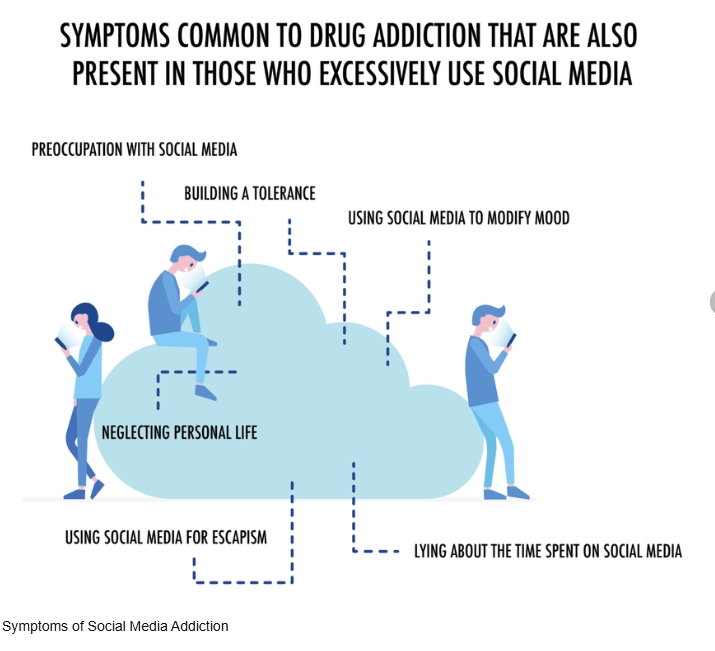
As a result, users start to feel “alone together”, in which they are isolated despite always being connected. The concomitant fear of missing out (FOMO) can drive some users to display symptoms and consequences that are usually associated with substance-related addictions.
Kuss and Griffiths (2017) make a distinction between the terms “social networking” and “social media”. While these two terms are often used interchangeably, they feel that there is a significant difference, where “social media” refers to “the web 2.0 capabilities of producing, sharing, and collaborating on tent online (i.e., user-generated content, implying a social element). Accordingly, social media use includes a wide range of social applications, such as collaborative projects, weblogs, content communities, social networking sites, virtual game worlds, and virtual social worlds.”
In contrast, “social networking” is focused on connecting people, so that engaging in social networking comprises a specific type of social media use. The most popular social networking sites are the following:
| Social networking site | # of users, as of 2025 |
| 3.07 billion (https://www.demandsage.com/facebook-statistics/) | |
| Snapchat | 850 million (https://www.demandsage.com/snapchat-users/) |
| 2 billion (https://www.demandsage.com/instagram-statistics/) | |
| Facebook messenger | 947 million (https://datareportal.com/essential-messenger-stats) |
| 2 billion (https://backlinko.com/whatsapp-users) |
II. What are the risk factors for developing social media addiction?
Cheng, et. al. (2021) present the results of a meta-analysis across 32 nations to determine the risk factors for developing social media addiction. They include age, type of society (individualistic vs. collectivist), and type of classification schemes.
A. Age
The need to belong is a very strong motivation for young individuals, who are now born into a world in which access to digital resources is routine. Perhaps not surprisingly, therefore, Cheng, et. al. (2021) found that the prevalence of social network addiction is inversely proportional to age:
| Group | Prevalence of social media addiction |
| Adolescent | 35% |
| University student | 23% |
| Community adult | 19% |
B. Type of Culture: Individualist vs. Collectivist
An important element pertains to how the individual perceives himself/herself as part of the culture around him/her. Individualism is used to describe those who are more independent, while collectivism often refers to people who are more receptive to group influence or culture.
The following overviews of collectivism and individualism are extracted from the paper Individualism versus Collectivism: Civil Affairs and the Clash of National Strategic Cultures, a publication of the Association of the United States Army, https://www.ausa.org/publications/individualism-versus-collectivism-civil-affairs-and-clash-national-strategic-cultures
| Characteristics of Collectivism (most common type of society in the world) | Characteristics of Individualism |
| The individual places the group’s goals ahead of personal goals, and success is measured by group achievement | Individualism can be seen as an “I” based culture full of frequently fluid environments |
| Societies are integrated into strong cohesive groups. | Its members are expected to look after themselves and possibly their immediate families. |
| In experimental situations, collectivists demonstrate more cooperative and less competitive behaviors than individualists. | Emphasis is on individual achievement and self reliance, where success is measured by individual achievement. |
| People in this group will be less accepting of risk. | Celebrate and reward risk-taking. |
| Collectivists tend to be less comfortable with direct confrontation. | Often brings with it a capitalist economic system that champions the free market, commercialization, and competition. |
With that as background information, cross-cultural comparisons reveal that the prevalence in collectivist nations is 31%, while the prevalence in individualist nations is 14%.
C. Protocol to determine threshold in questionnaires.
A number of scales, or tests, have been developed to determine the likelihood that an individual has social media addiction, including the Bergen Facebook Addiction Scale (BFAS), Bergen Social Media Addiction Scale (BSMAS). In each case, each answer is given a score, and a certain minimum score becomes the threshold by which a clinician will decide that an individual has social media addiction. The likelihood of a positive diagnosis, therefore, depends on who is doing the testing, and the threshold value that is used.
III. Digital Media Use and Adolescents’ Mental Health During the Covid -19 Pandemic
The outbreak of the Covid-19 pandemic resulted in a disruption of normal routines. Schools were closed, thereby necessitating distant learning. School closure alone contributed to anxiety, loneliness, stress, depressive symptoms, frustration in young people, and higher indiscipline and hyperactive conduct (Marciano, et. al., 2022). In response, adolescents alleviated the negative experiences of social distancing by spending more time online by using a number of platforms:
| Type of platform | % Adolescents who used this platform during lockdown of Covid-19 |
| Text messages | 83 |
| Phone calls | 72 |
| Social media and video chats | 66 |
| Instant messaging apps | 48 |
| e-mails | 37 |
This increased usage of social media did not necessarily result in increased well-being. Munasinghe, et. al. (2020) reported an association between augmented screen time with diminished time for physical activity, decreased happiness, and more fast food consumption.
Nonetheless, there were some positive consequences that came about from the use of digital media during the pandemic:
- “Social media was helpful in mitigating the feeling of loneliness during Covid-19, but only when a one-to-one or one-to-few communication was promoted;
- Online disclosure in the context of reciprocal friendship was found to relieve stress rather than a one-to-all peripheral disclosure on social media;
- Good online experiences like receiving positive feedback augmented social connection and reduced during the lockdown, and using social media as a humorous coping tool (i.e., using humor to cope with the pandemic increased happiness.“ (Marciano, et. al., 2022).
D. Conclusion
The compulsive use of social media is a real phenomenon, most prevalent among female adolescents. Nonetheless, social media bring both positive and negative experiences:
Data in table extracted from Eichenberg, et. al., (2024).
| Positive experiences associated with the use of social media | Negative experiences associated with the use of social media |
| *Provides entertainment *Combats boredom *Helps maintain contact with family *Provides a venue for music | *Induces comparison with others *Could lead to dissatisfaction with own body *Could lead to negative self-esteem in contact with influencers *Encounters insults and intrusive behavior |
P.S.: Lou Lehr, describing his habitat


Cheng, C.; Lau, Y-C; Chan, L.; Luk, J.W. (2021). Prevalence of social media addiction across 32 nations: Meta-analysis with subgroup analysis of classification schemes and cultural values. Addictive Behaviors 117. https://doi.org/10.1016/j.addbeh.2021.106845.
Eichenberg, C.; Schneider, R.; Rumpl. (2025). Social media addiction: associations with attachment style, mental distress, and personality. BMC Psychiatry 24:278. https://doi.org/10.10086/s12888-024-05709-z.
Kuss, D.J.; Griffiths, M.D. (2017). Social Networking Sites and Addiction: Ten Lessons Learned. International Journal of Environmental Research and Public Health 14:311-328. doi:10.3390/ijerph14030311.
Marciano, L.; Ostroumova, M.; Schulz, P.J.; Camerini, A-L. (2022). Digital Media Use and Adolescents’ Mental Health During the Covid-19 Pandemic: A Systematic Review and Meta-Analysis. Frontiers in Public Health 9:793868. doi: 10.3389/fpubh.2021.793868.
Munasinghe S, Sperandei S, Freebairn L, Conroy E, Jani H, Marjanovic S, et al. (2020). The impact of physical distancing policies during the COVID-19 pandemic on health and well-being among Australian adolescents. J Adolesc Health. 67:653–61. 10.1016/j.jadohealth.2020.08.008
Turkle, S. (2015). Reclaiming Conversation: The Power of Talk in A Digital Age; Penguin: New York, NY, USA.
 Addictions and Recovery