
This blog was prompted by a headline and article appearing in the 3 January 2025 edition of the Washington Post:
| Surgeon general urges cancer warning labels for alcohol and a reassessment of recommended limits of consumption. In an advisory, Vivek H. Murthy said alcohol consumption is the third leading preventable cause of cancer in the United States and contributes to 100,000 cancer cases and 20,000 related deaths each year. The warning label would need to be approved by Congress. It’s unclear how the next administration would handle the recommendation. |
The fact is that in 1988, the International Agency for Research on Cancer (IARC) classified alcoholic beverages as a group 1 carcinogen, which is its most severe classification (Rumgay, et. al., 2021).
Whether such a warning label will actually be approved is questionable. Nonetheless, there are significant correlations between alcohol consumption and the increased likelihood of developing cancer, as reflected by the following figures:

This second figure is adapted from Table 1 in Blot (1992):
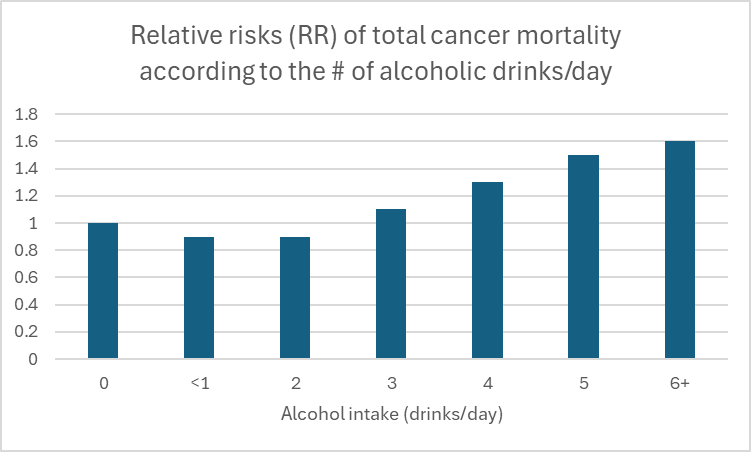
By definition, the relative risk for someone not drinking at all would be “0”, and you can see the upwards trend with increasing number of alcoholic drinks per day.
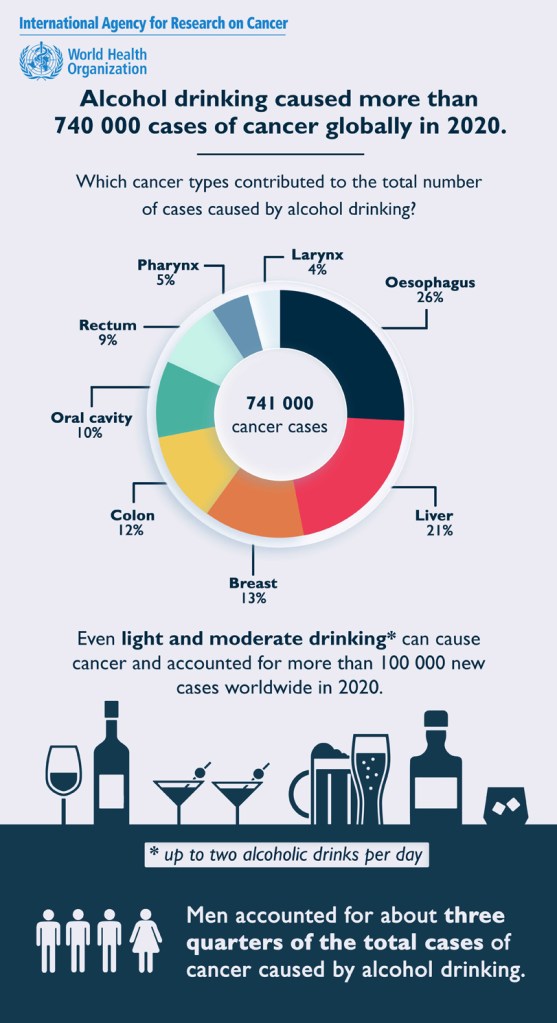
The net result is that alcohol drinking has caused 740,000 cases of cancer globally in 2020, according to data collected by the World Health Organization’s International Agency for Research on Cancer:
Mechanisms by which alcohol can cause cancer
The major ways in which alcohol can cause cancer are summarized in the following infographic.

Rumgay, et. al. (2021) go into more detail about these mechanisms:
- The production of acetaldehyde: Acetaldehyde is an early breakdown product in the metabolism of alcohol. It has a tendency to bind to DNA, which alters the physical shape of DNA and thereby will block DNA synthesis and repair. These binding areas, called DNA adducts, can induce multiple (deleterious) changes in DNA structure:
- Point mutations;
- Double-strand breaks; and
- Sister chromatid exchanges.
- Induction of oxidative stress: The metabolism of alcohol generates highly reactive oxygen species (ROS), including superoxide anion and hydrogen peroxide. These ROS often trigger changes in cell cycle behavior so that they will promote cell proliferation and and metastasis.
- Increased inflammation: Chronic alcohol consumption will recruit specific white blood cells (particularly monocytes and macrophages) which will secrete pro-inflammatory cytokines, such as tumor necrosis factor alpha and interleukins which activate oxidant-generating enzymes leading to further formation of ROS.
- Altered retinoid metabolism: Retinoids are important regulators against carcinogenesis, since they can induce cell growth, cell differentiation, and apoptosis, i.e. programmed cell death. Chronic alcohol consumption has been linked with decreased levels of retinoids in the liver.
- Changes to estrogen regulation: Alcohol might interfere with estrogen pathways by increasing increasing hormone levels important in breast carcinogenesis.
- Reduced function of the immune system: Alcohol acts negatively on the host immune system in a number of ways, all of which lead to compromised immune responses. First, alcohol can disrupt the production of proteins such as perforin which are enabling natural killer (NK) cells to target and destroy potentially cancerous cells. Alcohol can also block the release of NK cells from the bone marrow. Furthermore, alcohol may suppress T cell immune responses responsible for cell-mediated immunity, which is particularly important in the surveillance and destruction of cells turning cancerous.
- Liver cirrhosis: Chronic alcohol exposure is associated with reduced expression of the cytokine interferon-gamma which i an inhibitor liver fibrosis.


Blot, W.J. (1992). Alcohol and Cancer. Cancer Research (Supple.) 53: 2119s-2123s).
Rumgay, H.; Murphy, N.; Ferrari, P.; Soerjomataram, I. (2021). Alcohol and Cancer: Epidemiology and Biological Mechanisms. Nutrients 2021, 13, 3173. https://doi.org/10.3390/nu13093173 .
 Addictions and Recovery