
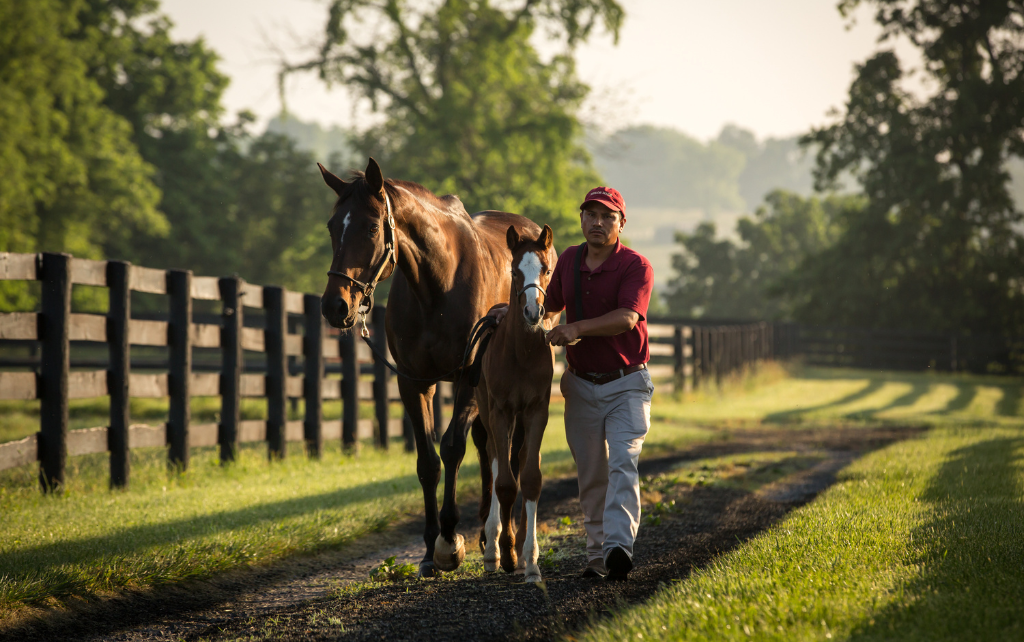

On May 3, 2025, the Washington Post published an article by Chuck Culpepper entitled “At a Kentucky farm, star racehorses help people fight a monster: Addiction” , which describes a program developed at Taylor Made Farm called Stable Recovery:
https://www.washingtonpost.com/sports/interactive/2025/stable-recovery-racehorses-addiction/
Stable Recovery provides a venue by which individuals who have had a LONG history of addiction and possibly incarceration can start their recovery by grooming, feeding, and taking care of race horses.
Frank Taylor, one of four brothers who own Taylor Made Farm, said the following about the program: “We’ve probably got about 60 men in housing and have graduated 110 men now,” Frank Taylor of Taylor Made said, “so it’s really starting to grow.”
The idea of creating such a program was met with considerable resistance from Frank’s brothers, Duncan, Ben, and Mark. Their response, again according to Frank was not just “No”, but “HELL, no.” Not to be turned down, he then said to them, ““‘Part of our mission statement, in the middle of our mission statement, is that we live out our Christian values by doing business. Right?’”
(My note: There is just something about suggesting the fear of the Lord that will convince people that maybe, just maybe, it’s time to do the right thing.)
The program operates like Alcoholics Anonymous, in which each morning starts with each man takes his turn speaking.
They start with 90 days of groom training and horse work that can lead to jobs that provide motivation, direction, and purpose to their lives.
There is something about the relationship between humans and horses that can change a man. One graduate of the program, Frank Bowman, said this: ““They say that dogs are man’s best friend, but I think if people really had the opportunity to have horses in their lives, I think horses would be man’s best friend. There’s just something about them that just takes your heart and mends it and builds it. Just how they can pick up on people’s emotions and understandings. They’re so perceptive toward people’s emotions. I’ve had guys tell me, ‘I was really sad today, and this horse just came up and put his head on my shoulder.’ … They’re probably the most emotionally intelligent creatures on this planet.”
Apparently, Taylor Made Farm has a LONG history of winning awards with their horses: https://taylormadefarm.com/, and now, they have a track record of changing lives.
______________________________________________
Other programs which assist in recovery
After reading this article, I decided to delve a little deeper into programs which promote recovery in this manner, so I went to pubmed.gov and keyed in “Relationship between humans and horses”, and received a short list of articles pertaining to programs like Stable Recovery to assist in the recovery of people with PTSD, addictions and other ailments:
Adolescents with Internet Gaming Disorder
Kang, et. al., (2018) report that equine-assisted activities and therapies (EAAT) improve the emotional status and attachment in adolescents with internet gaming disorder (IGD).
For this study, fifteen IGD adolescents with insecure attachment issues and 15 healthy comparison adolescents with secure attachment were recruited. After 7 days of equine-assisted activities and therapies (EAAT), Korean Experiences in Close Relationships Scale Revised version (K-ECRS) avoidance and anxiety scores improved in all adolescents. Functional connectivity (FC) from several parts of the brain increased in all participants as well. Furthermore, FC from the left amygdala to the left frontal orbital gyrus, as well as from the right amygdala to the right corpus callosum also increased.
Residents in Assisted Living Facilities
Assisted living is a popular option in the United States for individuals >65 years of age. The US Census Bureau expects that over 20% of the US population will be in this age bracket by 2030. The types of problems that residents in assisted living facilities may encounter include limited mobility, chronic health problems, such as heart disease and
diabetes, and/or diminished cognition.
Baldwin, et. al., (2021) describe a study involving residents in assisted living and memory care community, The Hacienda at the River, in Tucson, AZ, USA. The purpose of their study was to test the effectiveness of an on-site equine program at a senior living community in enhancing residents’ autonomic function, body awareness and social interactions with horses and other humans.
Inclusion criteria for human participants were:
- Age fifty-five or over;
- English-speaking;
- Must be a resident, family member of a resident, or working affiliate at The Hacienda at the River Assisted Living;
- Must verbally volunteer for the study;
- Consent form must be signed by themselves or by their designated power of attorney;
- Must be acquiescent to wearing HRV monitor around chest and/or earlobe;
- Have no known cardiac arrhythmias;
- No metal plates, pacemakers or similar devices in the body to prevent possible interference with heart rate monitors.
The horses used in this study were the following:
- Prissy: American Quarter Horse, mare, aged in 20 s, 15 hands;
- Joe: Certified Wild Horse, gelding, aged thirteen years, 13.1 hands;
- Herman: Arabian, gelding, aged eighteen years, 14.2 hands.
These horses had been working in a therapeutic capacity for at least two years and met standard of health and treatment for Professional Association of Therapeutic Horsemanship (PATH) International.
During exit interviews after interacting with a horse, participants reported increased feelings of connection to the horses. Interns reported that EAL provided an opportunity for social engagement with the horses, which became stronger with repeated sessions. Equine-assisted learning also encouraged social engagement with other participants and with the researchers. Many people in their 80 s, 90 s and 100 s are not familiar with identifying their personal feelings or speaking about them. The fact that participants became more willing to speak with the interns about their sensual experiences with the horses during subsequent weeks indicates that they were becoming more aware of their bodily sensations and less inhibited, confirming our hypothesis. Exit interviews overall indicated that the experience was very positive for
almost all participants.
Furthermore, two thirds of the horse–human pairs developed synchronized heart rate variability (HRV) peak frequencies during sessions. The synchronized HRV observation supports the hypothesis that “human and horse can be considered as 2 complex systems, and when they are in visual, olfactory or physical contact they get interacting through a coupling process”. In the exploratory research by Lanata, et al. (2016) HRV frequency coupling between the horse and each of the eleven humans increased when horse and human were in the same stall, and hence, in visual and olfactory contact, compared to when they were in neighboring stalls. Apparently, horses have the capacity to individually recognize a familiar person.
Post-deployment U.S. veterans diagnosed with post-traumatic stress disorder (PTSD) and/or traumatic brain injury (TBI)
According to Johnson, et. al., (2018), PTSD is marked by
four symptom domains: re-experiencing (i.e., flashbacks),
avoidance, changes in beliefs and feelings, and hyperarousal. It is estimated that 11%–20% from Operation Enduring Freedom/Operation Iraqi Freedom/Operation New
Dawn, 12% from the Gulf War, and 15% from the Vietnam
war (30% in their lifetime) experienced PTSD.
PTSD itself is associated with the following:
- Poor quality of life;
- Increased use of health care services;
- Increased incidence of comorbid physical and psychological conditions, such as:
- Depression
- Substance misuse, and
- Addiction to drugs and alcohol.
Men tend to show emotional withdrawal and numbing, while women tend to show higher arousal, lack of control, and self-persecution. For both men and women, greater combat exposure results in more PTSD symptoms and, as a result, poorer readjustment.
These maladaptive responses will lead to a snowballing effect as these veterans attempt to return to civilian life, with problems arising such as marital distress, domestic violence, poor parenting, and a variety of behavioral health problems for children.
Many veterans will not seek help because of the stigma associated with mental health issues.
One possible venue for the treatment of PTSD may be human-animal interaction, and specifically, interventions involving horses.
Therapeutic horseback riding (THR) is a form of therapy that has been applied for the treatment of adults and older adults with different types of physical and psychological disorders, including the following:
- Multiple sclerosis
- Spinal cord injury
- Spinal stenosis
- Mental retardation
- Traumatic brain injury (TBI)
In each of these cases, there has been improvement in psychological, physical and social domains. “Psychological improvements include increased self-efficacy, motivation,
and courage, reduced psychological distress, and enhanced psychological well-being. Social benefits include improved social involvement (Johnson, et. al., 2018).”
Twenty-nine veterans participated in the the study described by Johnson, et. al. (2018), to determine whether veterans diagnosed with PTSD and or TBI would benefit from a therapeutic horseback riding program. Fifteen were assigned to a group that immediately started riding, while the others were put onto a wait-list control group, in which they experienced a 6-week waiting period. The wait-list control group began riding after 6 weeks of serving in the control group. When they converted to the treatment group, another set of baseline data was collected from them. Inclusion criteria included the following:
Other inclusion criteria were: age 18 years or older, no
longer in active military service (including reserves),
weight of 220 pounds or less, able to walk at least 25 ft
without the assistance of a person, and willing to interact
with and ride a horse.
- Age 18 years or older;
- No longer in active military service (including reserves);
- Weight of 220 pounds or less. (The weight limit of veterans in our
inclusion criteria was determined because the horses
could not accommodate heavier participants); - Able to walk at least 25 feet without the assistant of a person;
- Willing to interact with and ride a horse.
As you may surmise, the results of their study were encouraging:
- In the riding group data, while riding, veterans had
statistically significant decreases in their PTSD symptoms over the 6-week THR program. Symptoms significantly decreased between baseline and week 3 and between week 3 and week 6
of riding; - The veterans in this study expressed that the interpersonal interactions with study staff was one of the benefits of participation;
- The benefit was greater among those individuals who were assigned to the riding group at the outset, rather than those who had to wait
Again, a quote from Johnson, et. al. (2018):
“On the most fundamental physiologic level, research
has provided evidence that basic human emotions rooted
in the limbic system generally do not occur in opposition
to each other (e.g., fear and affiliation, panic and play)
[70]. In our study, veterans interacted with their horses
(by grooming, tacking, rewarding-some brought carrots
for their horse) and spent quiet time talking with their
horses. Other investigators have reported that human
touch is an essential factor in the creation of human-horse
affiliations [71]. This affiliation may increase the likelihood
of veterans experiencing a reduction in anxiety, which is a
central component of PTSD.”
One such program for veterans is located at Magnolia Ranch Recovery, located in Pulaski, TN — https://magnoliaranchrecovery.com/addicted-veterans-and-equine-therapy-restoring-our-heroes/
Here is what they say about the benefits of Equine Therapy:
Emotional Regulation: Interacting with horses can help individuals regulate their emotions and reduce stress and anxiety. Horses are sensitive animals that can mirror and respond to human emotions, providing immediate feedback and enabling individuals to become more aware of their emotional states. Through activities such as grooming and leading horses, individuals can learn to manage their emotions, develop self-control, and improve emotional regulation skills.
Building Trust and Confidence: Working with horses can help individuals build trust and confidence in themselves and others. Horses are non-judgmental beings that respond to authentic communication and behavior, encouraging individuals to develop trust-based relationships. By successfully communicating with and gaining the trust of a horse, individuals can boost their self-esteem, improve their self-confidence, and strengthen their interpersonal skills.
Enhancing Communication Skills: Equine therapy can enhance communication skills by requiring individuals to effectively communicate with the horses and the therapy team. Horses communicate through body language, tone of voice, and energy, teaching individuals the importance of clear and assertive communication. Through practicing communication techniques with horses, individuals can improve their verbal and non-verbal communication skills, which can translate into better communication in their personal and professional relationships.
Stress Reduction: Spending time with horses in a peaceful and natural environment can help individuals reduce stress and promote relaxation. The rhythmic movement of riding a horse, the calming presence of the animals, and the serene surroundings of a stable or pasture can have a soothing effect on individuals’ nervous systems. Engaging in equine therapy activities can provide a therapeutic escape from daily stressors and contribute to overall emotional well-being.
Physical Benefits: In addition to the emotional and psychological benefits, equine therapy can also offer physical advantages. Activities such as grooming, leading, and riding horses require physical exertion and coordination, leading to improved balance, strength, and motor skills. For individuals with physical disabilities or injuries, working with horses can serve as a form of physical therapy and rehabilitation, promoting physical health and well-being.

(Image from https://magnoliaranchrecovery.com/addicted-veterans-and-equine-therapy-restoring-our-heroes/ .
P.S.:


Baldwin, A.L.; Rector, B.K.; Alden, A.C. (2021). Physiological and Behavioral Benefits for People and Horses during Guided Interactions at an Assisted Living Residence. Behav.
Sci. 2021, 11, 129. https://doi.org/10.3390/bs11100129
Johnson, R.A.; Albright, D.L.; Marzolf, M.R.; Bibbo, J.L.; Yaglom, H.D.; Crowder, S.M.; Carlisle, G.K.; Willard, A.; Russell, C.L.; Grindler, K.; Osterlind, S.; Wassman, M.; Harms, N. (2018). Effects of therapeutic horseback riding on
post-traumatic stress disorder in military
veterans. Military Medical Research (2018) 5:3
DOI 10.1186/s40779-018-0149-6
Kang, K.D.; Jung, T.W.; Park, I.H.; Han, D.H. (2018). Effects of Equine-Assisted Activities and Therapies on the Affective Network of Adolescents with Internet Gaming Disorder. The Journal of Alternative and Complementary Medicine 24. https://doi.org/10.1089/acm.2017.0416
Lanata, A.; Guidi, A.; Valenza, G.; Baragli, P.; Scilingo, E.P. (2016). Quantitative heartbeat coupling measures in human-horse interaction. Annu. Int. Conf. IEEE Eng. Med. Biol. Soc. 2016, 2016, 2696–2699.
 Addictions and Recovery