

Image from https://britishcbd.net/5-best-cbd-vape-juice-brands-2023/
In a previous blog,https://addictionsandrecoverydotblog.com/2024/01/25/18-nicotine-iv-vaping-as-a-harm-reduction-or-smoking-cessation-strategy/, we looked at vaping as a means of harm reduction when using nicotine. Vaping has become a means by which adolescents can take in delta-9-tetrahydrocannabinol, cannabidiol, and synthetic cannabinoids.
In this post, we will look at vaping cannabidiol, or CBD.
I. The advantages of vaping cannabidiol
In a previous blog, , we looked at the therapeutic properties of cannabinoids, and the relevant table from that blog is shown below.
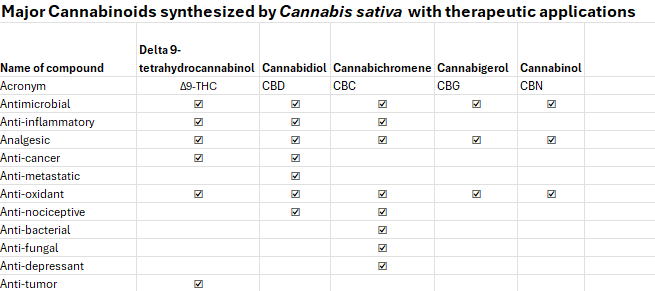
It should come as no surprise, therefore, that the website https://hempandbarrel.com/vaping-cbd-oil/ lists 5 advantages to using cannabidiol:
- Pain management:
- Anxiety and Stress Reduction:
- Improved Sleep:
- Neuroprotective Properties:
- Anti-Inflammatory Effects:
This website, and others like it, go further to explain the advantages of vaping cannabidiol ( https://cbdmagic.co/pros-and-cons-of-vaping-cbd/ ):
- Fast Absorption and Quick Effects: By inhaling CBD, it bypasses the digestive system and enters the bloodstream through the lungs. Ingesting CBD via edibles and oils would take up to an hour to take effect, while inhaling will provide relief in minutes;
- High Bioavailability: Vaping is a much more efficient way of acquiring CBD than by digesting it;
- Convenient and Discreet: Vape pens are small, portable, and easy to use, and to not generate a strong, lingering odor like cannabis. Thus, users can vape in public without drawing undue attention;
- Customizable Dosage and Flavor Options: Vaping allows precise adjustment of dosages by the user. Furthermore, AND PERHAPS MORE IMPORTANT OF ALL, CBD vape juices come in a plethora of flavors, “from fruity blends to classic mind, making the experience more enjoyable for those who dislike the early taste of natural CBD oil.”

Image from https://jm-wholesale.co.uk/products/why-so-cbd-1000mg-cbd-e-liquid-60ml-buy-1-get-1-free . Who can resist this?
II. Who is vaping cannabinoids? The annual National Youth Tobacco Survey (NYTS) provides interesting information about the vaping habits of U.S. middle- and high-school students.
Dai, et. al. (2023) conducted a cross-sectional study of 28,291 adolescents in middle and high schools, age range 11-18 years, in the United States. They found the following:
- Among 2448 current e-cigarette users, 21.3% reported any past-month vaping of CBD;
- Among 25,091 noncurrent e-cigarette users, 1.2% reported currently vaping CBD;
- The prevalence of vaping CBD was particularly high among Hispanic and sexual minority (gay, lesbian, or bisexual).
Furthermore, they state that adolescent cannabis vaping has increased in recent years, with 4.2%, 10.3%, and 14.8% of US eighth-, tenth-, and twelfth-grade students reporting currently (past 30-day) vaping cannabis in 2022 (Johnston, et. al., 2023).
Chung, et. al. (2025) studied 3 National Youth Tobacco Survey waves of U.S. middle- and high-school students for the years 2021 (n=20,128), 2022 (n=27,965), and 2023 (n=21,806), totaling 69,899 to determine the prevalence of current adolescent vaping of delta-9-tetrahydrocannabinol (THC), cannabidiol (CBD), and synthetic cannabinoids (SCs). Students were asked whether they had vaped any of these cannabinoids in the past 30 days. Investigators found the following trends in 30-day prevalence patterns:
| Year | THC | CBD | SCs |
| 2021 | 5.5% | 2.6% | 1.1% |
| 2022 | 8.4% | 2.9% | 1.3% |
| 2023 | 7.4% | 2.9% | 1.8% |
Liu, et. al. (2023) went a step further by examining the vaping of cannabis, cannabidiol, and synthetic cannabis habits by U.S. sexual Minority Youths. The following data, showing past 30-day vaping, are extracted from their Table 1:
| Canna-binoid | Hetero-sexual % | Gay and lesbian % | Bi-sexual % | Not sure % | Statis-tical signi-ficance |
| Mari-juana | 7.2 | 14.4 | 12.8 | 0.9 | <.001 |
| CBD or CBD oils | 2.2 | 6.4 | 4.8 | 2.3 | <.001 |
| Syn-thetic mari-juana or canna-binoids | 1.0 | 4.4 | 2.1 | 1.1 | <.001 |
The data show, therefore, that significantly more sexual minority youth are vaping cannabinoids than are heterosexual youth. Why? There is ample evidence to show that minority stress, e.g. from sexual orientation-based discrimination, is associated with youth substance use (Blosnick, et. al., 2013), and Liu et. al. (2025) suggest that this may account for vaping cannabis.
III. What are the negative consequences of vaping cannabinoids?
- THC: THC is the psychoactive component of cannabis, so the use can lead to cannabis use disorder, addiction, depression, loss of coordination, and hallucinations;
- CBD: In vivo inhalation studies in mice and in vitro cytotoxicity experiments with human cells show that vaping of CBD induces “a potent inflammatory response and leads to more pathological changes associated with lung injury than vaping of nicotine (Bhat, et. al, 2023);
- Synthetic cannabinoids: One of the nicknames which synthetic cannabinoids have in the United Kingdom has is “Spice”. According to an Internet resource, https://www.publichealth.hscni.net/sites/default/files/2025-03/Vaping%20A6%208pp%20Leaflet%2003_25%20final.pdf, “Spice can also cause serious side effects like breathing problems, heart attacks and seizures. Other side effects include dizziness, vomiting, heart-racing, sweating, anxiety and paranoia. People who already have an existing mental health problem may find that synthetic cannabinoids such as spice can make these problems worse.”
P.S.:
Bhat, T.A.; Kalathil, S.G.; Goniewicz, M.L.; Hutson, A.; Thanavala, Y. (2023). Not all vaping is the same: differential pulmonary effects of vaping cannabidiol versus nicotine. Thorax 78:922-932. doi:10.1136/thoraxjnl-2022-218743.
Blosnich, J.; Lee, J.G.L.; Horn, K. (2013). A systematic review of the aetiology of tobacco disparities for sexual minorities. Tob Control. 22(2):66-73. doi:10.1136/tobaccocontrol-2011-050181.
Chung, J.; Lim, C.C.W.; Stjepanovic, D.; Hall, W.; Connor, J.P.; Chan, G.C.K. (2025). Adolescent Cannabis Vaping Trends (2021-2023): Delta-9-Tetrahydrocannabinol, Cannabidiol, and Synthetic Cannabinoids. American Journal of Preventive Medicine 2025;000(000):107655.
Dai, H.D.; Subramanian, R.; Mahroke, A.; Wang, M. (2023). Prevalance and Factors Associated With Vaping Cannabidiol Among US Adolescents. JAMA Network Open 6(8).doi:10.10001/jamanetworkopen.2023.29167.
Johnston LD, Miech RA, Patrick ME, O’Malley PM, Schulenberg JE, Bachman JG. (2023). Monitoring the Future National Survey Results on Drug Use, 1975-2022: Overview, Key Findings on Adolescent Drug Use. Institute for Social
Research.
Liu, J.; Tan, A.S.L.; Lee, J. (2023). Vaping of Cannabis, Cannabididiol, and Synthetic Cannabis Among US Sexual Minority Youths. JAMA Network Open 6(8):e-2329041: doi 10.1001/jamanetworkopen.2023.29041.


 Addictions and Recovery