
I. First, a brief history of syringes and hypodermic needles.
Although syringes have been used for two thousand years, the first hypodermic needle was not invented until the mid-1800’s. Craig (2018) states that the first hypodermic syringe was invented by Francis Rynd in Dublin in 1844, annealed the edges of a folded flat strip of steel to make a tube. He then drew this tube through increasingly narrower dies whilst maintaining the patency of the needle. The beveled point was cut and ground, and then the hub is added with its variety of fittings and locks. In 1853, Alexander Wood, a Scottish physician, and Charles Gabriel Pravaz, a French surgeon, were first to develop a device recognizable as today’s hypodermic syringe. Unfortunately, Charles Gabriel Pravaz died shortly afterward, so Alexander Wood in Edinburgh has received more credit for doing so https://thepolyphony.org/2020/06/06/the-hypodermic-syringe/ .
Alexander Wood’s first use of a syringe was to inject morphine into patients with severe, localized pain, a technique he called “subcutaneous injection“. His first patient was an 80-year-old woman who suffered from a form of neuralgia. Concerned only with relieving localized pain, he injected her with 20 drops of vinous solution of morphia (morphine dissolved in sherry wine) at a point in her shoulder where the pain was most severe. She subsequently went into a deep sleep but later recovered (https://www.bbc.com/news/uk-scotland-55676034) .
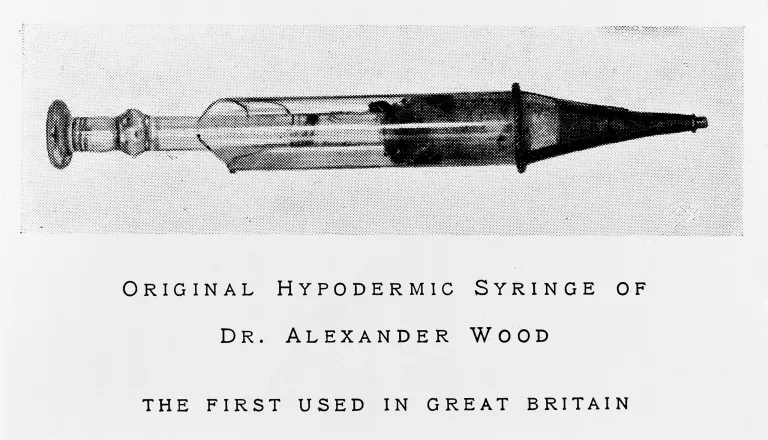
Original hypodermic syringe of Dr. Alexander Wood. The first used in Great Britain. Credit: Wellcome Collection. Attribution 4.0 International (CC BY 4.0)
My opinion is that if the first use of a hypodermic needle was to administer morphine, then it would not take very long for doctors to note morphine addictions. The following is a quote from https://anaesthetists.org/Home/Heritage-centre/Learning/Heritage-Centre-blog-celebrating-75-years-of-Anaesthesia/Fatal-Attraction-A-Brief-History-of-Morphine-a-blog-post-from-the-Heritage-Centre:
“However, critical voices emerged even in the initial wave of enthusiasm. Already in the 1860s, Felix von Niemeyer, though conceding that “the introduction of hypodermic injections was a great event, and…an immense advance in treatment [for neuralgia],” warned that he clearly observed it creating addiction in his patients, who began “to feel an absolute need of the injections.” The following decade saw more and more practitioners come forward with their own observations. Physician Clifford Allbutt, who had effusively and publicly praised hypodermic morphine only a few months before, now reported its injurious effects on his patients: “They seem as far from cure as they ever were, they all find relief in the incessant use of the syringe, and they all declare that without the syringe life would be insupportable.”
II. By the 1930s, the only infectious diseases known to be transmitted by blood transfusion were malaria and syphilis (Farrugia, 2023).
The constellation of diseases that can be transmitted by either blood transfusion or by the use of unclean syringes and needles now includes viral diseases. The following chart shows the percentage of viral infections in the United States which can be attributed to injection drug use:
| Virus | Percent of infections due to injection drug use | Notes |
| HIV | 7 | Antiretroviral drugs decrease complications from the disease and reduces the risk of transmitting HIV to others |
| Hepatitis C | 50 | Most cases lead to chronic liver disease, which may lead to liver failure, cirrhosis, and/or liver cancer. Antiviral drugs have a cure rate of 95% |
| Hepatitis B | 25 | 2-6% of those infected with hepatitis B develop chronic hepatitis B infection, which can lead to cirrhosis, liver cancer, and/or liver failure. No vaccines are available for hepatitis B. |
| Hepatitis D | Exact rates are unknown. Often associated with hepatitis B. Dual infections lead to accelerated development of cirrhosis, liver cancer, and liver-related deaths. | No vaccines are available for hepatitis D. |
| Hepatitis A | 33, according to the Centers for Disease Control and Prevention | Most recover, but 1% of patients develop severe liver failure. There are no medications to treat hepatitis A. |
Data in table adapted from Borelli (2025).
III. The drugs that are injected now.
While morphine was the first drug to be administered via injection, there are now quite a few more drugs that are administered via intravenous injection. This list appears as part of https://greenhousetreatment.com/iv-use/
- Heroin and prescription opioids
- Cocaine
- Amphetamine
- Methamphetamine
- PCP
- Synthetic cathinones (commonly called “bath salts”)
- Ketamine
- Anabolic steroids
In a study published in November, 2025, D’Adamo, et. al. (2025), showed trends in the United States of an increase in the number of individuals injecting methamphetamine and/or opioids:
- “The prevalence of injecting methamphetamine but not opioids significantly increased from 14.3% (n = 8367) in 2012 to 31.4% (n = 10 389) in 2023 (prevalence difference, 17.1 [95% CI, 16.6-17.7]);
- The prevalence of injecting both methamphetamine and opioids significantly increased from 4.1% (n = 2397) in 2012 to 12.2% (n = 4029) in 2023 (prevalence difference, 8.1 [95% CI, 7.7-8.5]);
- Significant increases in both outcomes were observed in nearly all age, sex, and race and ethnicity groups and Census regions/divisions examined;
- Notably, the prevalence of injecting methamphetamine but not opioids increased by more than 25 percentage points among those aged 18 to 24 years and among those in the East North Central and East South Central divisions.”
P.S.: Lyrics to “Sister Morphine” by the Rolling Stones
[Verse 1]
Here I lie in my hospital bed
Tell me, Sister Morphine, when are you coming ‘round again?
Oh, and I don’t think I can wait that long
Oh, you see that I’m not that strong
[Verse 2]
The scream of the ambulance is sounding in my ears
Tell me, Sister Morphine, how long have I been lying here?
What am I doing in this place?
Why does the doctor have no face?
Oh, I can’t crawl across the floor
Ah, can’t you see, Sister Morphine, I’m trying to score?
[Instrumental Break]
Hey
[Verse 3]
Well, it just goes to show things are not what they seem
Please, Sister Morphine, turn my nightmare into dreams
Oh, can’t you see I’m fading fast?
And that this shot will be my last?
[Verse 4]
Sweet Cousin Cocaine, lay your cool, cool hand on my head
Ah, come on, Sister Morphine, you better make up my bed
Because you know, and I know, in the morning I’ll be dead
Yeah, and you can sit around, yeah, and you can watch
All the clean white sheets stained red
P.P.S.:
Borelli, C. (2025). Viral Infections Related to Injection Drug Use. JAMA, Published online September 10, 2025, doi:10.1001/jama.2025.14271.
D’Adamo, A.; Genberg, B.L.; Krawczyk, N.; Rudolph, J.E.; Mehta, S.H.; Tobian, A.A.R.; Patel, E.U. (2025). Trends in Injecting Methamphetamine and Opioids Among People Who Inject Drugs in the US. JAMA, Published Online: November 26, 2025. doi: 10.1001/jama.2025.2034.
Farrugia, A. (2023). The Evolution of the Safety of Plasma Products from Pathogen Transmission—A Continuing Narrative. Pathogens 2023, 12(2), 318; https://doi.org/10.3390/pathogens12020318


 Addictions and Recovery