
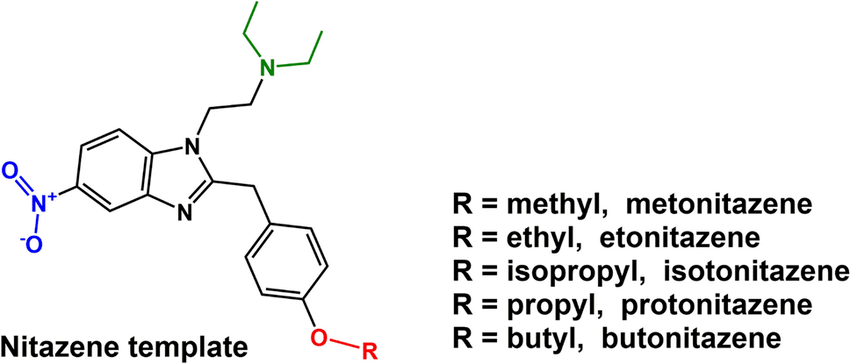
At first, public health officials were concerned that heroin and other opiates were being contaminated with fentanyl. That concern has been shadowed by a relatively new class of drugs, the nitazenes.
Nitazenes are potent drugs
First synthesized in the 1950’s, nitazenes now constitute a very potent group of opioids, which bind with the same receptors as morphine, even though they have very different chemical structures.
Nitazenes were never approved for medical use, perhaps because of their potency:
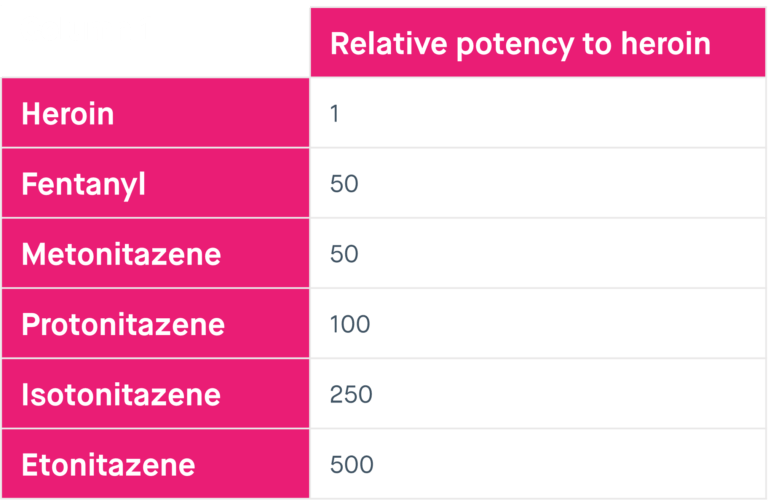
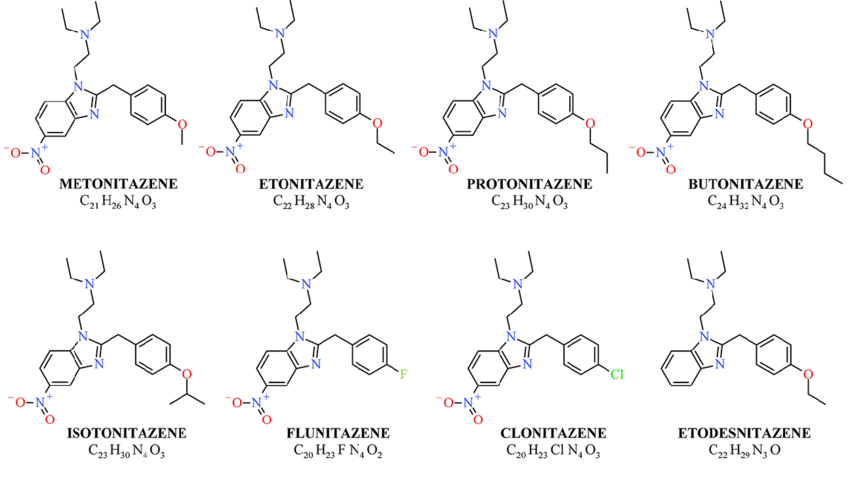
Their potency, in turn, is related to their affinity to the mu receptors in the brain, to which opioids attach and exert their multiple effects:
- Analgesia (loss of pain);
- Euphoria (A sense of intense joy or happiness that is beyond what would be expected under the given circumstances);
- Sedation (A state of calmness, relaxation, or sleepiness caused by certain drugs)
- Respiratory depression
Given the potency of nitazenes, the risks of opioid toxicity become very real:
- Respiratory distress
- Confusion
- Nausea
- Vomiting
- Coma
- Death
Because of this potency, nitazenes are considered not to have any medical application, and therefore are illegal to produce or possess. By definition, this includes Schedule 1 drugs in the United States and Class A drugs in Great Britain.
Prior to 2019, there were very few reported deaths attributed to nitazene use. However, beginning in 2019, deaths caused by nitazenes have been identified on every continent, including North America, South America, Asia and Oceania (Inter-American Drug Abuse Control Commission, 2024).
Although some people seek nitazenes to experience opioid effects, nitazene consumption frequently occurs unintentionally, as nitazenes are often mixed with or counterfeited as other drugs, e.g. heroin, fentanyl, or benzodiazepines.
Nitazenes are found in pills, powders and sprays, and can be ingested in a number of ways:
- Intravenously
- Intranasally
- Orally
- Sublingually
- By inhalation (Vaping)
Since nitazenes are still not detected by the standard analyses employed by most jurisdictions following overdose events, the number of fatality cases that are reported may severely underestimate the true effect of nitazenes on society. For example, Ujváry et. al. (2021) report that nitazines were involved in at least 200 overdose deaths in Europe and North America from 2020 to 2021, while Montanari et. al. (2022) report 93 fatalities from several case reports in 2022, mostly from the United States.
Kozell, et. al. (2024) tested the affinity of 19 nitazene species for mu, Kappa and Delta opioid receptors. They found that only two (metodesnitzene and flunitazine) had lower affinities to the mu receptor than fentanyl. This means that as a group, nitazenes are very high affinity, high potency, and high efficacy compounds, and therefore, their pharmacology suggests high potential for harm.
Treatment
I refer the reader to https://www.abbeycarefoundation.com/nitazenes/detox/ , the website representing the Abbeycare Foundation in Scotland, for details about treatment
Inter-American Drug Abuse Control Commission (2024). Information Bulletin: The Emergence of Nitazenes in The Americas. OAS. Official records; OEA/Ser.L.
Kozell, L.B.; Eshleman, A.J.; Wolfrum, K.M.; Swanson, T.L.; Bloom, S.H.; Benware, S.; Schmachtenberg, J.L.; Schutzer, K.A.; Schutzer, W.E.; Janowski, A.; Abbas, A.I. (2024). Pharmacologic Characterization of Substituted Nitazenes at mu, kappa, and delta Opioid Receptors Suggests High Potential for Toxicity. The Journal of Pharmacology and Experimental Therapeutics 389:219-228. dx.doi.org/10.1124/jpet.123.002052.
Montanari, E., Madeo, G., Pichini, S., Busardò,
F. P., & Carlier, J. (2022). Acute intoxications and
fatalities associated with benzimidazole opioid
(nitazene analog) use: A systematic review.
Therapeutic Drug Monitoring, 44(4), 494–510
Ujváry, I., Christie, R., Evans-Brown, M., Gallegos,
A., Jorge, R., de Morais, J., & Sedefov, R. (2021). Dark
classics in chemical neuroscience: Etonitazene
and related benzimidazoles. ACS Chemical
Neuroscience, 12(7), 1072–1092.
 Addictions and Recovery