
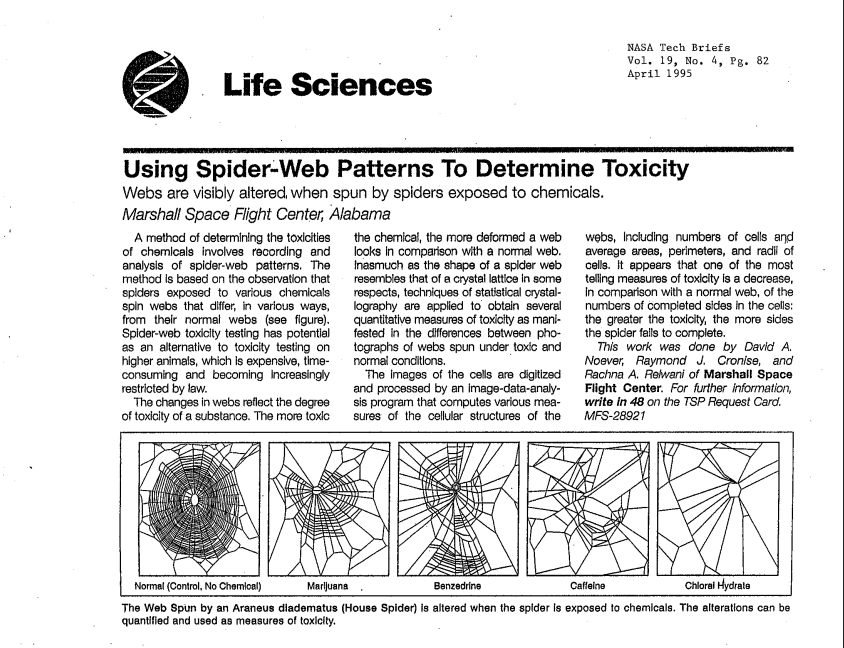
I’m NOT making this up! See?
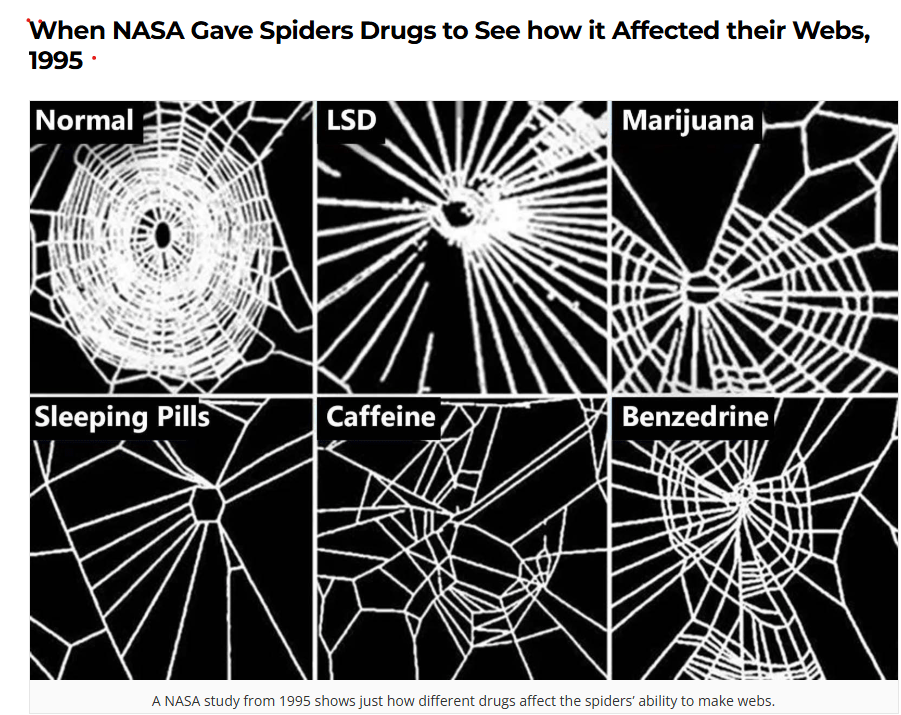
Above image extracted from https://rarehistoricalphotos.com/nasa-spiders-drugs-experiment/
Actually, research on the effects of psychoactive drugs on web-spinning spiders was initiated decades earlier by Peter Witt and colleagues at the University of Tubingen (1954).
Colleagues of the Zoology Department at the University of Tubingen were getting frustrated trying to record a spider building its web. They inquired Dr. Witt, of the Pharmacology Department, if he could supply them with a drug which would stimulate the spider to spin a web at a more convenient time for the investigators. He, in turn, gave them several drugs to try on the spiders, and while his colleagues were disappointed that the drugs did not accelerate the spiders’ performance, Witt was elated to find that the drugs caused the spiders to construct webs of strange shapes.
So here was a convenient way to test how psychoactive drugs may alter behavior.
Early experiments with psychoactive drugs were carried out with females of the species Zilla x-notata or Zygiella x-notata, the Missing-sector Orb-weaver:
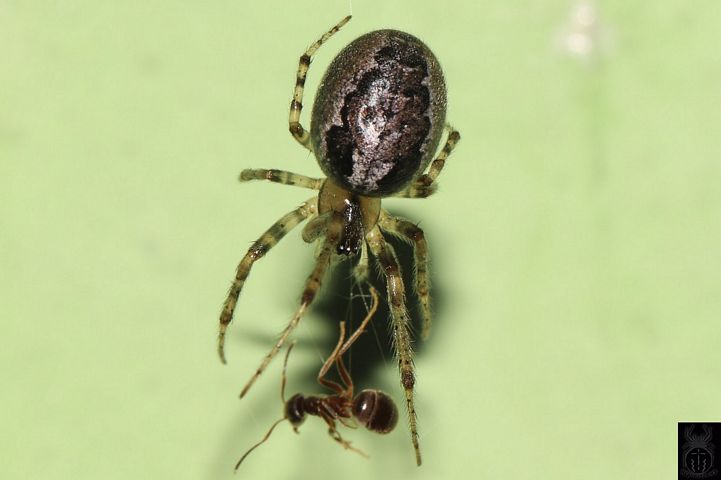
Photograph from https://www.araneidae.cz/x-notata.html, photo: Kryštof Rückl.
Most of the work, however, was done with female Araneus diadematus, the Cross spider.
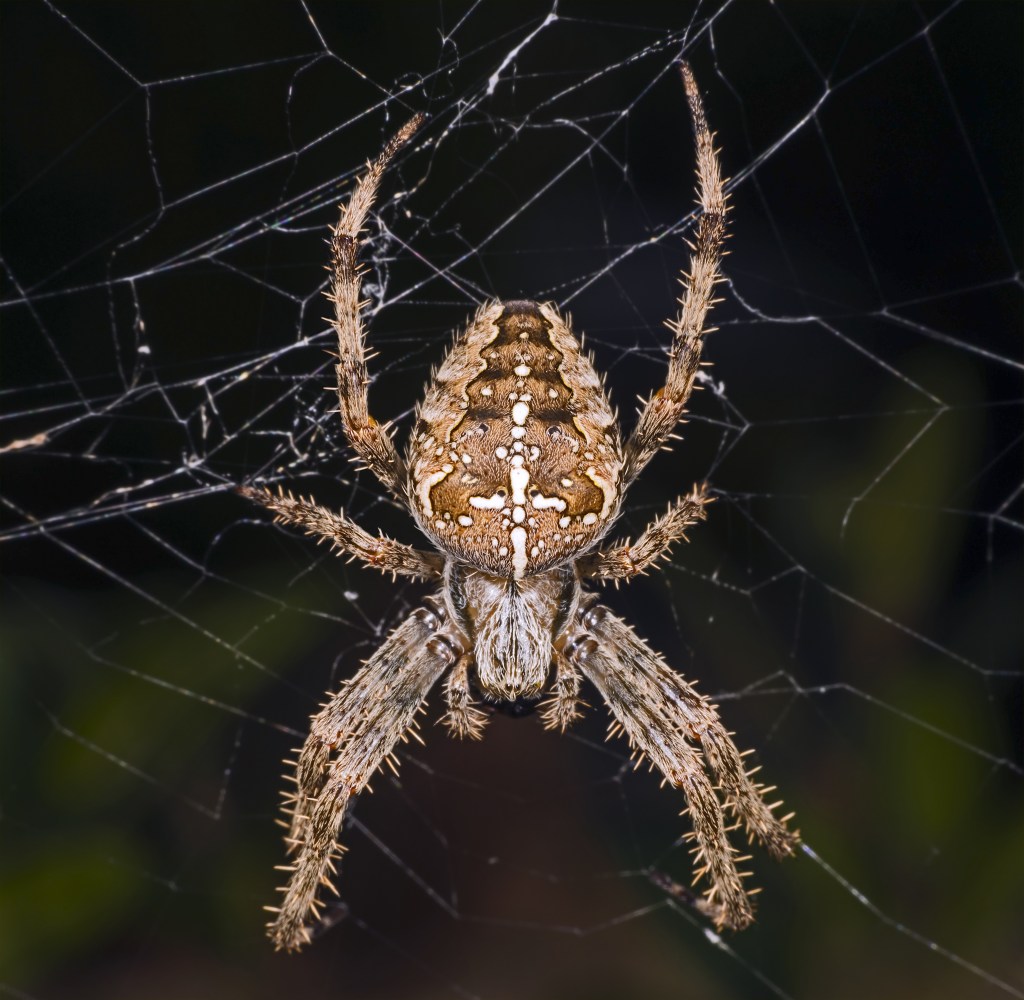
Under normal circumstances, each web is constructed the same. The spider begins by selecting a window or some other frame as the support. It attaches an end of a thread to one point on the frame, and moves horizontally for a distance until it has reached a second point. She then moves back to the center of this initial thread to spin a new thread perpendicularly from the middle of it, forming a T.
She then spins radial spokes from the center to the outer framework, after which she builds cross-members.
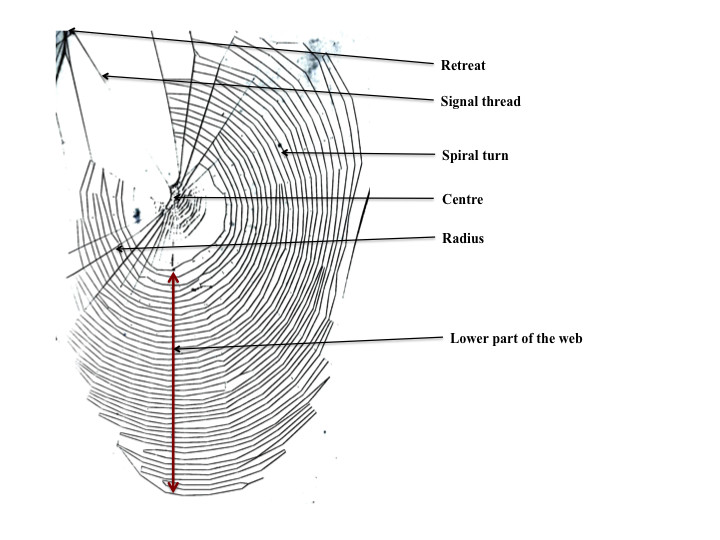
Illustration from Pasquet and Marchal (2014). Structural elements are indicated.
Witt discovered that it is mainly in the spinning of the spiral that spiders show the effects of drugs.
OK, but how do you administer the drug of interest to the spider? They’re predators, you know, and they don’t drink water.
From Witt (1954): A fluid containing the drug, sweetened with sugar to conceal the drug’s taste, was injected into the hind part of a fly, where the spider typically is accustomed to tap the juices. The fly is cut in half, but the spider is lured to it by a tuning fork simulating the vibrations of its wings. Spiders apparently find the taste of the sugar delicious, for they have taken every drug offered in this way.
Here are the effects that Witt observed:
- Benzedrine: The spider loses its ability to locate precisely the points at which it should fix its spiral;
- Marijuana: Marijuana produces no disturbance of the sense of direction, but it does cause the spider to omit the first part of the spiral: the animal starts closer to the center and leaves the outer part of the web uncovered by cross members;
- Scopolamine: Scopolamine destroys a spider’s sense of direction almost completely. Its spiral no longer takes regular turns around the center but may go off in false directions;
- Sleeping pills: Here the drug is not specified, but the effect is that the spiders would skip the spinning of the longest and most difficult radial threads — those to the corners of the frame, resulting in a web with significant gaps;
- Valium and phenobarbital: The webs were smaller and lighter (Witt, 1971);
- LSD-25: With low doses, i.e. <0.05 ug, webs were larger than control size. However, with doses exceeding 0.05 ug, webs were smaller and more irregular.
Eventually, NASA got into the act:
Pasquet, A. and Marchal, J. (2014). Does building activity influence web construction and web characteristics in the orb-web spider Zygiella x-notata (Araneae, Araneidae)? Zoological Studies DOI: 10.1186/1810-522X-53-11.
Witt, P. (1954). Spider Webs and Drugs. Scientific American. December 1954 issue:79-86.
Witt, P. (1971). Drugs Alter Web-Building of Spiders: A REview and Evaluation. Behavioral Science, Volume 16:98-113.
P.S.:


 Addictions and Recovery
