
Psychedelics are a group of hallucinogenic drugs that produce mind-altering and reality-distorting effects when they are ingested. For thousands of years, extracts of various fungi and cacti have been ingested for ceremonial, religious and recreational purposes, but it’s only been in the last twenty years that researchers and pharmaceutical companies have had the freedom to conduct clinical trials with the intent of finding drugs that may provide benefit for patients suffering from depression, anxiety, post-traumatic stress syndrome, chronic pain, phantom pain, schizophrenia, alcohol dependence, stimulant dependence, and various drug addictions.
Of all psychedelic drugs, psilocybin appears to have the most favorable safety profile of all psychedelic drugs:
- Low toxicity
- Low abuse/addictive liability
- Safe psychological responses
- No associated persisting adverse physiological or psychological effects during or after use
- Only one report of psilocybin overdose and subsequent fatality.
The natural source of psilocybin and related compounds, e.g. psilocin, are mushrooms, collectively called Magic Mushrooms, of the genus Psilocybe, which have an international distribution:
| Scientific name | Alternate name | Where it is found |
| Psilocybe cubensis | Stropharia cubensis | Gulf Coast stages, SE United States, Mexico, Central America, South America |
| Psilocybe caerulescens | Landslide mushrooms | Montgomery, AL, northern Georgia |
| Psilocybe mexicana | Teonanacatl | Mexico, Costa Rica, Guatemala |
| Psilocybe caerulipes | Blue foot mushrooms | Eastern US, from Nova Scotia to North Carolina, west to Michigan, as far south as Mexico |
| Psilocybe stuntzii | Blue ringer mushrooms, or Stunt’s Blue Legs | Pacific Northwest, sometimes in California, rarely as far as Santa Cruz |
| Psilocybe cyanescens | Wavy caps | Pacific Northwest, south to San Francisco Bay area; New Zealand, Western Europe, Central Europe, and parts of west Asia; expansion of range because of mycelia colonizing distribution network of woodchip suppliers |
| Psilocybe azurescens | Flying Saucer Mushrooms | West Coast of the US, including parts of Oregon and California |
| Psilocybe tampanensis | Magic Truffles, or Philosopher’s stone | Southeastern US, (known in FL and MS) |
Although each of these species synthesize a number of compounds, the two which are found in the highest concentrations are psilocybin and psilocin. When psilocybin is ingested, it is converted to psilocin, which is the compound that is actually psychoactive.
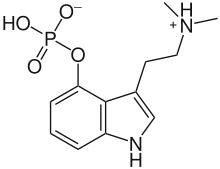
The following is a figure of a psilocybin molecule. Note the 6-carbon ring bonded to a 5-carbon ring with the nitrogen atom embedded in it:
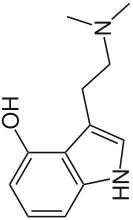
Note the same 6-carbon ring and 5-carbon ring backbone, similar to the psilocin molecule:
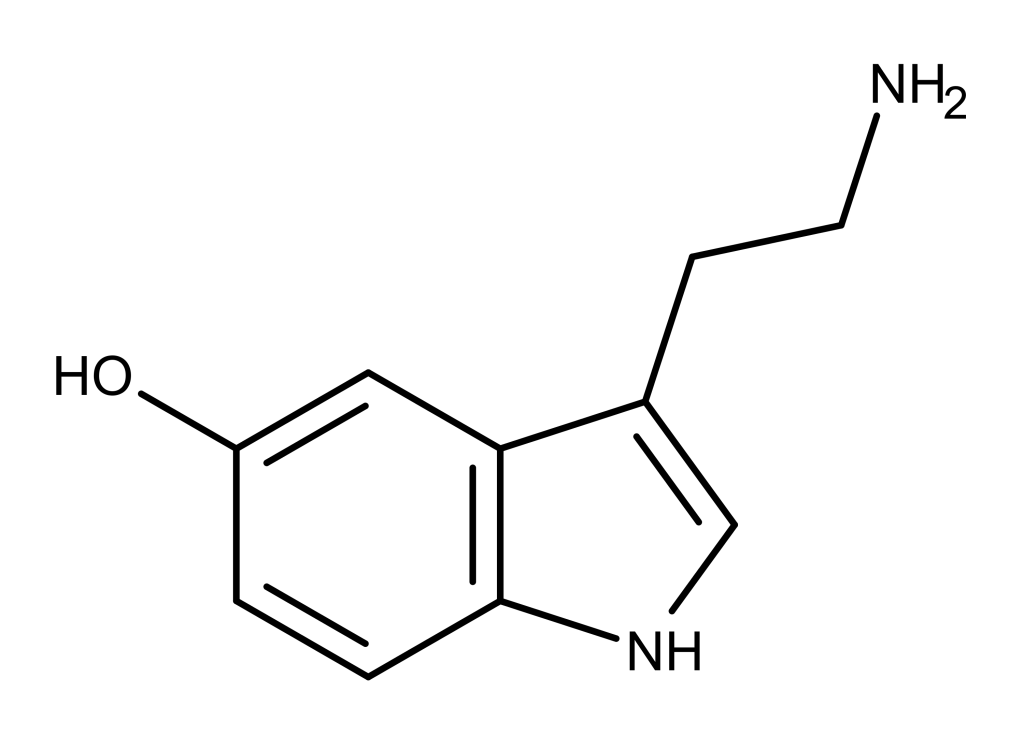
Finally, note how similar these two molecules are to serotonin:
Psilocin binds to 5HT-2A serotonin receptors, which are abundant in parts of the brain which are responsible for the mediation of mood and anxiety disorders such as the pre-frontal cortex. Downstream signaling leads to decreased depression, anxiety and related mood and anxiety disorders.
A low to medium dose (3-5 mg) is sufficient to produce sympathomimetic effects, but not hallucinogenic effects, whereas a dose of 8-25 mg will hallucinogenic effects, often within 70-90 minutes. Hallucinogenic effects can last up to 6 hours.
The use of psilocybin requires the implementation of a medically supervised setting with the proper preliminary counseling to ensure that the patient is in the right mindset, followed by adequate professional clinical psychological and physiological support.
Lowe et. al. (2021) list in Table 4 acute and long-term subjective effects of psilocybin administration.
| Effect | Reference(s) mentioned in Lowe et. al. (2021), with numbers from References Cited section |
| 1. Positive changes in personality and increased altruism | 192) James, E.; Robertshaw, T.L.; Hoskins, M.; Sessa. B. Psilocybin occasioned mystical-type experiences. Hum. Psychopharmacol. Clin. Exp. 2020,35. 193) Elsey, J.W. Psychedelic drug use in health individuals: A review of benefits, costs, and implications for drug policy. Drug. Sci Policy Law 2017, 3. 194) Madsen, M.K.; Fisher, P.M.; Stenbaek, D.S.; Kristiansen, S.; Burmester, D.; Lehel, S.; Palenicek, T.; Kuchar, M.; Svarer, C.; Ozenne, B.; et. al. A single psilocybin dose is associated with long-term increased mindfulness, preceded by a proportional change in neocortical 5-HT2A receptor binding. Eur. Neuropsychopharmacol. 2020, 33, 71-80. 195) Erritzoe, D.; Roseman, L.; Nour, M.M.; MacLean, K.; Kaelen, M.; Nutt, D.J.; Carhart-Harris, R.L. effects of psilocybin therapy on personality structure. Acta Psychiatr. Scand. 2018, 138, 368-378. 196) Watts, R.; Day, C.; Krzanowski, J.; Nutt, D.; Carhart-Harris, R. Patients’ Accounts of Increased “Connectedness” and “Acceptance” After Psilocybin for Treatment-Resistant Depression. J. Hum. Psychol. 2017, 57,520-564. |
| 2. Enhanced feelings of connectedness | 192) (cited earlier) |
| 3. Enhanced-nature relatedness | 40) Lyons, T.; Carhart-Harris, R.L. Increased nature relatedness and decreased authoritarian political views after psilocybin for treatment-resistant depression. J. Psychopharmacol. 2018, 32, 811-819. 192) (cited earlier) |
| 4. Pro-environmental behaviour | 192) (cited earlier) 197) Forstmann, M.; Sagioglou, C. Lifetime experience with (classic) psychedelics predicts pro-environmental behavior through an increase in nature relatedness. J. Psychopharmacol. 2017, 31, 975-988. |
| 5. Decreased violent and criminal behaviour | 198) Hendricks, P.S.; Crawford, M.S.; Cropsey, K.L.; Copes, H.; Sweat, N.W.; Walsh, Z.; Pavela, G. The relationships of classic psychedelic use with criminal behavior in the Unites States adult population. J. Psychopharmacol. 2018, 32, 37-48 199) Walsh, Z.; Hendricks, P.S.; Smith, S.; Kosson, D.S.; Thiessen, M.S.; Lucas, P.; Swogger, M.T. Hallucinogen use and intimate partner violence: Prospective evidence consistent with protective effects among men with histories of problematic substance use. J. Psychoparmacol. 2016, 30, 601-607. 200)Hendricks, P.S.; Thorne, C.B.; Clark, C.B.; Coombs, D.W.; Johnson, M.W. Classic psychedelic use is associated with reduced psychological distress and suicidality in the United States adult population. J. Psychopharmacol. 2015, 29, 280-288. |
| 6. Reduced suicidal ideation | 13) Hendricks, P.S.; Johnson, M.W.; Griffiths, R.R. Psilocybin, psychological distress, and suicidality. J. Psychopharmacol. 2015, 29, 1041-1043. 192) (cited earlier) 200) (cited earlier) |
| 7. Protection against suicidality and psychological distress | 13) (cited earlier) |
| 8. Tempered politically authoritarian views | 40) (cited earlier) 192) (cited earlier) |
| 9. Increase in personality domain of openness | 192) (cited earlier) 201) MacLean, K.A.; Johnson, M.W.; Griffiths, R.R. Mystical experiences occasioned by the hallucinogen psilocybin lead to increases in the personality domain of openness. J. Psychopharmacol. 2011, 25, 1453-1461. 202) Nour, M.M.; Evans, L.; Carhart-Harris, R.L. Psychedelics, Personality and Political Perspectives. J. Psychoact. Drugs 2017, 49, 182-191. |
| 10. Ego dissolution. Reduction of egotistical attitudes, narcissism, and induces greater prosocial behaviour | 65) Nichols, D.E. Psilocybin: From ancient magic to modern medicine. J. Antibiot. 2020, 73, 679-686. 192) (cited earlier) 203) Miller, W.R. The phenomenon of quantum change. J. Clin. Psychol. 2004, 60, 453-460. |
Numerous diseased states are being explored in which psilocybin-assisted therapy may provide significant benefit and treatment, including the following:
- Alcohol, stimulant and cannabis dependence
- Addictions to cocaine, tobacco, nicotine, and opioids
- Anxiety disorders such as Post-traumatic stress disorder (PTSD), Generalized anxiety disorder (GAD), Obsessive-compulsive disorder
- Various forms of depression, such as Cancer-related, Treatment-resistant, Major Depressive Disorder, Severe existential depression
- Chronic and intractable phantom pain
- Epilepsy
- Borderline and Narcissistic Personality Disorders
- Psychopathy
- Emotional dysregulation and violence against one’s partner, and
- Inflammation
According to an article by Dana G. Smith (2023) appropriate use of psychedelic therapy involves three phases:
- Preparatory sessions: The patient needs to meet with a trained clinician for several hours over a few days so that the patient understands what the treatment will entail, especially regarding the drug’s physical and psychological effects. The patient should be in an optimal frame of mind to benefit from the drug session;
- The drug session: For most of a drug session, the patient is typically relaxed, lying down, eyes closed, listening to music. Generally, there is not much talking. If the patient starts to feel anxious or the onset of a “bad trip”, the therapist may offer reassurance or guidance through a breathing exercise;
- The integration sessions: During the days or weeks after the trip, the patient processes the experience. The exact number of sessions varies, but 4 hours spread over two or three weeks is typical. The therapist helps the patient try to make sense of the feelings, insights, and memories that emerged while on the psychedelic. In order to help the patient, the therapist will ask open-ended questions to let the patient guide the conversation.
Lowe, H.; Toyang, N.; Stelle, B.; Valentine, H.; Grant, J.; Ali, A.; Ngwa, W.; Gordon, L. 2021. The Therapeutic Potential of Psilocybin. Molecules, 2021, 206, 2948., https://doi.org/10.3390/molecules26102948 .
Smith, D.G. 2023. What Does Good Psychedelic Therapy Look Like? New York Times, https://www.nytimes.com/2023/06/03/well/mind/psychedelic-therapy.html .
 Addictions and Recovery