
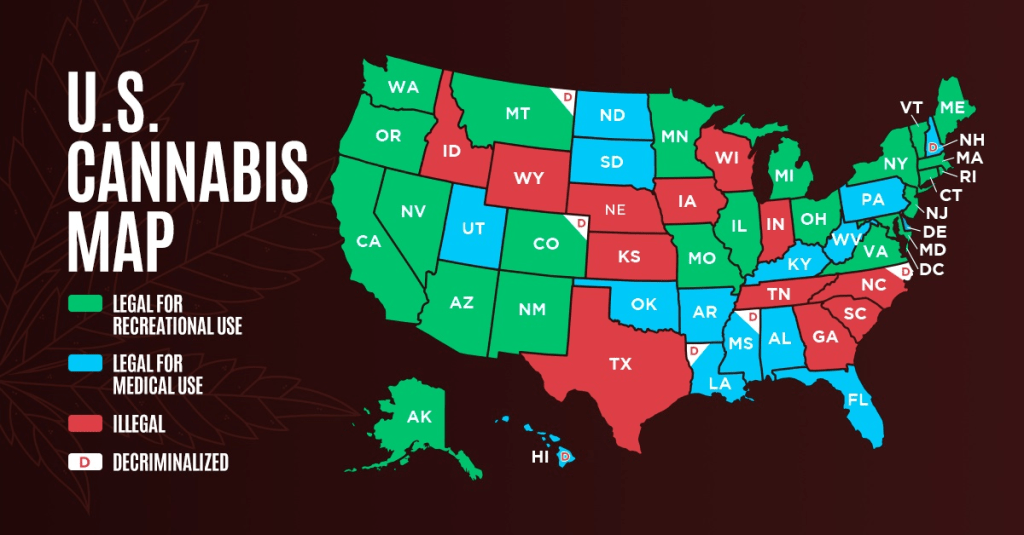
(Graph from https://covercannabis.com/blog/where-is-marijuana-legal/ current as of 2025)
In the previous blog, I presented information comparing the cocaine business with a normal business model.
Here, I want to present an argument that there are benefits to the decriminalization or legalization of illicit drug use in terms of reductions in drug-induced mortality, new HIV/AIDS cases, incarceration rates, and violent crime rates.
In June 1971, Nixon officially declared a “War on Drugs,” stating that drug abuse was “public enemy number one.” As part of the War on Drugs initiative, Nixon did the following:
- He increased federal funding for drug-control agencies and proposed strict measures, such as mandatory prison sentencing, for drug crimes;
- He also announced the creation of the Special Action Office for Drug Abuse Prevention (SAODAP), which was headed by Dr. Jerome Jaffe;
- He created the Drug Enforcement Administration (DEA) in 1973. This agency is a special police force committed to targeting illegal drug use and smuggling in the United States.
At the start, the DEA had 1,470 special agents and a budget of less than $75 million. Today, the agency has nearly 5,000 agents and a budget of $2.03 billion ( https://www.history.com/articles/the-war-on-drugs).
The late Everett McKinley Dirksen, a Republican from Illinois, is widely credited with the famous quip, “A billion here and a billion there, and pretty soon you’re talking real money”, so with the expenditure of such amounts of money over the past 56 years ($1 trillion as of 2021), it would be worthwhile to determine how successful this “War on Drugs” has been.
The consensus is that this War on Drugs has been a failure ( https://www.cnbc.com/2021/06/17/the-us-has-spent-over-a-trillion-dollars-fighting-war-on-drugs.html), because drug use, fatalities, and arrests have increased over the past 50 years.
Perhaps the reason for this failure has been the emphasis in the United States has been on law enforcement, rather than on treatment and on education.
As a citizen of the United States, this infographic showing incarceration rates as of 2017 is jarring. I would like the reader to focus your attention and compare the incarceration rates of the United States (666 per 100,000) with that of Portugal (135 per 100,000) because these are the two countries which I will discuss in the rest of the blog, comparing their policies of drug legalization with decriminalization:
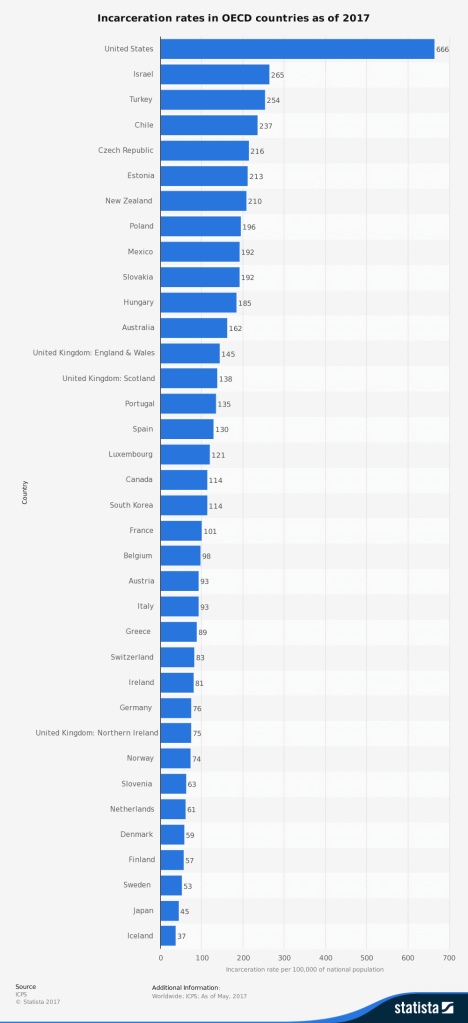
(Infographic from https://www.russellwebster.com/global-incarceration-2017/ )
Maybe, just maybe, a wiser strategy is to decriminalize possession or legalize drugs, such as marijuana.
First, allow me to clarify the distinction between decriminalization and legalization.
- Decriminalization: Possession/use is not criminally punished, but production and distribution remain illegal;
- Legalization: Production, distribution, and sale become legal and regulated.
This distinction is crucial—decriminalization changes demand-side forces much more than supply-side forces.
A. Portugal’s decision to decriminalize drugs
By 1999, Portugal was facing a healthcare crisis. Nearly 1% of the adult population (100,000 people) was addicted to heroin. As a result of syringe sharing, Portugal also had the highest rate of of drug-related AIDS deaths in the European Union ( https://www.beckleyfoundation.org/2018/04/23/lessons-from-portugal-the-case-for-drug-policy-reform/).
However, by 2018, the year of the above-mentioned Beckley Foundation report, the Health Ministry estimated that about 25,000 people in Portugal are users of heroin, and the drug mortality rate is the lowest in Western Europe: 1/10 the rate of Britain taken as a whole, 1/27 the rate of Scotland, and about 1/50 the rate of the US.
Furthermore, the number of new HIV diagnoses attributable to injecting drug use plummeted from 518 in the year 2000 to 13 in 2019:
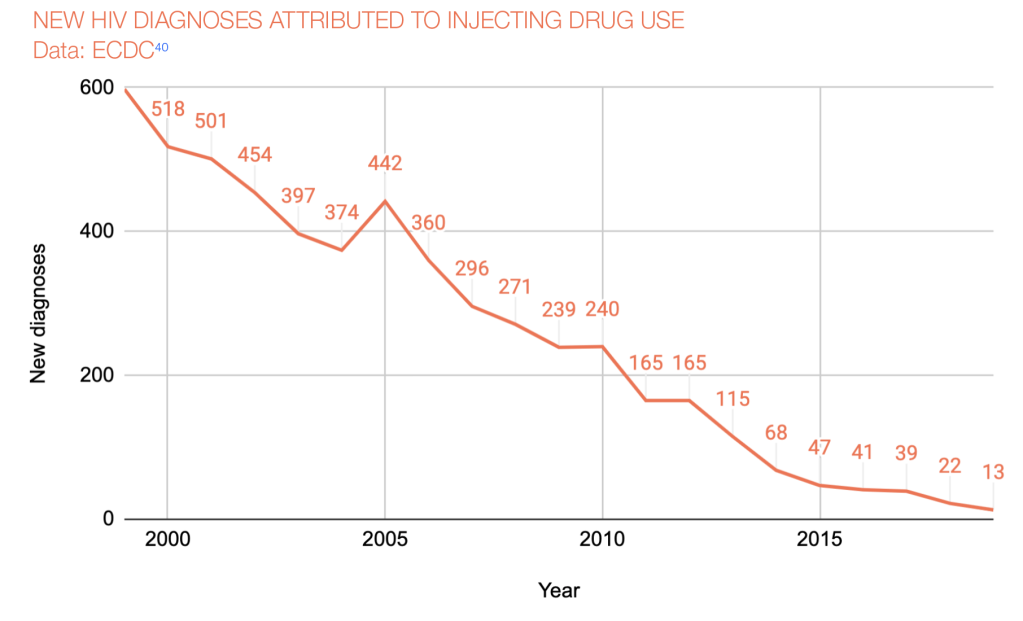
(Figure from https://transformdrugs.org/blog/drug-decriminalisation-in-portugal-setting-the-record-straight)
Marie Nougier provides a brief summary of the procedure by which people found possessing small quantities of drugs are referred to a Commission for the Dissuasion of Drug Addiction rather than criminally charged:
- The Commission is an administrative body composed of health, social and legal experts which helps participants to address issues related to their drug use;
- Each person referred to the Dissuasion Commissions undergoes an interview during which the Commission asks the participant a series of questions to understand his/her circumstances (drug use, family situation, employment, any history of psychological or health problems, etc.), establish a relationship of trust, and try to identify the best possible response to help the person.
- Therefore, the Dissuasion Commissions are considered as a critical mechanism to inform people about drug use, drug dependence, and the possible harms users may face, but also to refer them to the health and social services they may need. Although the Commissions can impose administrative penalties, the overall objective is to help people to overcome and address their health and social problems–not to punish them.
- The work of the Commission is mostly informative and preventive. The Commission will offer information about the health effects of drug use, the law, etc. and advise the person on available services to prevent harm and help ensure that the person’s consumption does not become problematic. If the person is dependent on drugs, the main objective is to encourage him/her to enter treatment or to resume a treatment program that has been interrupted – and as such regain control over their drug use, access opioid substitution therapy (OST), or stop using drugs altogether.
- Treatment is never coercive and is generally free of charge for the patient.
- Interestingly, a person who fails to enter or remain in treatment will not receive any criminal sanction or citation.
This policy has not only kept people out of prison, it has also significantly reduced stigma, discrimination, and health harms (https://womenanddrugs.wola.org/wp-content/uploads/2020/10/DONE-12-Portuguese-decriminalisation_ENGFINAL.pdf).
The following infographic summarizes the changes occurring in Portugal following the implementation of a drug policy based on decriminalization.
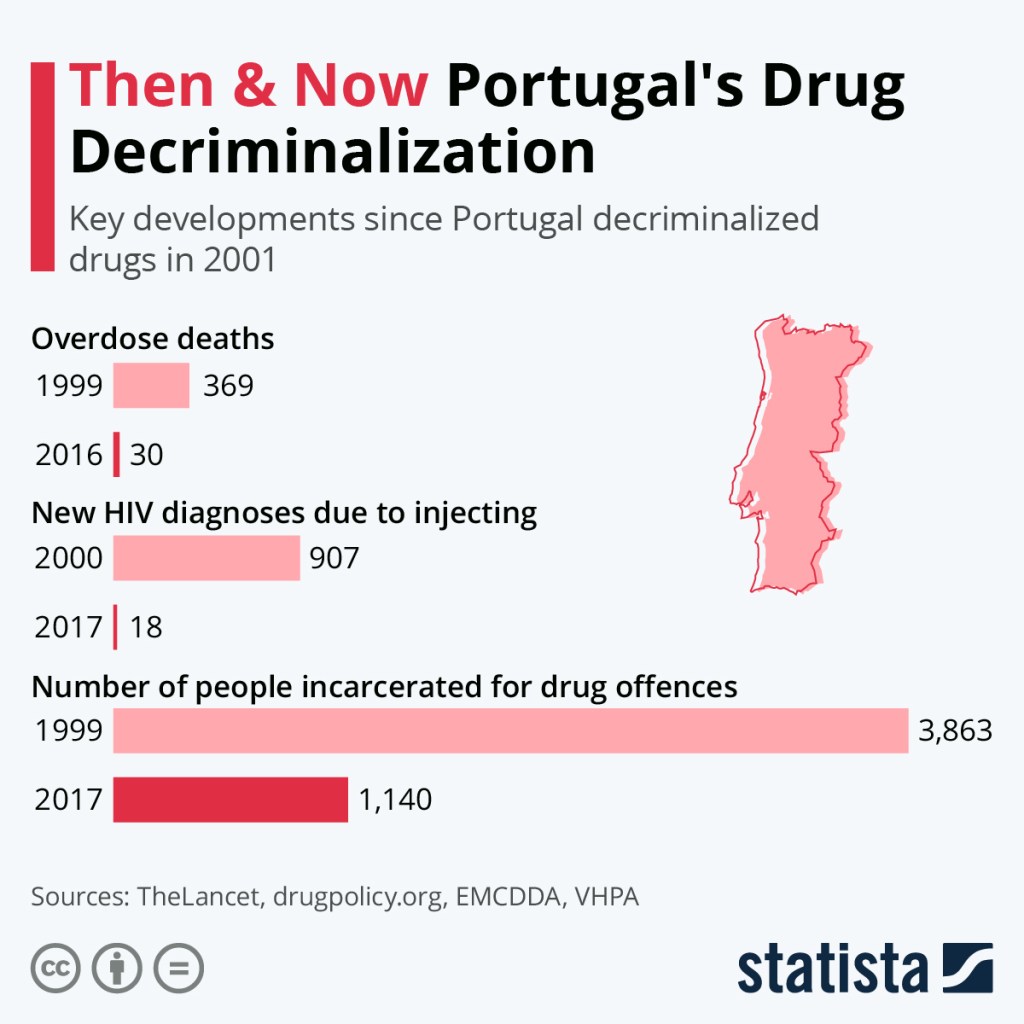
Infographic from https://www.statista.com/chart/20616/key-developments-since-portugal-decriminalized-drugs/
B. The legalization of cannabis in the United States
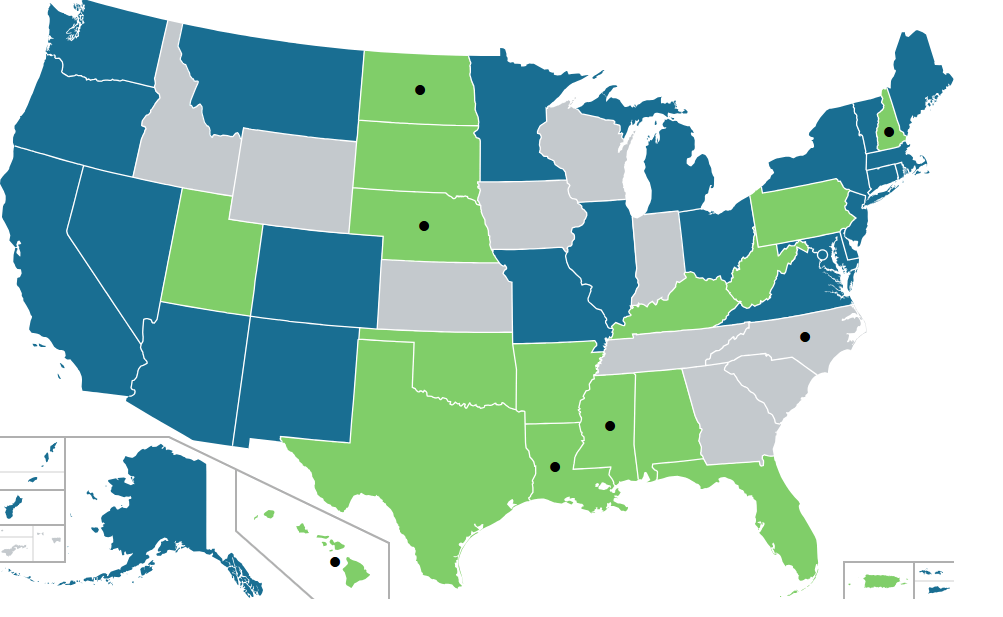
Whereas Portugal was able to enact its decriminalization laws at its federal level, the story of legalization of cannabis in the United States is more complicated, because its legalization was enacted at the state level, in violation of cannabis’ original status as a Schedule I drug.
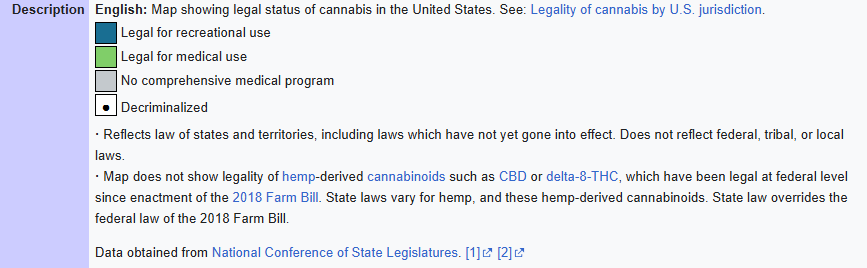
In 1996, the California legislature passed Proposition 215, which permitted medical cannabis in the California Health and Safety Code. Since then, In the United States, cannabis is legal in 40 of 50 states for medical use and 24 states for recreational use.
Lokal_Profil, Public domain, via Wikimedia Commons
Despite the passage of legalization laws, the number of people incarcerated for marijuana possession is still quite high:
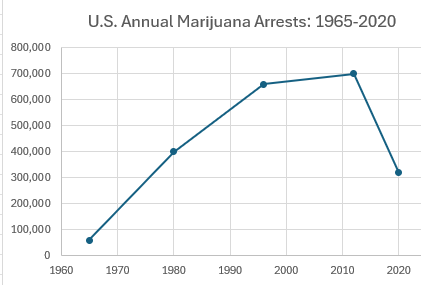
(Graph adapted from infographic in https://norml.org/blog/2021/09/27/marijuana-arrests-fall-precipitously-nationwide-in-2020/ )
The American Civil Liberties Union (ACLU) attributes this high number to racism in the criminal justice system. “According to the ACLU’s original analysis, marijuana arrests now account for over half of all drug arrests in the United States. Of the 8.2 million marijuana arrests between 2001 and 2010, 88% were for simply having marijuana. Nationwide, the arrest data revealed one consistent trend: significant racial bias. Despite roughly equal usage rates, Blacks are 3.73 times more likely than whites to be arrested for marijuana. ( https://www.aclu.org/the-war-on-marijuana-in-black-and-white )”
C. Differences between Portugal’s approach of decriminalization the U.S. states’ approaches to legalization (Information from ChatGPT).
1. Market Structure Effects (Porter’s Lens)
| Portugal | U.S. | |
| Threat of New Entrants | No change (supply still illegal → high barriers) | Big increase (licenses allow entry; capital replaces violence) |
| Buyer Power | Increases modestly (less fear; still illegal supply) | High (price transparency, choice, quality standards) |
| Supplier Power | Low (growers/traffickers still coerced) | Moderate (licensed producers can bargain, integrate) |
| Rivalry | Slightly less violent at retail; upstream unchanged | Competitive rivalry on price, branding, formats |
| Substitutes | Some increase (reduced stigma) | Strong (edibles, beverages, CBD, alcohol substitution) |
Bottom line:
Portugal does not change industry structure; U.S. cannabis does.
2. Violence & Crime Economics
Portugal
- Retail violence ↓
- Trafficking violence ≈ unchanged (often displaced geographically)
- Organized crime rents largely intact
U.S. Cannabis
- Black-market cannabis shrinks (degree varies by tax/regulation)
- Violence linked to cannabis distribution ↓
- Illicit market persists where taxes/regulation are excessive
Insight:
Violence falls only when the legal market undercuts illicit margins.
3. Pricing & Margins
Portugal
- Prices largely unchanged
- Risk premium remains embedded
- No tax revenue offset
U.S. Cannabis
- Prices fall over time
- Margins compress
- Taxes replace criminal rents
- Over time: commoditization (like alcohol)
4. Outcome Summary
| Goal | Portugal Model | U.S. Cannabis Model |
| Reduce incarceration | ✅ | ✅ |
| Improve public health | ✅ | ⚠️ mixed |
| Reduce cartel profits | ❌ | ✅ (product-specific) |
| Lower prices | ❌ | ✅ |
| Create legal industry | ❌ | ✅ |
| Generate tax revenue | ❌ | ✅ |
******************************************************
Unfortunately, I know full well that this approach will NEVER sell in the United States. As soon as a political leader suggests a strategy that de-emphasizes law enforcement, (s)he will be accused of being “soft on drugs”, and the strategy policy is doomed.
P.S.:


 Addictions and Recovery