
“Sex addiction” is not considered a disorder according to either the DSM-5-TR, the current U.S. psychiatric diagnostic manual, or in the ICD-11, the international diagnostic code formulated by the World Health Organization (WHO). However, the ICD-11 does recognize Compulsive Sexual Behavior Disorder (CSBD), which requires:
- Persistent failure to control sexual impulses;
- Repeated behavior despite harm;
- Significant distress or impairment.
The DSM rejected “sex addiction” for the following reasons:
- Neurobiology does not match addiction: It does not show the same dopamine hijacking pattern as drugs
- High desire is not equivalent to a disorder: Many people have high libido without pathology
- Moral & religious guilt distort reports: People often self-diagnose “addiction” when the real problem is shame
- Risk of pathologizing normal sexuality: Especially for LGBTQ people, people with high libido, or those in strict religious environments.
Nonetheless, even though the DSM may consider the title of the following infographic as being inaccurate, it does indicate a difference in attitudes and behaviors regarding compulsive sexual behavior disorder between men and women:
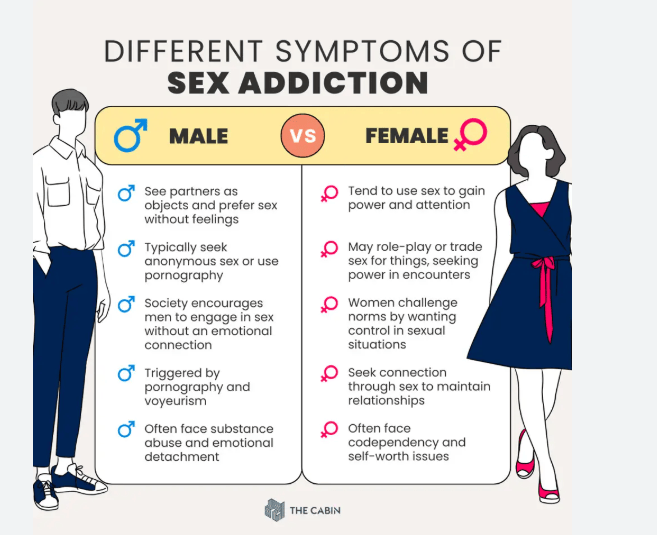
(Image from https://www.thecabinchiangmai.com/addiction-type/sex/)
According to criteria in the ICD-11, a person must meet all of the following to be diagnosed with CSBD:
- Loss of control: There is a persistent failure to control intense sexual urges, impulses, or behaviors, like the following:
- Repeatedly doing sexual behaviors longer than intended
- Repeated failed attempts to cut back
- Feeling “driven” or compelled
- Centrality: Sexual behavior becomes central to life, crowding out:
- Work
- Relationships
- Health
- Responsibilities
- Continuation despite harm: The continues despite negative consequences, such as:
- Relationship damage
- Legal or financial problems
- Health risks
- Shame or emotional collapse
- Duration: The pattern lasts 6 months or more. It is NOT a short crisis, breakup binge, or teenage hormones
- Distress is NOT from morality, and this is crucial. CSBD cannot be diagnosed if distress is mainly from:
- Religious guilt
- Cultural shame
- Disapproval of others
- The distress must come from within, i.e. “I cannot control this and it is damaging my life.”
What CSBD is NOT:
- High libido
- Kink
- Porn use
- Masturbation frequency
- Non-monogamy
- Being more sexual than your partner
- Being ashamed of sex
So what is really happening in CSBD is the following:
- Poor impulse control (frontal lobe)
- Habit loops (like gambling)
- Stress-driven coping
- Trauma, ADHD, OCD, or mood disorders often underneath.
How many people are involved?
That depends on the sampling method:
Convenience sampling
Convenience sampling, a non-probability sampling technique that involves selecting research subjects based on convenience and accessibility, yields the highest percentages. For example, Engel et. al. (2019) report that the percentage of females meeting the CSBD cutoff was 13.1%, while the percentage of males was 45.4%.
CSBD frequencies differ between populations. Very high frequencies were reported in student populations, with frequencies as high as 27.9% of males and 9.2% of females meeting the cut-off (Kingston, et. al, 2018).
National Surveys
The percentages of individuals with CSBD tend to be lower in national surveys. For example, Dickenson, et. al. (2018) report clinically relevant levels of distress/impairment associated with sexual compulsivity for 8.6% of their sample (10.3% men, 7% women).
Clinical Surveys
Here, researchers conduct surveys among specific populations, e.g. patients with obsessive-compulsive disorder. For example, Fuss, et. al. (2019) investigated CSBD in 539 adult outpatients with OCD (51.8% females). The lifetime prevalence of CSBD was 5.6% and, for current CSBD is 3.3%. Both incidences were significantly higher in males than in females (lifetime 8.8%/2.5% and current 5.4%/1.4%).
In a study comparing CSBD in adults with Autism Spectrum Disorder (ASD) and healthy controls (HC), Schottle, et. al., 2017), found that 30.4% of ASD males met the cut-off for CSBD, but only 10.0% of ASD females met the cut-off.
Ways in which CSBD may manifest itself (Kurbitz and Briken, 2021):
For both men and women, sexual addiction can involve compulsive behaviors such as constantly seeking new sexual partners, having frequent sexual counters, engaging in compulsive masturbation and frequently using pornography (Weinstein, et. al., 2015). Furthermore, sexual compulsivity has been associated with the number of unprotected vaginal sex acts with female workers, lower self-efficacy for condom use, greater use of illicit drugs, and more financial need (Semple, et. al., 2010).
With men, we see a higher prevalence of the following behaviors:
- Exhibitionism
- Sadism
- Voyeurism: the act of observing or recording unsuspecting people
engaging in private activities—like undressing, bathing, or having sex— without their consent, typically for sexual
gratification; - Frotteurism: (I had to look this up. It is “a psychiatric
paraphilia in which a person experiences intense
sexual arousal or gratification from touching
or rubbing their genitals against a nonconsenting
person.”) - Coercive fantasies
- More masturbation frequency
With women, we see a higher prevalence of the following:
- Masochism, and
- Fetishism.
Attachment theory suggests that individuals who developed a safe attachment style, as opposed to an anxious or avoidant style, can form healthy relationships in adolescence and adulthood. The following information regarding attachment theory is largely extracted from “What Is Attachment Theory?” (https://www.verywellmind.com/what-is-attachment-theory-2795337 )
“Attachment theory is a psychological framework for understanding the emotional bonds and relationships between people. It focuses on the early attachment patterns that form in childhood and how they influence trust, intimacy, and behavior in adult romantic relationships.
According to attachment theory, people are born with a need to seek closeness and security from caregivers. These early bonds set the foundation for later relationships and continue to influence attachments throughout life. The quality of these early bonds can influence how people relate to others, including how secure, anxious, or avoidant they are in close relationships.
There are four patterns of attachment:
- Secure attachment: Children who can depend on their caregivers show distress when separated and happiness when reunited, while still feeling confident that the caregiver will return. When frightened, securely attached children readily seek comfort from caregivers. This is the most common attachment style, with research suggesting that about 81.8% of people are securely attached.
- Anxious (ambivalent) attachment: Children with an ambivalent attachment style become very distressed when a parent leaves. Due to limited parental availability, these children cannot depend on their primary caregiver to be there when they need them. Recent research indicates that around 13.2% have an anxious/avoidant style.
- Avoidant attachment: Children with an avoidant attachment tend to avoid parents or caregivers, showing no preference between a caregiver and a complete stranger. This attachment style might be a result of abusive or neglectful caregivers. Children who are punished for relying on a caregiver will learn to avoid seeking help in the future.
- Disorganized attachment: Children with a disorganized attachment style display a confusing mix of behavior, seeming disoriented, dazed, or confused. They may avoid or resist the parent. Lack of a clear attachment pattern is likely linked to inconsistent caregiver behavior. In such cases, parents may serve as both a source of comfort and a source of fear, leading to disorganized behavior.”
The argument presented by Weinstein, et. al., (2015) is that “individuals with secure attachment are expected to have low chances of becoming addicted to sex since they regulate and limit their sexual activity more than those with insecure attachment. Furthermore, individuals, individuals who are addicted to sex are looking for sexual activity without the need for emotional relationships and they are more likely to be characterized by avoidant or anxious attachment.
They developed three hypotheses:
- That secure attachment would be associated with lower rates of sex compulsion;
- That homosexual men and women would show higher levels of sexual compulsivity than heterosexual men and women;
- That attachment style might mediate between sexual orientation and sexual compulsion.
To test these hypotheses, they recruited equal numbers of heterosexual men, homosexual men, heterosexual women, and homosexual women (26 each). Each participant was then assessed with the Sexual Compulsivity Scale (SCS), a questionnaire developed to determine tendencies toward sexual preoccupation and hyper-sexuality, and with the Experience in Close Relationships, a questionnaire with 36 questions divided equally into avoidance of intimacy and attachment and anxious attachment that is related to abandonment and separation anxiety.
They found the following:
- Regarding the first hypothesis: There was a positive correlation between anxious attachment and sexual compulsivity as well as a positive correlation between avoidant attachment and sexual compulsivity. Their data, therefore, support their first hypothesis between avoidant and anxious attachment and sexual compulsivity;
- Regarding the second hypothesis: They found non-significant gender, sexual orientation, and attachment effects. However, they found a significant gender by sexual orientation interaction. Further analysis showed that lesbian women had higher ratings of sexual compulsivity than heterosexual men, but non-significant differences in sexual compulsivity between homosexual and heterosexual men. A comparison of anxious attachment between lesbian and heterosexual women showed a significantly higher rating of anxious attachment in lesbian women than heterosexual women. Therefore, the second hypothesis is partially supported;
- Regarding the third hypothesis: This hypothesis was refuted due to the lack of attachment effect or interaction between attachment and sexual orientation in the Analysis of Covariance test (ANCOVA).
How CSBD is Treated: The goal is regaining control, not eliminating sexuality.
- First-line: Psychotherapy
- CBT (Cognitive Behavioral Therapy, where the targets include the following:
- Emotional avoidance
- Habit Breaking
- ACT (Acceptance & Commitment Therapy, which teaches:
- How to feel urges without obeying them
- Values-based behavior
- Emotional regulation
- Trauma therapy (if relevant), if behavior is driven by
- Childhood trauma
- Attachment wounds
- Abuse
- CBT (Cognitive Behavioral Therapy, where the targets include the following:
- Medication (when needed)
- SSRIs, e.g. fluoxetine, which reduce compulsive urges
- Naltrexone, which blocks reward-loop cravings
- AHDH meds, which improve impulse control
- Mood stabilizers, if bipolar is involved
- Skills training, where people learn
- Urge surfing
- Emotional regulation
- Delay & substitute behaviors
- Boundary setting
- Digital hygiene (porn, apps)
- Support groups, such as:
- SMART Recovery
- Sex-positive CSBD groups
P.S.: My reaction to reading a description of frotteurism:

Dickenson, J.A.; Gleason, N.; Coleman, E.; Miner, M.H. (2018). Prevalence of Distress Associated With Difficulty Controlling Sexual Urges, Feelings, and Behaviors in the United States. JAMA Netw. Open 1, e184468.
Engel, J.; Kessler, A.; Veit, M.; Sinke, C.; Hietland, I.; Kneer, J.; Hartmann, U.; Kruger, T.H.C. (2019). Hypersexual behavior in a large online sample: Individual characteristics and signs of coercive sexual behavior. J. Behav. Addict. 8:213-222.
Fuss, J.; Briken, P.; Stein, D.J.; Lochner, C. Compulsive sexual behavior disorder in obsessive-compulsive disorder: Prevalence and associated comorbidity. J. Behav. Addict. 8:242-248.
Kingston, D.A.; Walters, G.D.; Olver, M.E.; Levaque, E.; Sawatsky, M.; Lalumiere, M.L. (2018). Understanding the Latent Structure of Hypersexuality: A Taxometric Investigation. Arch. Sex. Behav. 47:2207-2221.
Kurbitz, L.I.; Briken, P. (2021). Is Compulsive Sexual Behavior Different in Women Compared to Men? Journal of Clinical Medicine 10:3205. https://doi.org/10.3390/jcm10153205.
Schottle, D.; Briken, P.; Tuscher, O.; Turner, D. (2017). Sexuality in autism: Hypersexual and paraphilic behavior in women and men with high-functioning autism spectrum disorder. Dialogues Clin. Neurosci. 19:381-393.
Semple, S.J.; Strathdee, S.A.; Cruz, M.G.; Robertson, A.; Goldenberg, S.; Patterson, T.L. (2010). Psychosexual and social-cognitive correlates of sexual risk behavior among male clients of female sex workers in Tijuana, Mexico. AIDS Care, 22(12):1478-1480.
Weinstein, A.; Katz, L.; Eberhardt, H.; Cohen, K.; LeJoyeux, M. (2015). Sexual compulsion – Relationship with sex, attachment and sexual orientation. Journal of Behavioral Addictions 4(1):22-26. DOI: 10:1556/JBA.4.2015.1.6.
P.S.:


 Addictions and Recovery