
In a previous blog, https://addictionsandrecoverydotblog.com/2025/06/01/54-symptoms-common-to-drug-addiction-are-also-present-in-those-who-excessively-use-social-media/, I presented evidence that the symptoms of excessive social media use resemble those of drug addiction.
As of writing this blog (April, 2026), addiction to social media or Social Media Use Disorder do not appear in the DSM, the Diagnostic and Statistical Manual of Mental Disorders. It is currently in its fifth edition and is the authoritative guide for healthcare professionals to diagnose and classify mental disorders. It provides standardized diagnostic criteria, symptoms, and codes used for clinical diagnosis, research, and insurance billing.
However, if we compare the DSM-5 criteria for Substance Use Disorder (SUD), of which Alcohol Use Disorder (AUD) is a part, they bear a striking resemblance to the behaviors associated with social media addition: The DSM-5 criteria for Substance Use Disorder (SUD), of which Alcohol Use Disorder (AUD) is a part, are compared to the proposed diagnostic criteria for Social Media Use Disorder (SMUD):
| DSM-5 criteria for Substance Use Disorder, from Choi, Morris, and Marti (2025) | Proposed diagnostic criteria for Social Media Addiction (Moretta and Wegmann, 2025) |
| (1) Taking the substance in larger amounts or for a longer duration than intended; (2) Unsuccessful efforts to cut down or control use (loss of control); (3) Spending a great deal of time obtaining, using, or recovering from use of the substance; (4) Intense cravings or a strong urge to use; (5) Recurrent use despite failing to fulfill major role obligations at work, school, or home; (6) Continued use despite social problems; (7) Giving up or reducing important social, occupational, or recreational activities (given-up activities); (8) Recurrent use in physically hazardous/dangerous situations; (9) Continued use despite a physical or psychological problem that could have been caused or made worse by the substance; (10) An indication of increased tolerance, i.e., needed more of the substance to obtain the same effect; and (11) The development of withdrawal symptoms (a), which can be relieved by taking more of the substance (b). | (1) Impaired control over social media use (e.g. onset, frequency, intensity, duration, termination, context); (2) Important social, occupational, or recreational offline activities are given up or reduced because of social media use; (3) Failing to fulfill major role obligations at work, school, or home because of social media use; (4) Persistent or recurrent physical, social, interpersonal, and/or psychological problems that are likely to have been caused or exacerbated by social media; (5) Craving or a strong desire or urge to use social media; (6) Preferring online social interaction, communication and system features over the real life at the point of experiencing social overload, communication overload, and system feature overload; (7) State-FoMO (Fear of Missing Out): fears, worries, and anxieties concerning being out of something that occurs on social media |
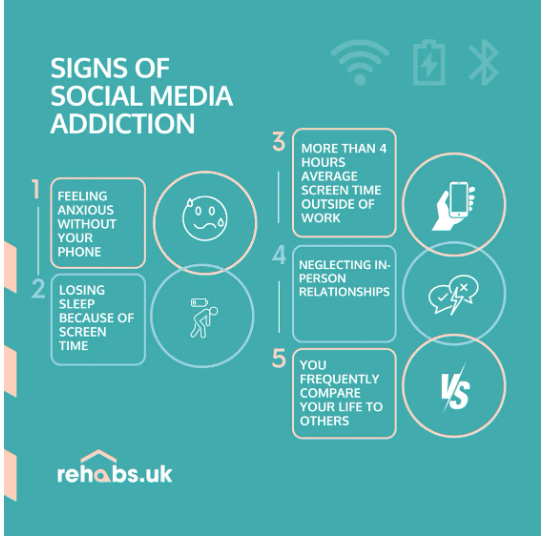
The following infographic, showing the signs of social media addiction, is from https://rehabsuk.com/blog/smartphone-addiction-the-importance-of-digital-detox-and-the-rise-of-dumb-tech/:
Sierra Vista Hospital, located in Sacramento, CA, maintains a webpage, Is Social Media Addiction Real? What to Know ( https://sierravistahospital.com/blog/is-social-media-addiction-real-what-to-know/), which describes the potentially debilitating effects of social media addiction, particularly among teens:
- 40% of Americans 18 to 22 years old self-reported being addicted to social media. (In contrast, Amirthalingam and Khera [2024] report a prevalence range of 5% to 20%);
- 70% of teens aged 13 to 17 felt left out or excluded when using social media;
- 35% have experienced cyberbullying;
- 7 in 10 teens who use social media for over 5 hours per day at at a higher risk of suicide.
Furthermore:
- Social media addiction can significantly affect mental health. Users often experience heightened levels of anxiety and depression. The constant connectivity may lead to feelings of isolation and loneliness;
- Sleep disturbances are common among those addicted to social media. Late-night scrolling disrupts natural sleep patterns. This can result in daytime fatigue and decreased productivity;
- Attention span and focus may also suffer due to social media overuse. Constant notifications and updates create a habit of rapid switching between tasks. This impacts the ability to concentrate on important activities;
- For many, self-esteem is intertwined with online interactions. Positive or negative feedback from peers can influence personal self-worth. This reliance on virtual validation can skew one’s self-image;
- Overall, the addiction to social media contributes to a cycle of emotional distress. Users may find themselves trapped in an unhealthy loop of seeking online engagement to fill emotional voids;
- A study from the University of Glasgow and published by the BMJ shows that frequent or daily social media use was associated with higher odds of alcohol consumption (48%), drug use (28%) and tobacco use (85%) compared with infrequent or non-daily use ( https://www.gla.ac.uk/news/archiveofnews/2023/november/headline_1024305_en.html ).
In order to understand why the use of social media can be addicting, we have to look at two things:
- The reward circuitry of the brain
- How social media apps are engineered to continuously tap this reward circuitry, so that users constantly seek “the next hit”.
The reward circuitry of the brain
The components of the mesolimbic dopaminergic system connect the ventral tegmentum area (VTA), located in midbrain, to the nucleus accumbens (NA), and the prefrontal cortex, which controls judgement (Figure 3.1). Drugs of abuse activate the VTA-to-nucleus accumbens pathway, and this, in turn, stimulates projections to prefrontal cortex. Though quite small, the nucleus accumbens occupies an important place connecting parts of the brain from which emotion emanates.
Figure 1: Schematic of reward circuitry, connecting the nucleus accumbens, ventral tegmentum, and the frontal cortex:
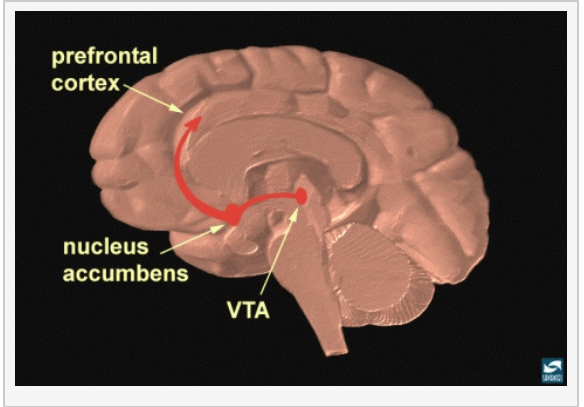
Illustration from https://nida.nih.gov/sites/default/files/1922-the-neurobiology-of-drug-addiction.pdf
This reward circuit is supposed to reinforce the following:
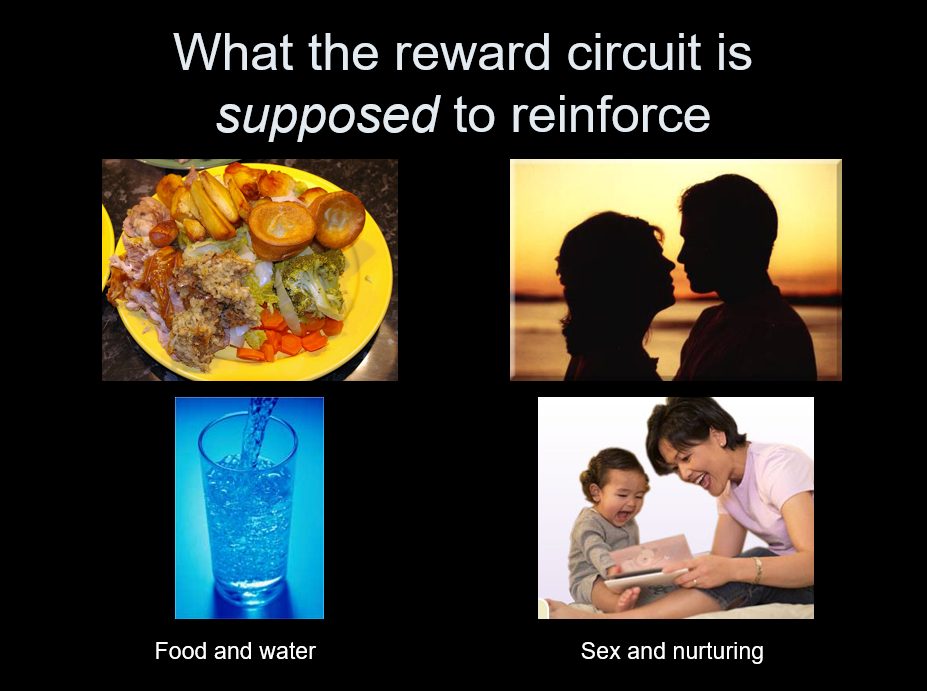
The original view of dopamine is that a pulse of dopamine “marks”natural rewards, such as food, water, sex, and nurturing, making it more likely for an individual to seek and repeat those behaviors. In this view, the amounts of dopamine that are typically released following food, water, sex, or nurturing are limited, but the magnitude of that pulse of secreted dopamine will be far greater following a line of cocaine, or a glass of whiskey, than the pulse of dopamine that the brain ever sees following a meal or a pleasurable sexual experience, so the cocaine or alcohol now become a source of behavioral reinforcement.
Over the past 15 years, however, motivational theorists, physiologists, and neurobiologists have discovered that the phenomenon of laboratory animals or humans seeking and attaining a reward is multi-faceted, and the wanting of a particular reward is quite distinct from the liking of that reward, and this newer perspective changes the role of dopamine in reward. Interestingly enough, some studies indicate that dopamine is released in anticipation of a reward (Phillips, et. al., 2003), and dopaminergic neurons reduce their firing rate, cease firing entirely, after the reward is delivered. These neurons are often extinguished when the expected reward is NOT delivered. Hence, the function of dopamine may be mediate reward predictability (Schultz, 1998; Schultz et. al., 2000).
This reward circuitry is manipulated by app developers to retain users:
How social media apps are engineered to continuously tap this reward circuitry, so that users constantly seek “the next hit”.
Eskwelabs ( https://www.eskwelabs.com/ )is an online upskilling school which provides access to “affordable and high quality data skills education”. They maintain a website which describes the work that goes into developing apps which can be addicting ( https://www.eskwelabs.com/blog/breaking-free-from-social-media-addiction ), and the details are interesting:
Apparently, many app developers use “The Hook Model” ( https://fs.blog/hooked/) to build “habit-forming products.” For users to keep coming back to their apps for more!
The model has four components:
- Trigger (either external or internal)
- Action
- Variable reward
- Investment
Here is a figure and description of how the model works:

- Triggers could either be internal (something related to personal goals or even insecurities we deal with) or external (like notifications, alerts, etc.). Companies can collect data on which external triggers would be most effective in getting a person to take action.
- Actions are “the behaviors done in anticipation of a reward.” These need to be simple—clicking on a photo, hitting the like button, retweeting a tweet, swiping right, or scrolling up. Once again, Big Tech can amass massive amounts of data (hence, Big Data) on all these actions.
- Rewards are self-explanatory, but they’re complicated to get right, because they need to be unpredictable in order to be desirable. Will they like my new status on Facebook or not? Is anyone going to give a heart react to my Instagram post? Will my Tiktok go viral? How many retweets can I get? This slot-machine style is something carefully crafted by Big Tech, and the more data we give them, the more accurately they can design desirable rewards for us.
- Investment is the last phase in this model and it’s a powerful one because it can either make or break the habit Big Tech is trying to form in you. The more data you offer leads to more of yourself that you’re investing into the social media app. For example, it’s a lot harder to abandon an app you’ve uploaded so many of your photos and videos to versus one you’ve barely even posted on.
Eskewlabs goes even further, by providing suggestions to detox from social media:
How to do a social media detox
Now that you’re filled with the knowledge of the Hook Model, Big Data, and the types of data social media apps collect in massive amounts from all users all over the world, you may be inclined to feel a bit discouraged and even afraid.
But this last section is dedicated specifically to empower you to break free from any kind of social media addiction. We will use the idea of doing a detox.
Step 1: Make it realistic
Check your own usage of the social media apps on your smartphone. A lot of the smartphones now provide data—in pie chart format or sometimes bar chart format—regarding your screen time.
If you know what your baseline is, you can set appropriate detox goals. You don’t have to shoot for the moon and aim for 30 days of detox when you might only need 10. Again, it will depend on you.
Step 2: Make the chances of success more likely
- Turn your phone’s screen into grayscale mode. You can go to your smartphone’s settings and set this up. App developers use the psychology of color to make it irresistible to check on unanswered or unseen notifications. Notice how these dots are always red. If they were in cooler tones like blue or green, would you be as compelled to open them as fast?
- Delete the apps on your smartphone. There is more friction when you have to access Facebook, Instagram, Twitter, and Youtube via desktop compared to opening them on your smartphone. Set your digital environment up for success by removing the temptation altogether.
- Inform your constant contacts that it’s best to reach you elsewhere and that you’re going through a social media detox. Having the nagging feeling that you could be missing an important message from someone close to you is enough to make you run back to social media. If you let your contacts know about your plan to detox in advance, then the peace of mind you’ll have during your detox period is both a reward and a tactic for not jumping back onto the apps.
- Write down a list of activities that can replace your social media time. While it’s ideal to use the empty space in your day to rest, it’s possible that as an avid social media user you may not find it as easy to be idle. So before you even go on the detox, it’s crucial to have a list of activities you can do so that you turn to those instead of the apps.
Step 3: Make it intentional
Clarify why you are doing this social media detox and journal your answer. You can revisit this after your detox and respond to your past self with the wisdom you’ve gained from your future self.
Step 4: Begin your social media detox
It is totally up to you when to start and how long it’ll be. Know that Eskwelabs is cheering you on every step of the way!
The view of the legal system has changed with a recent landmark case.
In the past, Big Tech companies (e.g. Facebook, Meta, Google, TikTok, Snapchat) successfully placed the burden of managing screen time on individuals and parents, operating on the assumption that capturing human attention is fair game. These Tech giants have maintained “that users and parents have the agency and tools to manage screen time. However, a growing body of academic research suggests features like infinite scrolling, autoplay and push notifications are engineered to override human self-control” (https://theconversation.com/is-social-media-addictive-how-it-keeps-you-clicking-and-the-harms-it-can-cause-276022).
Last March, a California jury found that Meta and Google were to blame for the depression and anxiety of a woman who compulsively used social media as a small child, awarding her $6 million in a rare verdict holding Silicon Valley accountable for its role in fueling a youth mental health crisis ( https://www.npr.org/2026/03/25/nx-s1-5746125/meta-youtube-social-media-trial-verdict) . (TikTok and Snapchat had already settled with the 20-year-old plaintiff prior to this trial.)
The jurors concluded that Meta and Google should pay the woman $3 million in compensatory damages and an additional $3 million in punitive damages. While the amounts awarded to the plaintiff are relatively minuscule, the implications of this case are profound. It represents the first time a jury has found that social media apps should be treated as defective products which have been engineered to exploit the developing brains of vulnerable kids and teenagers.
Amirthalingam, J.; Khera A. (2024). Understanding Social Media Addiction: A Deep Dive. Cureus 16(10):e72499. DOI 10.7759/cureus.72499.
Choi, N.G.; Morris, J.A.; Marti, C.N. (2025). DSM-5 Criteria for Alcohol and Cannabis Use Disorders: Are Older Adults Less Likely to Endorse Certain Criteria? International Journal of Environmental Research and Public Health 22:843. https://doi.org/10.3390/ijerph22060843.
Moretta, T.; Wegmann, E. (2025). Toward the classification of social media use disorder: Clinical characterization and proposed diagnostic criteria. Addictive Behaviors Reports 21:100603. https://doi.org/10.1016/j.abrep.2025.100603.
Schultz, W. (1998). Predictive reward signal of dopamine neurons. Journal of Neurophysiology 80:1-27.
Schultz, W.; Tremblay, L.; Hollerman, J.R. (2000). Reward processing in primate orbitofrontal cortex and basal ganglia. Cereb. Cortex 10:272-283.


 Addictions and Recovery