
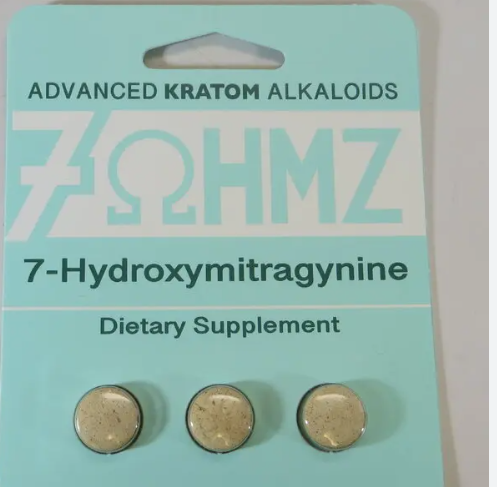
In a previous blog, https://addictionsandrecoverydotblog.com/2024/11/19/41-kratom/, we looked at kratom, the collective word for a mixture of opioid compounds extracted from the leaves of Mitragyna speciosa, a 4 to 16 metre high tropical tree indigenous to South East Asia, the Philippines and New Guinea. Traditionally, fresh or dried kratom leaves are chewed or made into tea; they are seldom smoked. At a low dose, kratom has stimulant effects and is used to combat fatigue during long working hours. However, at high dosages, however, it can have sedative-narcotic effects.
The two main psychoactive components in the leaves are mitragynine and 7-hydroxymitragynine. Although mitragynine has a high concentration in the leaves of kratom, research has shown that after it is ingested, it is metabolized to 7-hydroxymitagynine (Kruegel, et. al., 2019). Both mitragynine and 7-hydroxymitragynine are mu receptor agonists, i.e., they bind to mu receptors in the brain and act like opiates in that they act as sedatives and analgesics, and suppress gastrointestinal movement. However, 7-hydroxymitragynine is a much more potent mu receptor agonist because it possesses 14-22 times higher binding affinity than morphine (Pullman, et. al., 2025), and is more likely to suppress breathing.
In August 2025, Samantha Anderer wrote an an article entitled “What to Know About 7-OH, the New Vape Shop Hazard.” In it, she described how health officials are becoming increasingly concerned about a concentrated kratom byproduct called 7-OH which is purchased legally in vape shops and gas stations, and has a potential for dependence.
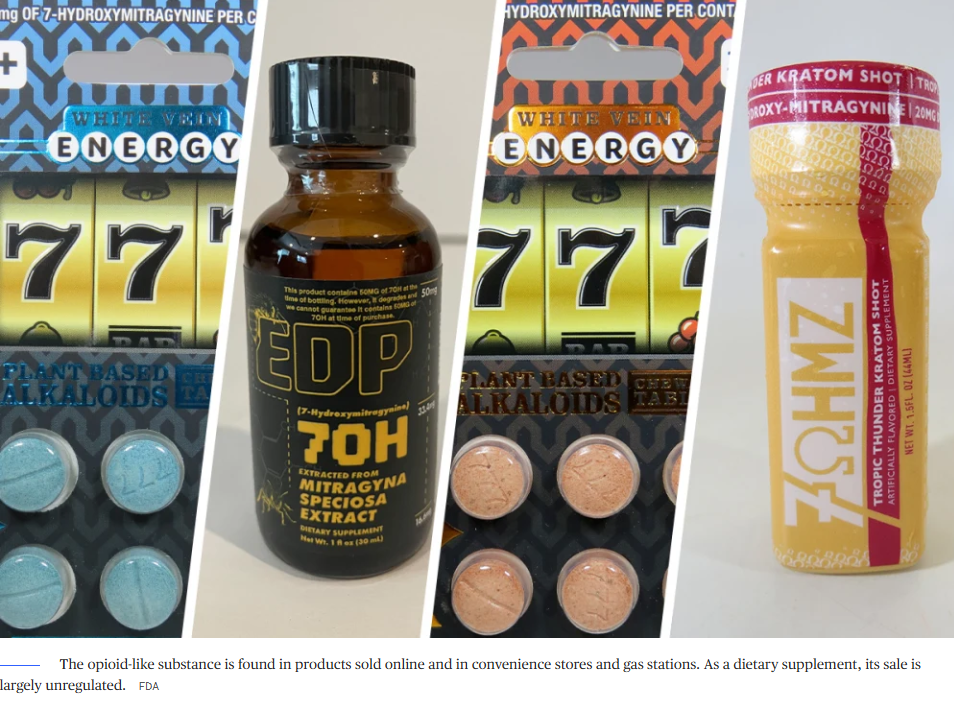
She reports that the drug is sold at places frequented by youth, and often sold in brightly colored packages. Furthermore, it is available in many forms, including tablets, drink mixes and shots, fruit-flavored gummies, and candies.
Many of the products sold in vape shops and gas stations labelled simply as “kratom” also have synthetically produced 7-OH added, and therein lies a major concern.
One might argue that concern over the risks associated with 7-OH are justified, considering this case study by Pullman et. al., (2025):
A 29-year-old man presented to the emergency department following cardiopulmonary arrest as the result of 7-hydroxymitragynine overdose. He was found unresponsive and received approximately 10 minutes of cardiopulmonary resuscitation. He has successfully revived with two doses of naloxone 4 mg intravenously. Due to his opioid tolerance, he typically consumes 90 mg of 7-hydroxymitragynine, which is well above the specific product labelled recommended dose of 12.5 mg per serving. Chemical analysis of the product he reported using confirmed that it contained 7-hydroxymitragynine 11.7 mg, mitragynine 0.45 mg, mitragynine pseudoindoxyl 0.17 mg (another metabolite of mitragynine), and paynantheine (a kratom alkaloid), per serving size.
7-OH is formally known as 7-hydroxymitragynine, but it is also called 7-hydroxy, 7-OHMG, 7-HMG, or simply “7”. It, along with mitragynine, are the two main psychoactive components in kratom, but 7-OH is usually in very low concentrations. The preparations listed above that are for sale contain much higher amounts of the compound. The DEA in 2016 said it planned to regulate the active ingredients in kratom, including 7-OH, as Schedule I substances. But the agency dropped the effort after considerable pushback from kratom advocates. Around 1.9 million people ages 12 and up in the U.S. reported using kratom in 2022, according to the National Survey on Drug Use and Health (Bendix, 2025) .
P.S.: An addendum to that case study of the 29-year-old man revived with naloxone:
Q: What did the patient do after he was revived?
A: “Post-revival, he vomited and then reported ingesting 7-hydromitragynine 190mg (approximately four tablets) to get ‘high’ while intoxicated.”

W…T…F…: Paris Tuileries Garden Facepalm statue
Page URL: https://commons.wikimedia.org/wiki/File:Paris_Tuileries_Garden_Facepalm_statue.jpg , Attribution: Alex E. Proimos, CC BY 2.0 https://creativecommons.org/licenses/by/2.0, via Wikimedia Commons.
Anderer, S. (2025). What to Know About 7-OH, the New Vape Shop Hazard. Published online in JAMA, August 22, 2025. doi:10.1001/jama.2025.13592.
Bendix, A. (2025). FDA asks Justice Department to classify gas station products with opioid-like effects as illicit substances .https://www.nbcnews.com/health/health-news/fda-asks-justice-department-classify-gas-station-products-opioid-effec-rcna221769 .
Kruegel, A.C.; Uprety, R.; Grinnell, S.G.; Langreck, C.; Pekarskaya, E.A.; Le Rouzic, V.; Ansonoff, M.; Gassaway, M.M.; PIntar, J.E.; Pasternake, G.W.; Javitch, J.A.; Majumdar, S.; Sames, D. (2019.) 7-hydroxymitragynine Is an Active Metabolite of Mitragynine and a Key Mediator of Its Analgesic Effects. ACS Central Science 5:992-1001. doi: 10.1021/acscentsci.9b00141.
Pullman, M.K.; Kanumuri, S.R.R.; Sharma, A.; Leon, J.F.; Cutler, S.J.; McCurdy, C.R. (2025). Cardio-pulmonary arrest in a patient revived with naloxone following reported use of 7-hydroxymitragynine. Clinical Toxicology. https://doi.org/10.1080/15563650.2025.2565428.


 Addictions and Recovery
